2009 · Kovala-Demertzi — Organotin meclofenamic complexes: Synthesis, crystal structures and antiproliferative activity of the first complexes of meclofenamic acid — novel anti-tuberculosis agents.
Super-Abstract
This in-vitro chemistry study synthesized and characterized organotin complexes of meclofenamic acid and tested them against cancer cell lines and Mycobacterium tuberculosis. The triphenyltin complex showed strong cytotoxic activity against breast, bladder, and lung cancer cell lines, as well as promising anti-tuberculosis activity. (Journal of Inorganic Biochemistry, 2009.)
Commentary
This paper describes inorganic chemistry — the synthesis of metal-organic compounds and their biological activity. It belongs to the field of medicinal inorganic chemistry, not to hydrogen therapy. The connection to molecular hydrogen (H₂) is purely structural: the authors mention „intra-molecular hydrogen bonds“ as part of the crystallographic description of their compounds — a standard structural chemistry concept referring to hydrogen bonds between atoms within a molecule. This has nothing to do with dissolved molecular H₂ gas or hydrogen-rich water. This paper does not investigate H₂ therapy in any form. Its inclusion in an H₂ database is a false positive due to structural chemistry keyword overlap.
Key quotes
- „The polar imino hydrogen atom participates in intra-molecular hydrogen bonds.“ — the only „hydrogen“ mention — refers to crystallographic H-bonds in the compound structure, not to H₂ therapy
- „Complexes (2) and (3) are self-assembled via pi-->pi, C-H-pi, stacking interactions and intra-molecular hydrogen bonds.“ — structural self-assembly description — purely inorganic chemistry
- „The [Ph(3)Sn(Meclo)] complex was found to be a promising anti-mycobacterial lead compound, displaying high activity against M. tuberculosis H37Rv.“ — the main biological finding — anti-tuberculosis activity of the organotin complex
Our assessment
This paper has no relevance to therapeutic molecular hydrogen (H₂). All mentions of „hydrogen“ refer to hydrogen bonds in crystal structures — a basic structural chemistry concept entirely unrelated to dissolved H₂ gas. The study investigates organotin compounds as potential cancer and tuberculosis drugs. It is legitimate medicinal inorganic chemistry but should not appear in a database focused on molecular hydrogen therapy.
Study design
- Type: in-vitro study (synthesis + crystallography + cell-based assays) · Models: cancer cell lines (MCF-7, T24, A-549, L-929); Mycobacterium tuberculosis H37Rv · H₂ connection: none (H-bonds = structural chemistry only)
- Result: [Ph₃Sn(Meclo)] complex showed cytotoxicity against all tested cancer lines and high anti-mycobacterial activity; organotin compound — not an H₂ study
Abstract
The complexes [Me(2)(Meclo)SnOSn(Meclo)Me(2)](2) (2) and [Ph(3)Sn(Meclo)] (3) where HMeclo is meclofenamic acid, N-(2,6-dichloro-m-tolylanthranilic acid)], have been prepared and structurally characterized by means of vibrational, (1)H and (13)C NMR spectroscopies. The crystal structure of complexes (2) and (3) have been determined by X-ray crystallography. Three distannoxane rings are present to the dimeric tetraorganodistannoxane of planar ladder arrangement of (2). The structure is centro symmetric and features a central rhombus Sn(2)O(2) unit two additional tin atoms linked at the oxygen atoms. Five- and six-coordinated tin centers are present in the dimer distannoxane. X-ray analysis of (3) revealed a penta-coordinated structure containing Ph(3)Sn coordinated to the chelated carboxylato group. The polar imino hydrogen atom participates in intra-molecular hydrogen bonds. Complexes (2) and (3) are self-assembled via pi-->pi, C-H-pi, stacking interactions and intra-molecular hydrogen bonds. Meclofenamic acid and [Ph(3)Sn(Meclo)] have been evaluated for antiproliferative activity in vitro against three human cancer cell lines: MCF-7 (human breast cancer cell line), T24 (bladder cancer cell line), A-549 (non-small cell lung carcinoma) and a mouse L-929 (a fibroblast-like cell line cloned from strain L). The [Ph(3)Sn(Meclo)] complex exhibited high cytotoxic activity against all the cancer cell lines. Meclofenamic and [Ph(3)Sn(Meclo)] were tested for anti-mycobacterial activity against Mycobacterium tuberculosis H37Rv. The [Ph(3)Sn(Meclo)] complex was found to be a promising anti-mycobacterial lead compound, displaying high activity against M. tuberculosis H37Rv.
Source & links
Screenshot of the PubMed page
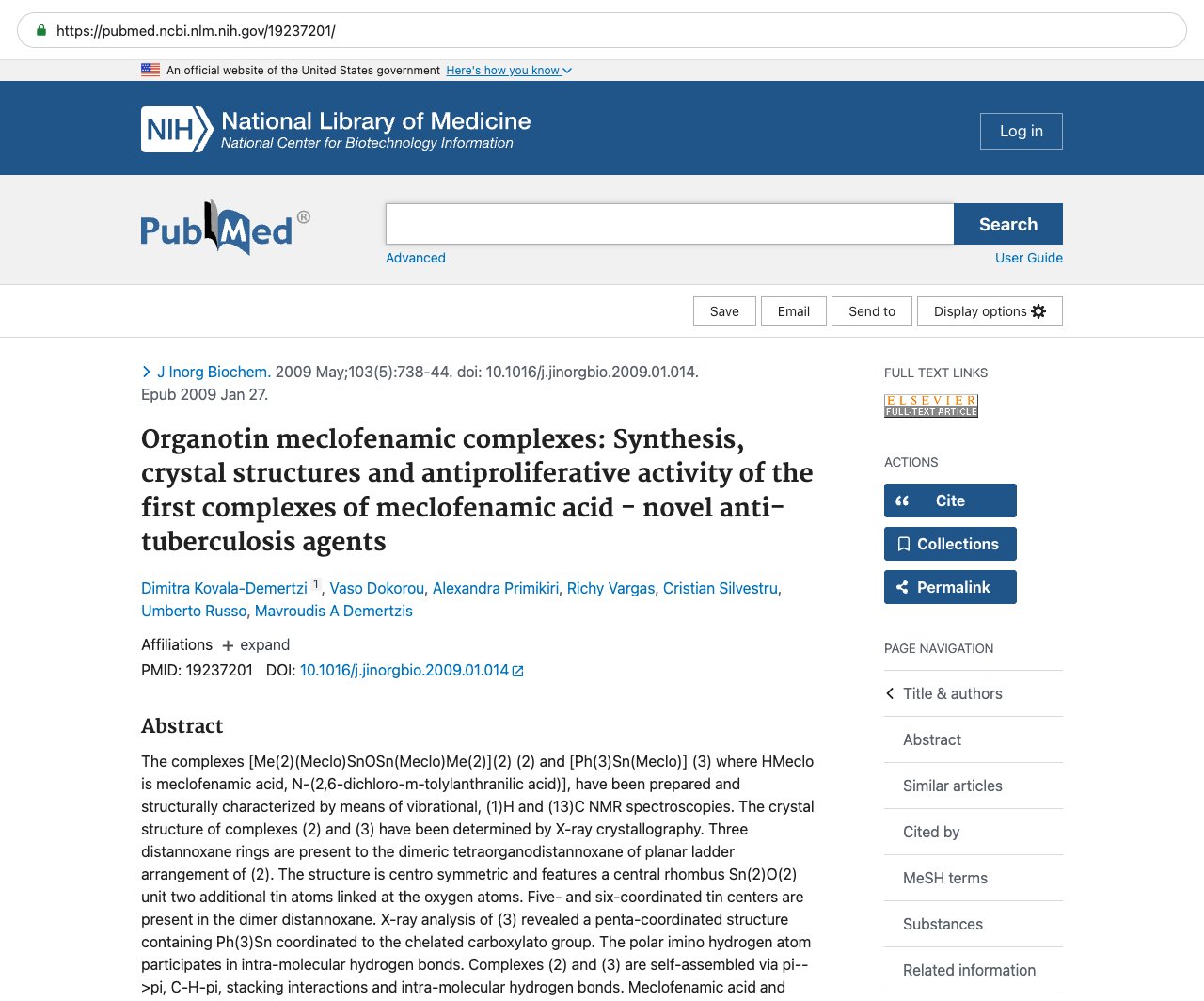
This page mirrors the published abstract (© the authors / publisher) for reference and citation. The canonical source is the PubMed record linked above. This is not medical advice.