2021 · Kubota — Randomized, crossover clinical efficacy trial in humans and mice on tear secretion promotion and lacrimal gland protection by molecular hydrogen
Super-Abstract
Molecular hydrogen improved tear film stability and dry eye symptoms. In an exploratory crossover trial (10 subjects), an H₂-generating supplement raised the exhaled H₂ concentration and significantly stabilized the tear film (p < 0.01); in the mouse model tear secretion increased. (Scientific Reports, 2021.)
Commentary
Dry eye disease is a growing widespread ailment — driven by screen work and the aging population. It arises from an unstable tear film and inflammation of the lacrimal gland fueled by oxidative stress. This is exactly where the study comes in: it combines a randomized crossover trial in humans with controlled mouse experiments. In humans, 10 subjects took an H₂-generating supplement; measurably, the exhaled H₂ concentration rose (p < 0.01), and both tear film stability (p < 0.01) and complaints (p < 0.05) improved significantly. In the animal model, H₂ increased tear secretion in healthy mice (p < 0.05) and slowed tear reduction in the dry eye model (p = 0.007). This is a neat bridge: the mechanism is shown in mice, the effect confirmed in humans. Honestly though: the human group is tiny (n = 10) and exploratory — the authors themselves call for larger studies.
Key quotes
- „administering a persistent H2-generating supplement increased the human exhaled H2 concentration (p < 0.01) and improved tear stability (p < 0.01) and dry eye symptoms (p < 0.05) significantly.“ — the human finding: measurable H₂ uptake plus clinical improvement
- „H2 significantly increased tear secretion in healthy mice (p < 0.05) and significantly suppressed tear reduction in a murine dry eye model (p = 0.007).“ — the mechanistic proof in the animal model
- „H2 may be a safe and effective new treatment for dry eye disease and thus larger trials are warranted.“ — the cautious, honest conclusion of the authors
Our assessment
Interesting because it addresses an unusual but everyday indication (dry eye) with an H₂ drinking supplement and links human and animal data — this strengthens mechanistic plausibility. For us, evidence that H₂ water/supplements are studied beyond the „classic“ fields. Limitation, stated honestly: the human study is a small exploratory pilot group (n = 10), not large-scale placebo double-blind — hence evidence level 2. Hard proof of efficacy is pending; the authors themselves demand larger studies. The animal part is convincing, but animal experimental effects do not automatically transfer 1:1 to humans.
Study design
- Type: clinical crossover trial (human, exploratory) + controlled mouse experiments · n: 10 (human) + mouse models · Duration: not specified in the abstract · H₂ delivery: persistent H₂-generating supplement (oral)
- Result: exhaled H₂ ↑ (p < 0.01); tear film stability ↑ (p < 0.01); symptoms ↓ (p < 0.05); mouse tear secretion ↑ (p < 0.05); dry eye model: tear reduction slowed (p = 0.007)
Abstract
The incidence of dry eye disease is increasing worldwide because of the aging population and increasing use of information technology. Dry eye disease manifests as tear-layer instability and inflammation caused by osmotic hypersensitization in tear fluids; however, to our knowledge, no agent that treats both pathologies simultaneously is available. Molecular hydrogen (H2) is known to be effective against various diseases; therefore, we aimed to elucidate the effects of H2 on tear dynamics and the treatment of dry eye disease. We revealed that administering a persistent H2-generating supplement increased the human exhaled H2 concentration (p < 0.01) and improved tear stability (p < 0.01) and dry eye symptoms (p < 0.05) significantly. Furthermore, H2 significantly increased tear secretion in healthy mice (p < 0.05) and significantly suppressed tear reduction in a murine dry eye model (p = 0.007). H2 significantly and safely improved tear stability and dry eye symptoms in a small exploratory group of 10 human subjects, a subset of whom reported dry eye symptoms prior to treatment. Furthermore, it increased tear secretion rapidly in normal mice. Therefore, H2 may be a safe and effective new treatment for dry eye disease and thus larger trials are warranted.
Source & links
Screenshot of the PubMed page
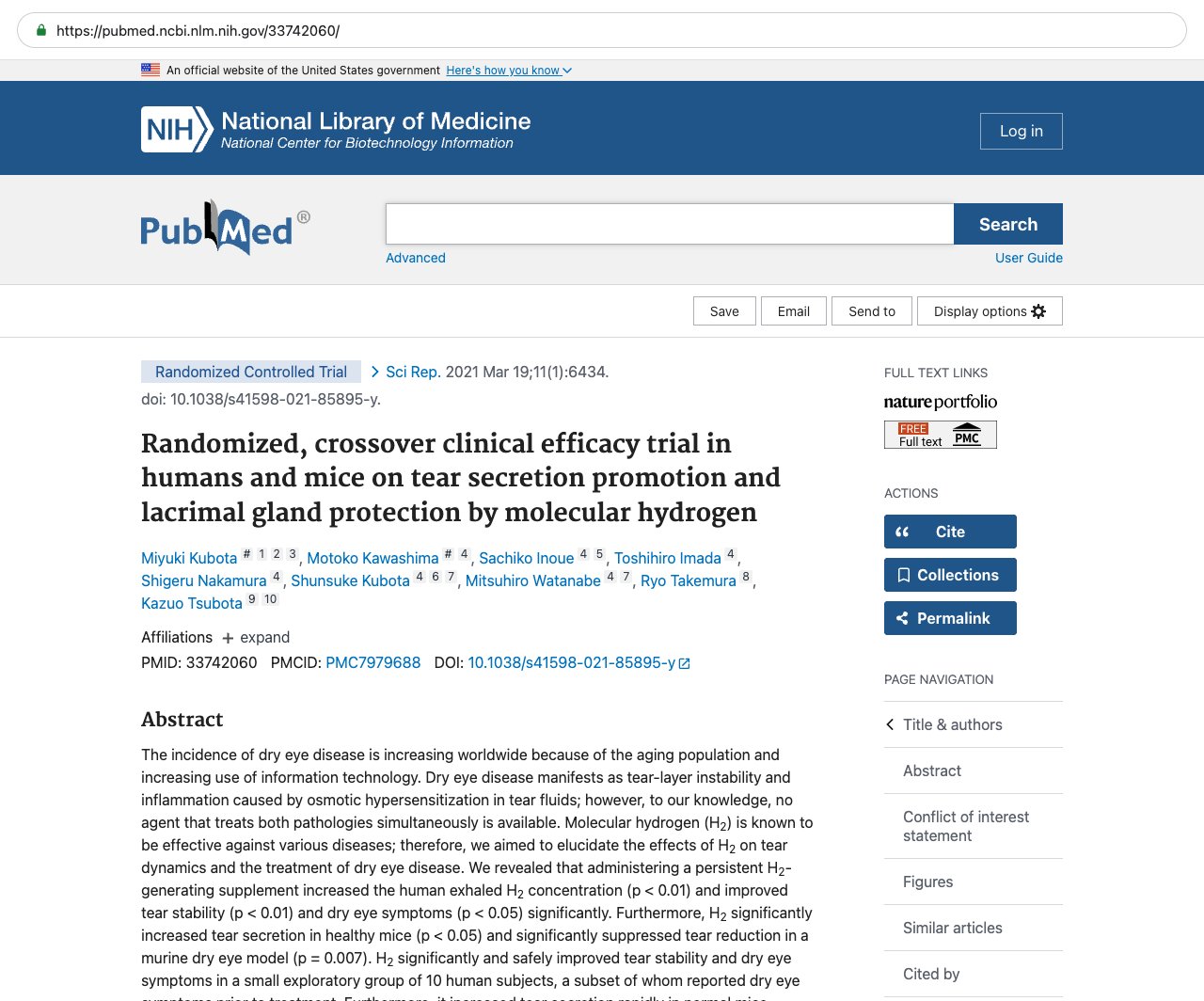
This page mirrors the published abstract (© the authors / publisher) for reference and citation. The canonical source is the PubMed record linked above. This is not medical advice.