2024 · Kura — The Protective Role of Molecular Hydrogen in Ischemia/Reperfusion Injury
Super-Abstract
Ischemia/reperfusion injury (IRI) — where tissue damage is paradoxically worsened when blood flow is restored after oxygen deprivation — is a major cause of harm in heart attacks, strokes, and organ transplantation. This review synthesises the evidence that molecular hydrogen (H₂) can mitigate IRI through multiple mechanisms: selectively neutralising damaging ROS, suppressing inflammation, enhancing energy production, reducing calcium overload, and modulating cell death pathways. Further research is needed before H₂ can be routinely integrated into clinical IRI management. This is a literature review.
Commentary
IRI is one of the most clinically important and mechanistically complex injury processes in medicine: the restoration of blood flow, while necessary, unleashes a burst of reactive oxygen species and inflammatory mediators that can destroy tissue that survived the ischaemia itself. H₂'s appeal as a potential IRI therapy lies precisely in its combination of rapid diffusibility (it reaches all compartments, including mitochondria) and selective radical scavenging. This review covers IRI across organs — heart, brain, kidney, liver, transplanted organs, and surgical contexts — providing a cross-organ perspective that few other reviews offer. The mechanistic breadth is notable: H₂ appears to act not just as an antioxidant but also as a modulator of apoptosis, necroptosis, and ATP synthesis. The authors are appropriately measured, calling for further integration into clinical practice rather than claiming it is already proven.
Key quotes
- „Molecular hydrogen is a selective antioxidant with anti-inflammatory, cytoprotective, and signal-modulatory properties. It has been shown to be effective at mitigating IRI in different models, including heart failure, cerebral stroke, transplantation, and surgical interventions.“ — summary of H₂'s multi-organ IRI-mitigating profile
- „Hydrogen reduces IRI via different mechanisms, like the suppression of oxidative stress and inflammation, the enhancement of ATP production, decreasing calcium overload, regulating cell death, etc.“ — multi-mechanism action of H₂ in IRI
- „Further research is still needed to integrate the use of molecular hydrogen into clinical practice.“ — honest limitation statement by the authors
Our assessment
This is a well-structured narrative review with a broad cross-organ perspective on H₂ in IRI. The multi-mechanism framing is scientifically compelling, and the coverage of cardiac, neurological, renal, hepatic, and transplant IRI models is thorough. However, most evidence cited is preclinical; human clinical trial data for H₂ in IRI is still limited. The authors' call for further research before clinical integration reflects an honest reading of the current evidence base. This review is a solid entry point for understanding H₂'s potential in IRI, not a proof of clinical efficacy.
Study design
- Type: narrative review · n: n/a (literature synthesis across multiple organ systems) · H₂ delivery: multiple modalities discussed (inhalation, saline, water)
- Result: no pooled effect sizes; converging evidence across preclinical IRI models in heart, brain, kidney, liver, and transplantation; mechanisms identified include ROS suppression, anti-inflammation, ATP enhancement, Ca²⁺ overload reduction, cell death regulation
Abstract
Ischemia/reperfusion injury (IRI) represents a significant contributor to morbidity and mortality associated with various clinical conditions, including acute coronary syndrome, stroke, and organ transplantation. During ischemia, a profound hypoxic insult develops, resulting in cellular dysfunction and tissue damage. Paradoxically, reperfusion can exacerbate this injury through the generation of reactive oxygen species and the induction of inflammatory cascades. The extensive clinical sequelae of IRI necessitate the development of therapeutic strategies to mitigate its deleterious effects. This has become a cornerstone of ongoing research efforts in both basic and translational science. This review examines the use of molecular hydrogen for IRI in different organs and explores the underlying mechanisms of its action. Molecular hydrogen is a selective antioxidant with anti-inflammatory, cytoprotective, and signal-modulatory properties. It has been shown to be effective at mitigating IRI in different models, including heart failure, cerebral stroke, transplantation, and surgical interventions. Hydrogen reduces IRI via different mechanisms, like the suppression of oxidative stress and inflammation, the enhancement of ATP production, decreasing calcium overload, regulating cell death, etc. Further research is still needed to integrate the use of molecular hydrogen into clinical practice.
Source & links
Screenshot of the PubMed page
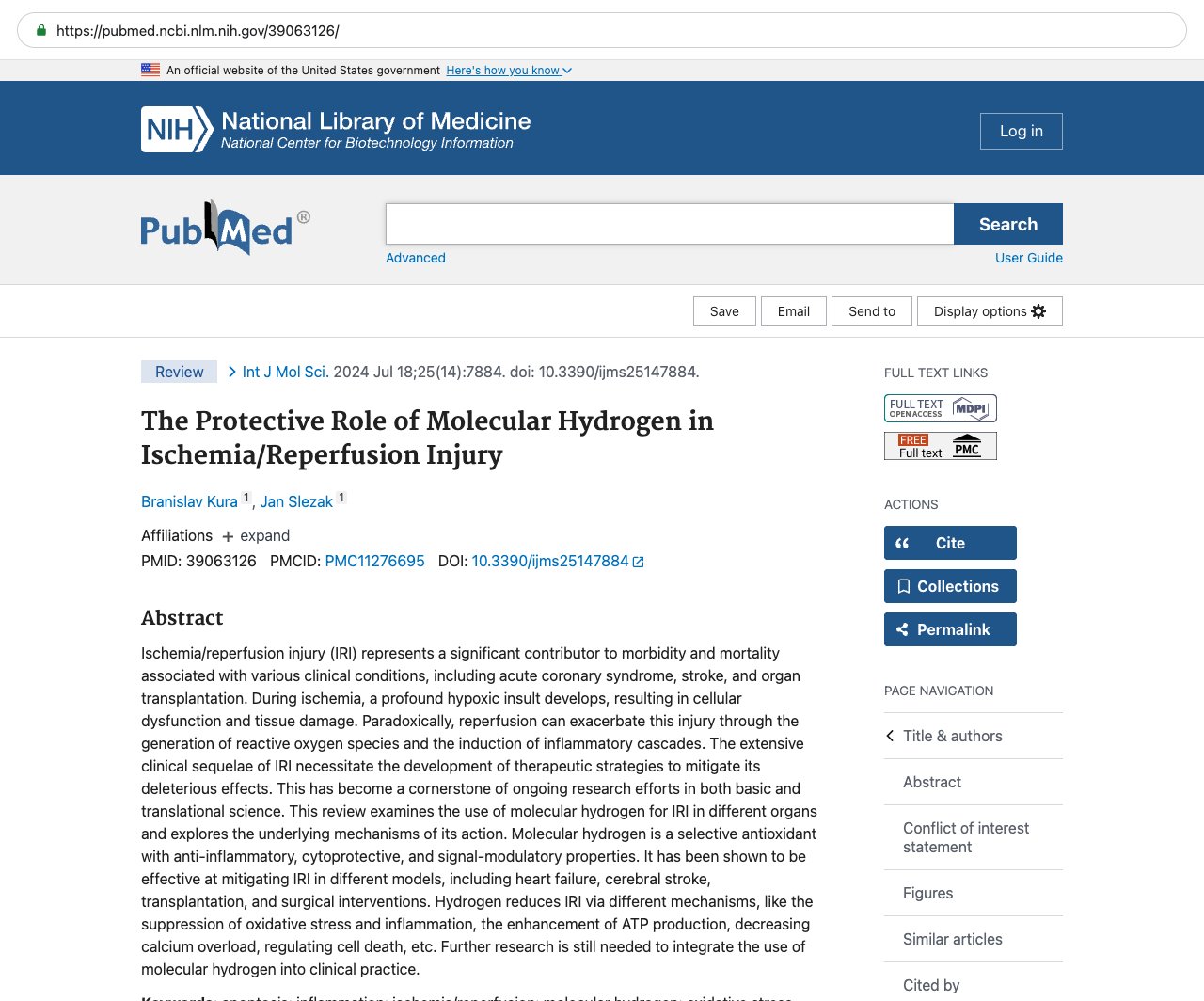
This page mirrors the published abstract (© the authors / publisher) for reference and citation. The canonical source is the PubMed record linked above. This is not medical advice.