2010 · Kurisaki — Spontaneous adjustment mechanism in an RNA-binding protein: cooperation between energetic stabilization and target search enhancement.
Super-Abstract
This computational biology study used molecular dynamics simulation to analyse structural changes in an RNA-binding protein (NOVA) after it dissociates from its RNA target. The simulation revealed a spontaneous conformational change driven by intramolecular hydrogen bonds, which the authors propose enhances the protein's ability to find new RNA targets. Note: this paper has no connection to molecular hydrogen (H₂) therapy — it is a structural biology study.
Commentary
This is a 75-nanosecond molecular dynamics simulation study of the neuro-oncological ventral antigen (NOVA) protein — a neuronal RNA-binding protein relevant to paraneoplastic neurological disease. The study examines how NOVA changes shape after releasing its RNA, proposing a „spontaneous adjustment mechanism” that improves RNA target search efficiency. The paper appears in an H₂ database only because the word „hydrogen” appears in the biochemical context of intramolecular hydrogen bonds — not because it has any bearing on therapeutic H₂.
Key quotes
- „NOVA dissociated from the NOVA-RNA complex showed a large conformational change: formation of intra-molecular hydrogen bonds between the C-terminal region and the loop structure located at the middle of amino acid sequence.“ — the key structural finding from the simulation — hydrogen bonds here are intramolecular chemical bonds, not H₂ gas
- „The deformed structure is more stabilized in macromolecular crowding environment where the dielectric constant is smaller than 5.“ — the energetic context: the conformational change is stabilised inside crowded cellular environments
- „We propose a novel concept of spontaneous adjustment mechanism to explain the structural and energetic changes observed for NOVA in the free state.“ — the authors' theoretical contribution — a computational model of RNA-binding protein dynamics
Our assessment
This is a computational structural biology study with no relevance to molecular hydrogen (H₂) therapy. It models protein-RNA dynamics using molecular mechanics — hydrogen bonds in this context are standard chemical bonds between atoms, not dissolved H₂ gas. Its presence in an H₂ database is an indexing error. No health claims regarding H₂ can be derived from this publication.
Study design
- Type: in-silico / computational study · Model: molecular dynamics simulation of NOVA protein (75 ns) · H₂ relevance: none
- Result: NOVA undergoes spontaneous conformational change after RNA release, stabilised by intramolecular hydrogen bonds; proposed mechanism improves RNA target search efficiency in macromolecular crowding conditions
Abstract
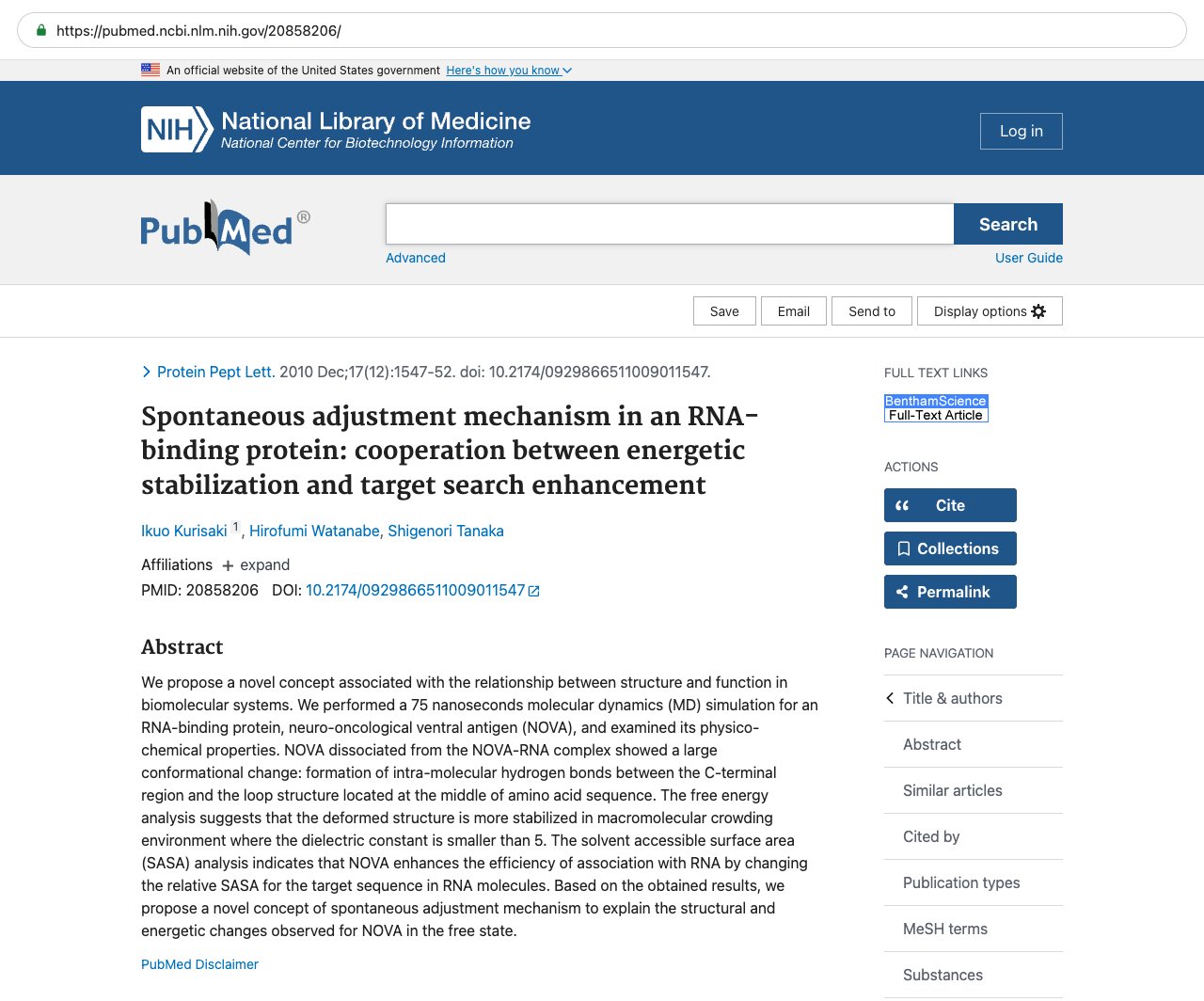
We propose a novel concept associated with the relationship between structure and function in biomolecular systems. We performed a 75 nanoseconds molecular dynamics (MD) simulation for an RNA-binding protein, neuro-oncological ventral antigen (NOVA), and examined its physico-chemical properties. NOVA dissociated from the NOVA-RNA complex showed a large conformational change: formation of intra-molecular hydrogen bonds between the C-terminal region and the loop structure located at the middle of amino acid sequence. The free energy analysis suggests that the deformed structure is more stabilized in macromolecular crowding environment where the dielectric constant is smaller than 5. The solvent accessible surface area (SASA) analysis indicates that NOVA enhances the efficiency of association with RNA by changing the relative SASA for the target sequence in RNA molecules. Based on the obtained results, we propose a novel concept of spontaneous adjustment mechanism to explain the structural and energetic changes observed for NOVA in the free state.
Source & links
Screenshot of the PubMed page
This page mirrors the published abstract (© the authors / publisher) for reference and citation. The canonical source is the PubMed record linked above. This is not medical advice.