2011 · Lazzeroni — Production of Clinically Useful Positron Emitter Beams During Carbon Ion Deceleration
Super-Abstract
This radiation physics study models how to produce high-energy carbon-11 (¹¹C) fragments from a primary ¹²C beam for simultaneous cancer treatment and PET imaging — and finds that hydrogen-rich materials such as liquid hydrogen and polyethylene are the most efficient decelerators for this process. The mention of hydrogen here is entirely about nuclear physics, not about molecular hydrogen (H₂) therapy. (Physics in Medicine and Biology, 2011.)
Commentary
Carbon ion therapy is an advanced form of radiotherapy offering precise dose delivery to tumours. A promising refinement is the use of radioactive ¹¹C beams that allow PET imaging of the dose distribution while treating — a „treat and image“ approach. This study uses the Monte Carlo transport code SHIELD-HIT07 to model ¹¹C production by fragmenting a ¹²C beam in various decelerating materials. The key finding is that materials with a high hydrogen fraction by weight — liquid hydrogen first, followed by hydrogen-rich compounds like polyethylene — produce the fastest initial build-up of ¹¹C fluence because hydrogen nuclei are the most efficient at slowing ¹²C fragments through elastic collisions. A two-media decelerator design is proposed: liquid hydrogen for initial fast build-up, followed by polyethylene for energy modulation. This paper has no connection to H₂ medicine or molecular hydrogen biology.
Key quotes
- „the maximum (11)C fluence build-up is high in compounds where the fraction by weight of hydrogen is high, being the highest in liquid hydrogen.“ — hydrogen-rich materials are best for ¹¹C production — a nuclear physics finding, not a therapeutic H₂ result
- „a cost effective alternative solution to the single medium initially envisaged is presented: a two-media decelerator that comprises a first liquid hydrogen section followed by a second decelerating section made of a hydrogen-rich material, such as polyethylene.“ — the proposed engineering solution for efficient radioactive beam production
- „radioactive beams offer the best clinical solution to simultaneously treat and in vivo monitor the dose delivery and tumor response using PET or PET-CT imaging.“ — the clinical motivation: real-time dose monitoring during ion beam therapy
Our assessment
This is a computational/theoretical physics study in radiation oncology engineering. It has no relevance to molecular hydrogen therapy. The word „hydrogen“ refers exclusively to hydrogen atoms as a component of nuclear physics decelerating materials. Honest note: this paper should not be cited in support of any H₂ health claim. It belongs to medical physics and particle therapy engineering, not H₂ biomedicine.
Study design
- Type: computational simulation study · Model: Monte Carlo SHIELD-HIT07 transport code, ¹²C beam fragmentation in various absorber materials · H₂ relevance: liquid hydrogen and polyethylene as nuclear physics decelerators — unrelated to H₂ therapy
- Result: liquid hydrogen provides the highest ¹¹C fluence build-up; two-media decelerator (liquid H₂ + polyethylene) is proposed as cost-effective solution; superconducting cyclotron beam intensity increase could enable clinical implementation
Abstract
In external beam radiation therapy, radioactive beams offer the best clinical solution to simultaneously treat and in vivo monitor the dose delivery and tumor response using PET or PET-CT imaging. However, difficulties mainly linked to the low production efficiency have so far limited their use. This study is devoted to the analysis of the production of high energy (11)C fragments, preferably by projectile fragmentation of a stable monodirectional and monoenergetic primary (12)C beam in different absorbing materials (decelerators) in order to identify the optimal elemental composition. The study was performed using the Monte Carlo code SHIELD-HIT07. The track length and fluence of generated secondary particles were scored in a uniform absorber of 300 cm length and 10 cm radius, divided into slices of 1 cm thickness. The (11)C fluence build-up and mean energy variation with increasing decelerator depth are presented. Furthermore, the fluence of the secondary (11)C beam was studied as a function of its mean energy and the corresponding remaining range in water. It is shown that the maximum (11)C fluence build-up is high in compounds where the fraction by weight of hydrogen is high, being the highest in liquid hydrogen. Furthermore, a cost effective alternative solution to the single medium initially envisaged is presented: a two-media decelerator that comprises a first liquid hydrogen section followed by a second decelerating section made of a hydrogen-rich material, such as polyethylene (C(2)H(4)). The purpose of the first section is to achieve a fast initial (11)C fluence build-up, while the second section is primarily designed to modulate the mean energy of the generated (11)C beam in order to reach the tumor depth. Finally, it was demonstrated that, if the intensity of the primary (12)C beam can be increased by an order of magnitude, a sufficient intensity of the secondary (11)C beam is achieved for therapy and subsequent therapeutic PET imaging sessions. Such an increase in the intensity might be easily achieved with a superconducting cyclotron.
Source & links
Screenshot of the PubMed page
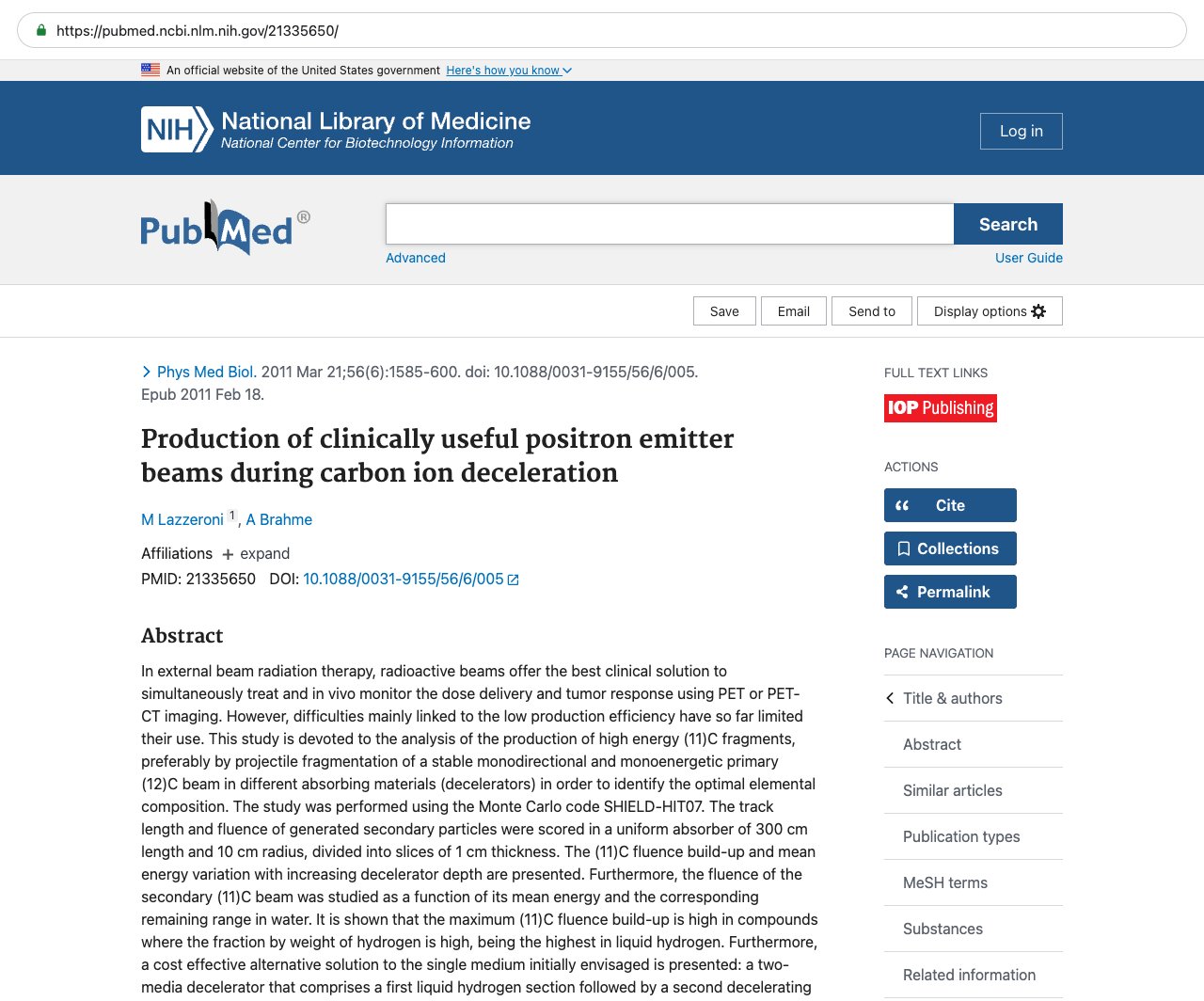
This page mirrors the published abstract (© the authors / publisher) for reference and citation. The canonical source is the PubMed record linked above. This is not medical advice.