2019 Canadian journal of physiology and pharmacology Review / Meta-analysis InhalationDrinking (HRW)
2019 · LeBaron et al. — Hydrogen gas: from clinical medicine to an emerging ergogenic molecule for sports athletes.
Super-Abstract
Hydrogen gas (H₂) may serve as both an exercise mimetic and a „redox adaptogen“ — reducing harm from excessive or damaging exercise while potentially amplifying the benefits of healthy training. This 2019 review by LeBaron and colleagues draws parallels between the cellular responses to beneficial exercise and those attributed to H₂, and cautions that more research is needed before strong ergogenic claims can be made.
Commentary
The review makes a conceptually rich argument: conventional antioxidants and anti-inflammatory drugs often blunt exercise adaptations because the very oxidants and cytokines produced during exercise are training signals. H₂, the authors suggest, does not simply suppress all ROS — instead it appears to attenuate pathological oxidative stress while preserving, or even enhancing, hormetic training responses (mitochondrial biogenesis, Nrf2 activation, NAD⁺/NADH ratio, sirtuins, heat-shock proteins). The distinction between noxious exercise (high-intensity sporadic bouts or chronic elite-level overtraining) and beneficial exercise is central. The paper honestly notes that direct evidence in athletes remains limited and more controlled trials are warranted.
Key quotes
- „Ingestion of conventional antioxidants and anti-inflammatories often impairs exercise-induced training adaptations.“ — the problem with standard supplements: they block training signals
- „we propose that hydrogen may act as an exercise mimetic and redox adaptogen, potentiate the benefits from beneficial exercise, and reduce the harm from noxious exercise.“ — the central hypothesis of the paper
- „more research is warranted to elucidate the potential ergogenic and therapeutic effects of H2 in exercise medicine.“ — honest caveat: the evidence base in athletes is still limited
Our assessment
This is a narrative review that builds a plausible and interesting theoretical framework for H₂ in sports medicine. The „redox adaptogen“ framing is original and well-argued. Limitations: the evidence cited is predominantly preclinical or from early clinical studies; direct ergogenic trials in trained athletes are scarce. The review is co-authored by LeBaron, who has declared interests in the H₂ field. The hypotheses are testable and stimulate future research, but should not be read as established proof of ergogenic benefit.
Study design
- Type: narrative review · n: n/a (literature synthesis) · H₂ delivery: inhalation and drinking hydrogen-rich water (as reported in cited studies)
- Proposed framework: H₂ as redox adaptogen and exercise mimetic — attenuating noxious ROS while preserving beneficial training signals (Nrf2, mitochondrial biogenesis, sirtuins)
Abstract
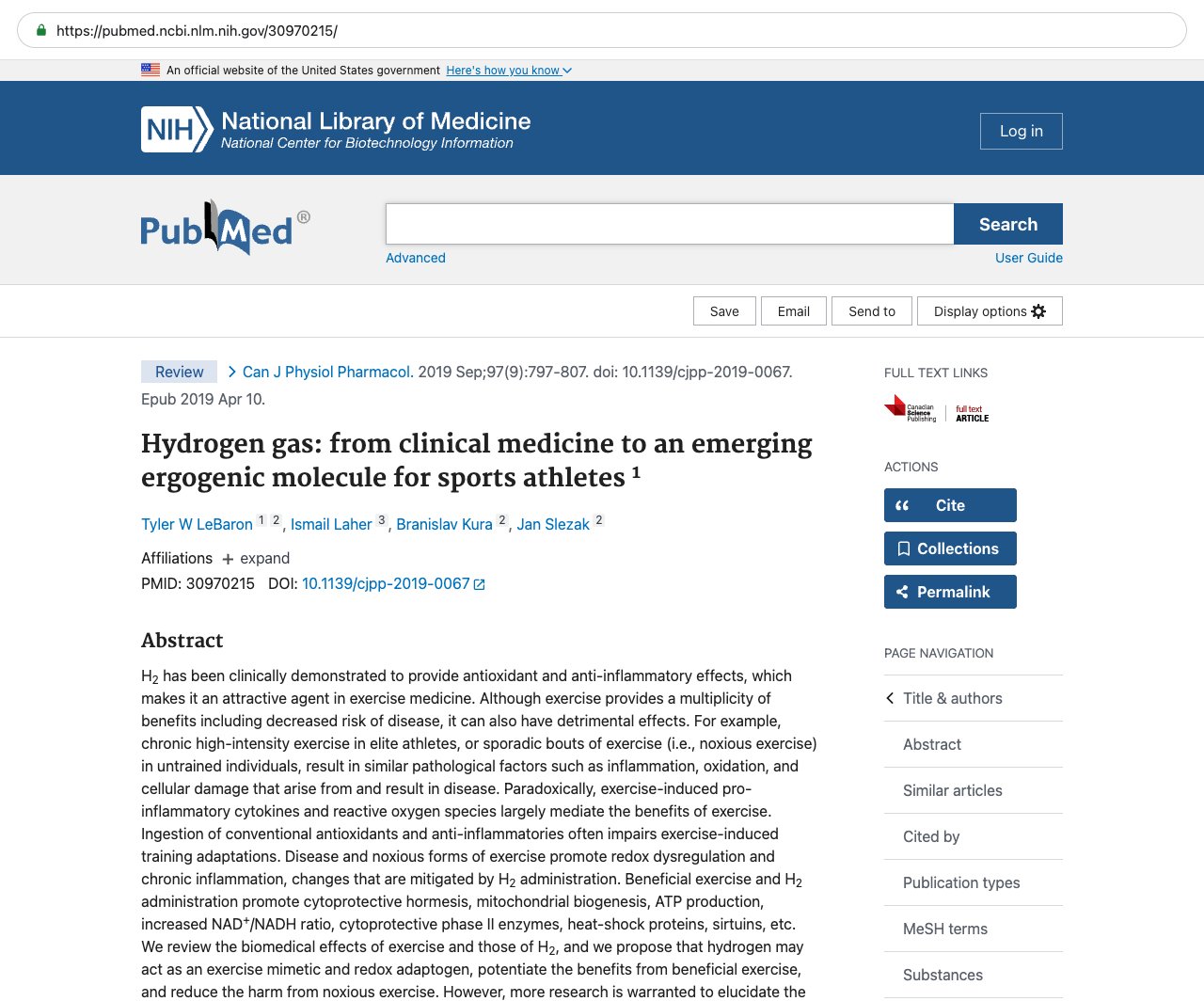
H2 has been clinically demonstrated to provide antioxidant and anti-inflammatory effects, which makes it an attractive agent in exercise medicine. Although exercise provides a multiplicity of benefits including decreased risk of disease, it can also have detrimental effects. For example, chronic high-intensity exercise in elite athletes, or sporadic bouts of exercise (i.e., noxious exercise) in untrained individuals, result in similar pathological factors such as inflammation, oxidation, and cellular damage that arise from and result in disease. Paradoxically, exercise-induced pro-inflammatory cytokines and reactive oxygen species largely mediate the benefits of exercise. Ingestion of conventional antioxidants and anti-inflammatories often impairs exercise-induced training adaptations. Disease and noxious forms of exercise promote redox dysregulation and chronic inflammation, changes that are mitigated by H2 administration. Beneficial exercise and H2 administration promote cytoprotective hormesis, mitochondrial biogenesis, ATP production, increased NAD+/NADH ratio, cytoprotective phase II enzymes, heat-shock proteins, sirtuins, etc. We review the biomedical effects of exercise and those of H2, and we propose that hydrogen may act as an exercise mimetic and redox adaptogen, potentiate the benefits from beneficial exercise, and reduce the harm from noxious exercise. However, more research is warranted to elucidate the potential ergogenic and therapeutic effects of H2 in exercise medicine.
Source & links
Screenshot of the PubMed page
This page mirrors the published abstract (© the authors / publisher) for reference and citation. The canonical source is the PubMed record linked above. This is not medical advice.