2006 · Lee et al. — Electrolyzed-reduced water protects against oxidative damage to DNA, RNA, and protein
Super-Abstract
Electrolyzed-reduced water (ERW) — which contains dissolved H₂ — significantly reduced H₂O₂-induced DNA strand breaks in human lymphocytes in the test tube, and also protected RNA and proteins from oxidative damage. Ascorbic acid dissolved in ERW showed roughly three times the antioxidant activity compared to normal water. This is an in-vitro cell study; no conclusions about effects in living humans can be drawn.
Commentary
The authors exposed isolated human lymphocytes to hydrogen peroxide (H₂O₂) in vitro and tested whether ERW — applied before, during, or after oxidative stress — could reduce DNA damage as measured by the comet assay. All three timing strategies (pre-, co-, and post-treatment) showed reduced DNA strand breaks. ERW also protected total RNA from temperature-induced degradation and prevented oxidative cleavage of the enzyme horseradish peroxidase. An enhancement of ascorbic acid antioxidant activity (~3-fold) in ERW versus deionised water is also reported. The electrolysis process reduces dissolved oxygen and generates dissolved H₂ alongside an alkaline pH, and the paper attributes protective effects to these combined properties. A key limitation is that the study does not separately isolate the contribution of H₂ from other ERW characteristics (alkaline pH, altered mineral content). As an in-vitro study, all findings apply strictly to isolated cells and biomolecules under artificial oxidative stress — not to the complex environment of a living human body.
Key quotes
- „Pretreatment, cotreatment, and posttreatment with electrolyzed-reduced water enhanced human lymphocyte resistance to the DNA strand breaks induced by H2O2 in vitro.“ — core finding: ERW protects human lymphocytes from oxidative DNA damage at all three treatment timings
- „electrolyzed-reduced water was much more effective than diethylpyrocarbonate-treated water in preventing total RNA degradation at 4 and 25 degrees C.“ — ERW also stabilises RNA, suggesting broad antioxidant protection
- „Enhancement of the antioxidant activity of ascorbic acid dissolved in electrolyzed-reduced water was about threefold that of ascorbic acid dissolved in nonelectrolyzed deionized water.“ — ERW amplifies vitamin C antioxidant activity roughly three-fold in cell-free assay
Our assessment
An in-vitro study demonstrating antioxidant protective properties of ERW (which contains dissolved H₂) in isolated human cells and biomolecules. The results are internally consistent and the methods are standard. Important limitations: this is a cell/test-tube study — the findings cannot be directly extrapolated to effects in living humans. The study also does not isolate H₂ alone as the causative agent (alkaline pH and other ERW properties were not controlled separately). The results are a useful mechanistic pointer, not clinical evidence.
Study design
- Type: in-vitro cell study · Model: isolated human lymphocytes; horseradish peroxidase; total RNA · H₂ delivery: electrolyzed-reduced water (ERW) containing dissolved H₂
- Assays: comet assay (DNA strand breaks), RNA degradation assay, SDS-PAGE (protein cleavage), xanthine-xanthine oxidase superoxide scavenging assay
- Result: ERW reduced H₂O₂-induced DNA strand breaks; protected RNA from degradation; prevented oxidative protein cleavage; ~3-fold enhancement of ascorbic acid antioxidant activity
Abstract
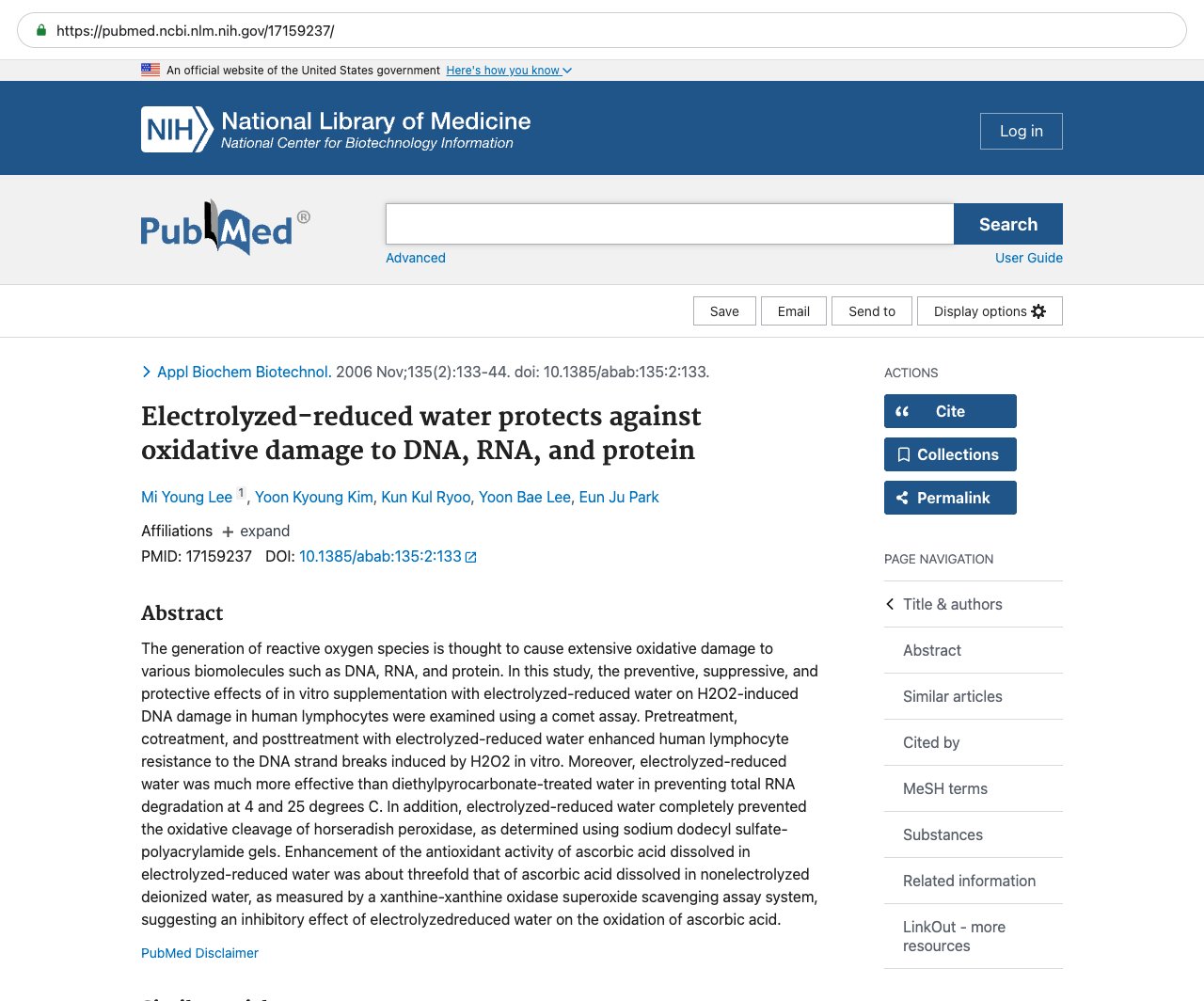
The generation of reactive oxygen species is thought to cause extensive oxidative damage to various biomolecules such as DNA, RNA, and protein. In this study, the preventive, suppressive, and protective effects of in vitro supplementation with electrolyzed-reduced water on H2O2-induced DNA damage in human lymphocytes were examined using a comet assay. Pretreatment, cotreatment, and posttreatment with electrolyzed-reduced water enhanced human lymphocyte resistance to the DNA strand breaks induced by H2O2 in vitro. Moreover, electrolyzed-reduced water was much more effective than diethylpyrocarbonate-treated water in preventing total RNA degradation at 4 and 25 degrees C. In addition, electrolyzed-reduced water completely prevented the oxidative cleavage of horseradish peroxidase, as determined using sodium dodecyl sulfate-polyacrylamide gels. Enhancement of the antioxidant activity of ascorbic acid dissolved in electrolyzed-reduced water was about threefold that of ascorbic acid dissolved in nonelectrolyzed deionized water, as measured by a xanthine-xanthine oxidase superoxide scavenging assay system, suggesting an inhibitory effect of electrolyzedreduced water on the oxidation of ascorbic acid.
Source & links
Screenshot of the PubMed page
This page mirrors the published abstract (© the authors / publisher) for reference and citation. The canonical source is the PubMed record linked above. This is not medical advice.