2020 Nan fang yi ke da xue xue bao = Journal of Southern Medical University Mechanism / Preclinical Drinking (HRW)
2020 · Li — Hydrogen Water Alleviates Paraquat-induced Lung Fibroblast Injury In Vitro by Enhancing Nrf2 Expression
Super-Abstract
In human lung fibroblasts exposed to the herbicide paraquat, hydrogen-rich water treatment reduced cell damage markers and inhibited fibrosis-related collagen production — an effect that worked through upregulation of the antioxidant transcription factor Nrf2. This is an in-vitro cell culture study; results cannot be transferred directly to human patients. (Journal of Southern Medical University, 2020.)
Commentary
Paraquat is a highly toxic herbicide that causes severe oxidative lung damage and pulmonary fibrosis through excessive reactive oxygen species (ROS) generation. This in-vitro study uses a cell line model (HFL1 human lung fibroblasts) to test whether hydrogen-rich water can counteract paraquat-induced fibrotic changes. The key mechanistic finding is that hydrogen water upregulates Nrf2 — the master antioxidant regulatory transcription factor — and this effect mediates the reduction in collagen deposition, α-SMA (fibroblast activation marker), and other fibrosis indicators. RNA interference of Nrf2 abolished the protective effect, confirming the mechanistic link. The Nrf2 pathway is well-established as a therapeutic target in oxidative lung disease, so this finding is mechanistically coherent — but all results are from cell culture and require in-vivo and ultimately clinical validation.
Key quotes
- „Hydrogen water enhances Nrf2 expression to promote the proliferation and production of antioxidants and inhibit the differentiation and collagen secretion in PQ-exposed human lung fibroblasts in vitro.“ — the core conclusion: Nrf2 is the key mediator of H₂ water's protective effect in this model
- „Interference of Nrf2 expression obviously attenuated the effect of hydrogen water on PQ-exposed cells.“ — mechanistic confirmation: silencing Nrf2 abolishes the protective effect
- „Hydrogen water treatment significantly increased the expression of Nrf2 and promoted the production of the antioxidants in PQ-exposed lung fibroblasts.“ — the antioxidant mechanism: Nrf2 upregulation drives SOD, CAT, and GSH production
Our assessment
This is an in-vitro cell culture study — a useful mechanistic investigation, but not evidence of therapeutic efficacy in humans. The Nrf2-mediated antioxidant mechanism is plausible and consistent with other H₂ research, but paraquat poisoning is an extreme toxic model not representative of typical human lung conditions. Additionally, the jump from cell-level Nrf2 upregulation to clinical benefit in pulmonary fibrosis requires substantial further investigation including animal models and human trials. Results should not be interpreted as evidence that hydrogen water treats lung disease in humans.
Study design
- Type: in-vitro cell culture study · Model: HFL1 human lung fibroblasts exposed to 600 µmol/L paraquat (PQ) for 24 h · H₂ delivery: hydrogen-rich water treatment (with/without Nrf2 RNA interference)
- Result: H₂ water reduced Col-I, Col-III, α-SMA expression; upregulated Nrf2 and antioxidants (SOD, CAT, GSH); inhibited paraquat-induced fibrotic differentiation; Nrf2 silencing abolished the protective effect
Abstract
OBJECTIVE: To investigate the effects of hydrogen water on proliferation, differentiation, collagen secretion and Nrf2 expression in paraquat-induced human lung fibroblasts. METHODS: In vitro cultured human lung fibroblasts (HFL1) exposed to 600 μmol/L paraquat (PQ) for 24 h were treated with hydrogen water with or without RNA interference of Nrf2 expression. The changes in the cell proliferation were examined using MTT assay, and the expressions of Col-I, Col-III, α-SMA and Nrf2 in the cells were detected using Western blotting, real-time quantitative PCR and immunofluorescence assay. The contents of SOD, CAT and GSH in the cells were determined with ELISA. RESULTS: Compared with the PQ-exposed cells, the cells with hydrogen water treatment showed significantly lowered expressions of Col-I, Col-III, and α-SMA. Interference of Nrf2 expression obviously attenuated the effect of hydrogen water on PQ-exposed cells. Hydrogen water treatment significantly increased the expression of Nrf2 and promoted the production of the antioxidants in PQ-exposed lung fibroblasts. CONCLUSIONS: Hydrogen water enhances Nrf2 expression to promote the proliferation and production of antioxidants and inhibit the differentiation and collagen secretion in PQ-exposed human lung fibroblasts in vitro.
Source & links
Screenshot of the PubMed page
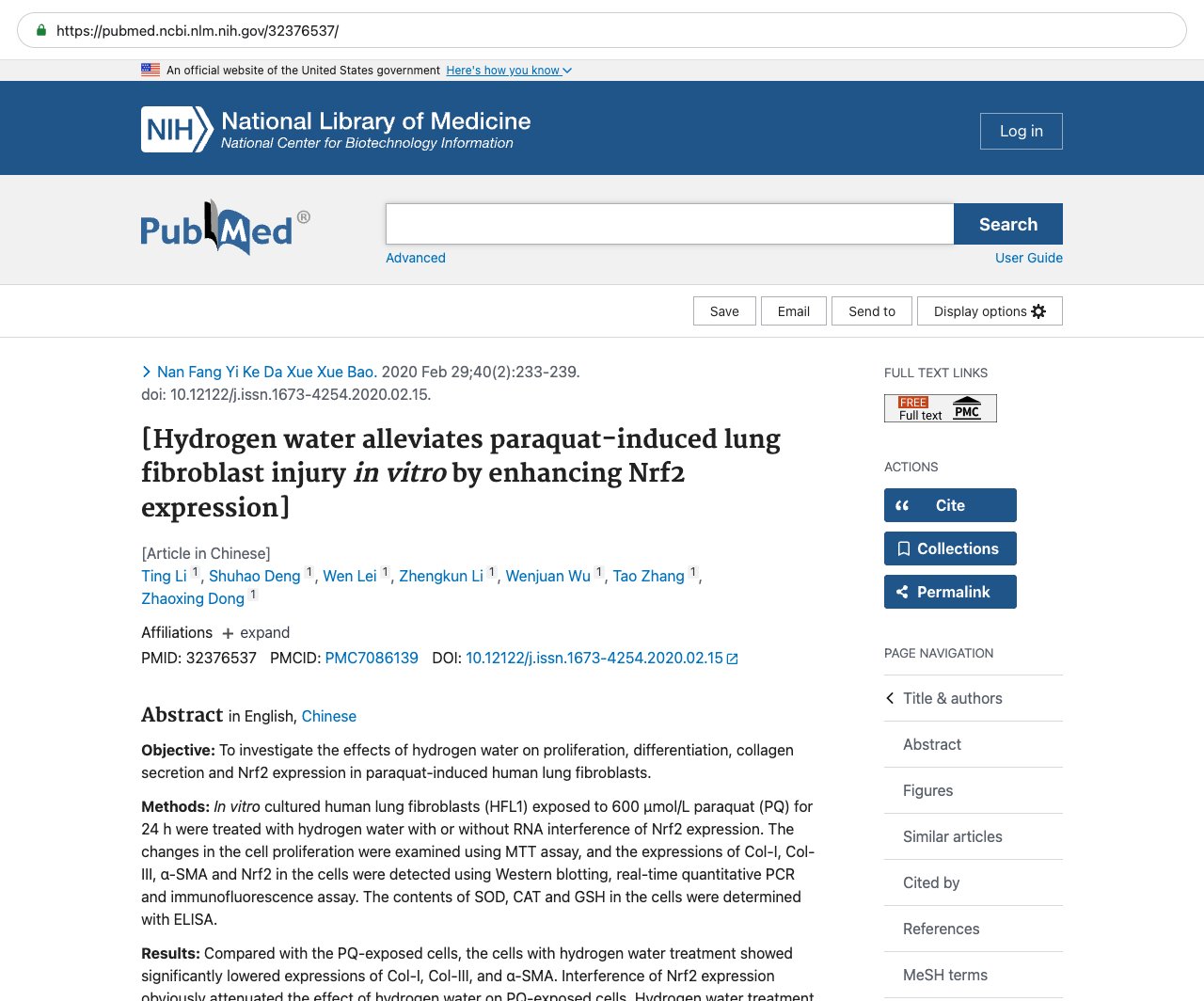
This page mirrors the published abstract (© the authors / publisher) for reference and citation. The canonical source is the PubMed record linked above. This is not medical advice.