2021 · Li et al. — Recent advances in studies of molecular hydrogen in the treatment of pancreatitis.
Super-Abstract
Pancreatitis — a serious inflammatory disease of the pancreas with high mortality — has recently attracted interest in molecular hydrogen (H₂) as a potential treatment, acting through antioxidant, anti-inflammatory, anti-apoptotic, and immune-modulatory mechanisms. This review synthesises the available preclinical and mechanistic evidence. (Life Sciences, 2021.)
Commentary
This review by Li and colleagues systematically covers pancreatitis pathogenesis — acinar cell injury, trypsin activation, SIRS, MODS — and maps how H₂ might intervene at each step. The paper is thorough in covering multiple mechanistic pathways: oxidative stress, ER stress, impaired autophagic flux, and immune regulation. The framing as a „novel antioxidant“ is consistent with the broader H₂ literature. The review provides theoretical bases and experimental data for future research and clinical application. The honest limitation acknowledged is that most cited evidence is preclinical; clinical trial data specifically for pancreatitis were limited at the time of publication.
Key quotes
- „Molecular hydrogen (H2) is a novel antioxidant that possesses the features of selective scavenging of oxygen free radicals and nontoxic metabolites.“ — the defining pharmacological property of H₂ that makes it relevant to pancreatitis
- „Recent studies have found that H2 is also useful in the treatment of pancreatitis, which may be related to the mechanism of antioxidative stress, anti-inflammation, anti-apoptosis, regulation of immunity and regulation of molecular pathways.“ — the multiple proposed mechanisms for H₂ in pancreatitis
- „This review focuses on the pathogenesis of pancreatitis and the research progress and potential mechanisms of H2 against pancreatitis to provide theoretical bases for future research and clinical application of H2 therapy for pancreatitis.“ — the explicitly stated purpose: theoretical groundwork, not clinical proof
Our assessment
This is a preclinical and mechanistic review. The evidence base for H₂ in pancreatitis consists primarily of animal and in-vitro studies; this is not a clinical trial summary. The review provides a rigorous mechanistic framework but does not constitute clinical evidence that H₂ treats pancreatitis in humans. The pathways described are biologically plausible given H₂'s known properties. Human clinical trials specifically in pancreatitis are needed before any clinical conclusions can be drawn.
Study design
- Type: narrative review of preclinical/mechanistic studies · n: n/a (literature synthesis; primarily animal/in-vitro studies) · H₂ delivery: unspecified (various across cited studies)
- Result: multiple mechanistic pathways identified for H₂ in pancreatitis (antioxidant, anti-inflammatory, anti-apoptotic, immune regulation); preclinical evidence reviewed; clinical trial evidence in pancreatitis was limited at publication
Abstract
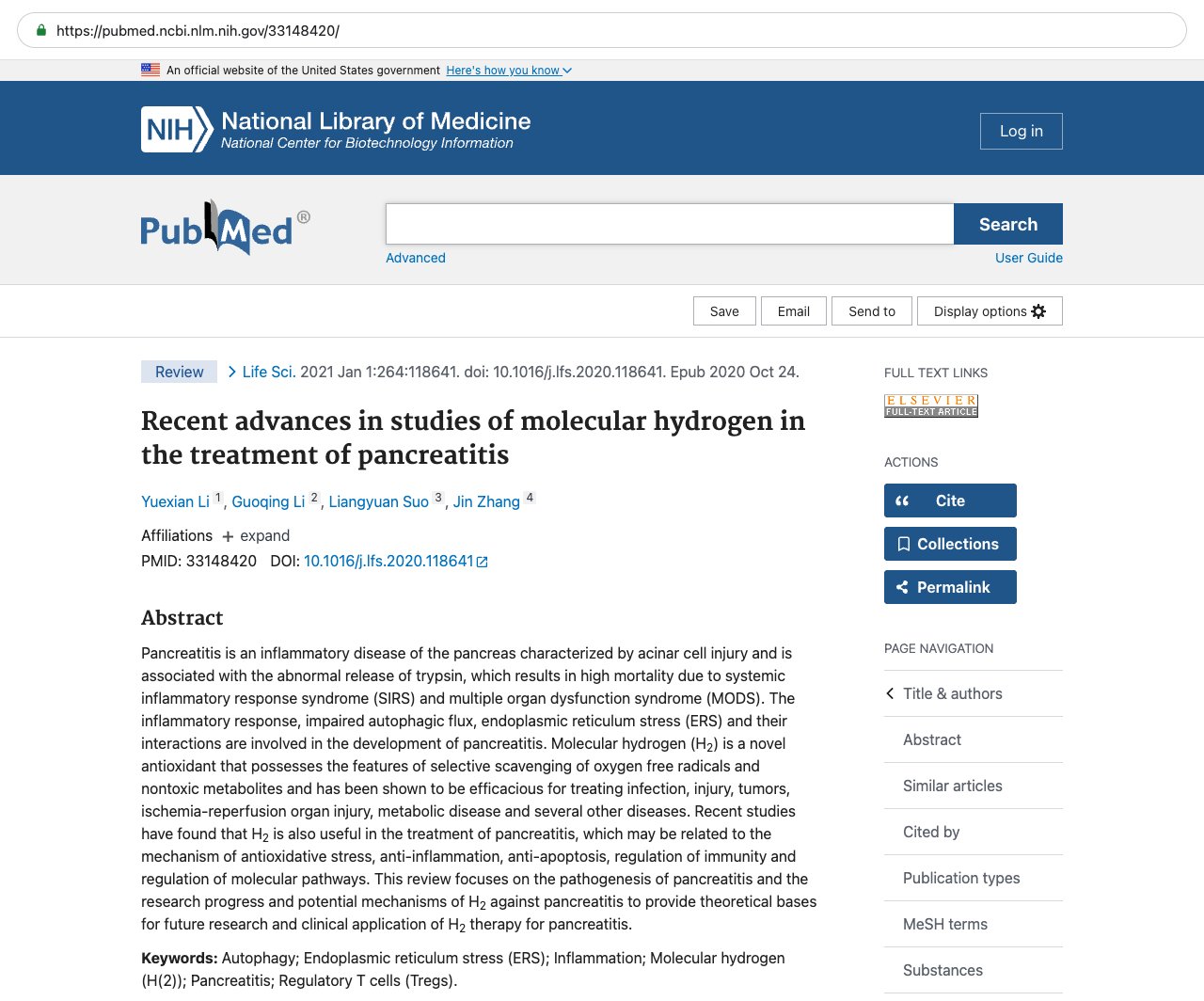
Pancreatitis is an inflammatory disease of the pancreas characterized by acinar cell injury and is associated with the abnormal release of trypsin, which results in high mortality due to systemic inflammatory response syndrome (SIRS) and multiple organ dysfunction syndrome (MODS). The inflammatory response, impaired autophagic flux, endoplasmic reticulum stress (ERS) and their interactions are involved in the development of pancreatitis. Molecular hydrogen (H2) is a novel antioxidant that possesses the features of selective scavenging of oxygen free radicals and nontoxic metabolites and has been shown to be efficacious for treating infection, injury, tumors, ischemia-reperfusion organ injury, metabolic disease and several other diseases. Recent studies have found that H2 is also useful in the treatment of pancreatitis, which may be related to the mechanism of antioxidative stress, anti-inflammation, anti-apoptosis, regulation of immunity and regulation of molecular pathways. This review focuses on the pathogenesis of pancreatitis and the research progress and potential mechanisms of H2 against pancreatitis to provide theoretical bases for future research and clinical application of H2 therapy for pancreatitis.
Source & links
Screenshot of the PubMed page
This page mirrors the published abstract (© the authors / publisher) for reference and citation. The canonical source is the PubMed record linked above. This is not medical advice.