2023 · Li — Trend of research on the medical use of molecular hydrogen: a bibliometric analysis
Super-Abstract
This bibliometric analysis of 1,126 PubMed publications on molecular hydrogen therapy (up to July 2021) shows a clear upward trend from 2007 onward. Oxidative stress and inflammation dominate the research landscape; emerging topics include gut microbiota, pyroptosis, and COVID-19. This is a literature overview, not a new experimental study.
Commentary
Bibliometric analyses map the intellectual landscape of a research field without testing hypotheses themselves. This paper identifies which journals, authors, and keywords have shaped the H₂-medicine field. The finding that publications grew steadily from 2007 to 2020 reflects the catalysing effect of Ohsawa's landmark 2007 Nature Medicine paper on H₂ as a selective antioxidant. The most frequent keywords — „molecular hydrogen“, „hydrogen-rich water“, „oxidative stress“, „inflammation“ — confirm the central mechanistic focus. The emergence of „gut microbiota“ and „pyroptosis“ as recent keywords is consistent with newer mechanistic studies like the Liu 2023 ALD paper. The 2021 data cutoff means the analysis misses the rapid growth period of 2022–2024. This review provides useful field-level context but no clinical conclusions about H₂ efficacy.
Key quotes
- „From 2007 to 2020, the number of publications in this field had been on an upward trend.“ — overall publication growth over 13 years
- „Oxidative stress and inflammation were the most important research directions currently, and gut microbiota, pyroptosis, and coronavirus disease 2019 might become hotspots in the future.“ — current and emerging research themes
- „The therapeutic application of molecular hydrogen had attracted much attention in these years.“ — summary assessment of field momentum
Our assessment
This is a bibliometric (literature mapping) study, not an efficacy review and not a clinical study. It tells us that the field is growing and where its attention is focused — it does not tell us whether H₂ treatments work in humans. For a field-level orientation, the analysis is useful; for clinical or mechanistic conclusions, primary studies and systematic reviews must be consulted. The 2021 data cutoff is a notable limitation.
Study design
- Type: bibliometric analysis (literature review) · n: 1,126 PubMed publications (up to July 30, 2021) · H₂ delivery: not applicable (literature analysis)
- Result: steady publication growth 2007–2020; top keywords: oxidative stress, inflammation, hydrogen-rich water; emerging topics: gut microbiota, pyroptosis, COVID-19; no pooled efficacy data
Abstract
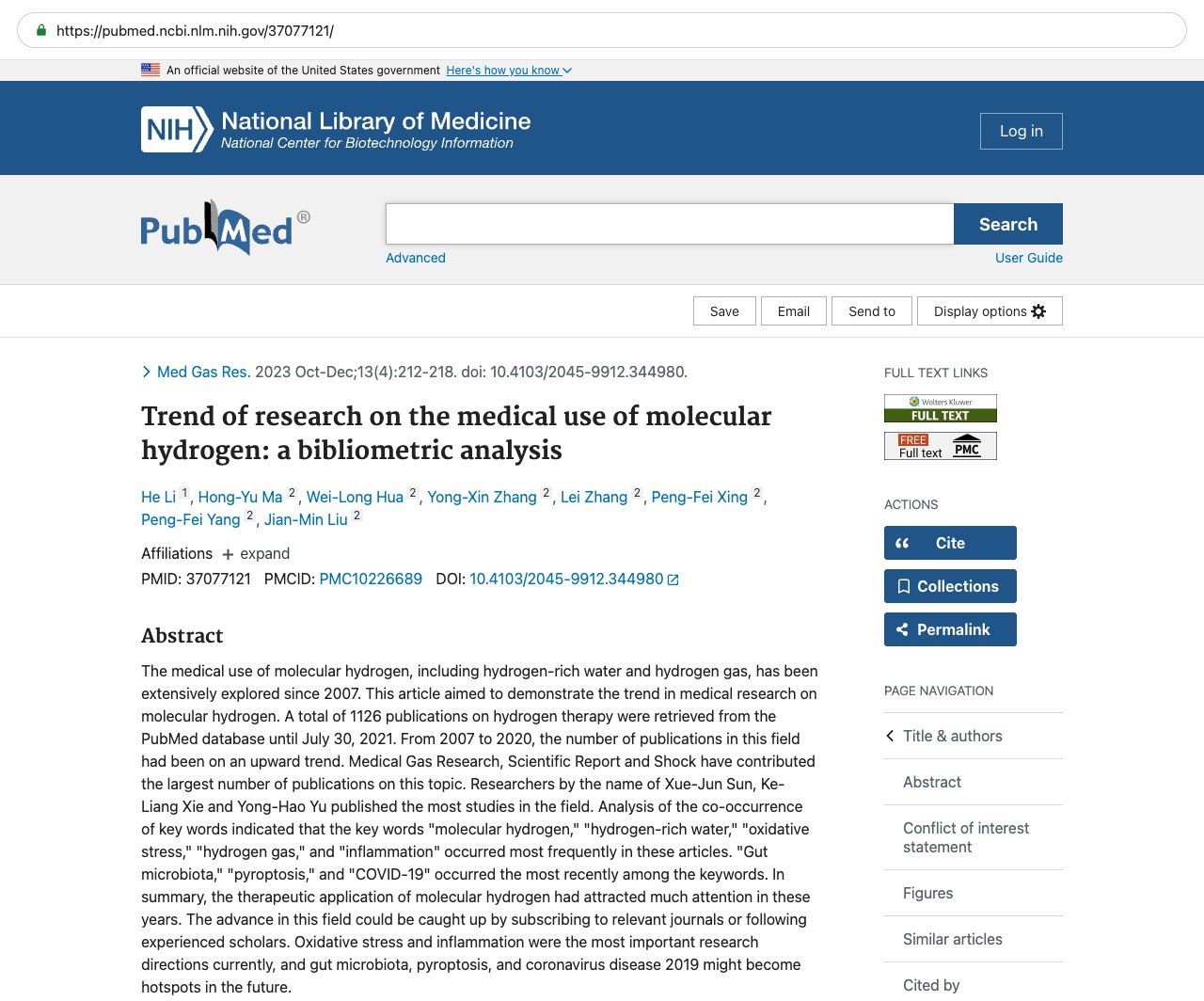
The medical use of molecular hydrogen, including hydrogen-rich water and hydrogen gas, has been extensively explored since 2007. This article aimed to demonstrate the trend in medical research on molecular hydrogen. A total of 1126 publications on hydrogen therapy were retrieved from the PubMed database until July 30, 2021. From 2007 to 2020, the number of publications in this field had been on an upward trend. Medical Gas Research, Scientific Report and Shock have contributed the largest number of publications on this topic. Researchers by the name of Xue-Jun Sun, Ke-Liang Xie and Yong-Hao Yu published the most studies in the field. Analysis of the co-occurrence of key words indicated that the key words "molecular hydrogen," "hydrogen-rich water," "oxidative stress," "hydrogen gas," and "inflammation" occurred most frequently in these articles. "Gut microbiota," "pyroptosis," and "COVID-19" occurred the most recently among the keywords. In summary, the therapeutic application of molecular hydrogen had attracted much attention in these years. The advance in this field could be caught up by subscribing to relevant journals or following experienced scholars. Oxidative stress and inflammation were the most important research directions currently, and gut microbiota, pyroptosis, and coronavirus disease 2019 might become hotspots in the future.
Source & links
Screenshot of the PubMed page
This page mirrors the published abstract (© the authors / publisher) for reference and citation. The canonical source is the PubMed record linked above. This is not medical advice.