2025 · Li — Delivery of Molecular Hydrogen for Precision Immunomodulation: Mechanisms, Detection Methods, and Applications
Super-Abstract
Molecular hydrogen modulates immune function through antioxidant action, suppression of inflammatory mediators, and inhibition of apoptosis — yet the precise dose-efficacy relationship in living organisms remains unclear due to the lack of accurate in-vivo detection methods. This review surveys both the mechanisms and the current portfolio of H₂ delivery systems, identifying critical gaps that need to be filled before clinical precision use is possible. (Advanced Science, 2025.)
Commentary
The immune system is exquisitely sensitive to redox state, and H₂'s ability to selectively quench hydroxyl radicals and peroxynitrite positions it as a plausible immunomodulatory agent. This review goes beyond cataloguing effects and tackles two underexplored problems: (1) the molecular pathways linking H₂ to immune regulation remain only partially mapped, and (2) the tools for measuring actual H₂ levels in tissues in vivo are inadequate — making it impossible to rigorously establish dose-response relationships. The authors point out that earlier reviews focused disproportionately on nanomaterial delivery systems while neglecting mechanistic analysis. This paper attempts to correct that imbalance by classifying delivery systems (gas inhalation, hydrogen-rich water, nano-carriers, solid hydrogen-releasing materials) alongside the immunological mechanisms they may engage. A frank acknowledgement of unresolved questions runs throughout.
Key quotes
- „two critical issues remain unresolved: the unclear mechanism underlying the immunomodulatory effects of H2 and the lack of precision detection methods to clarify the dose-efficacy relationship in vivo.“ — the two key gaps the review sets out to address
- „The delivery of molecular hydrogen (H2) is increasingly recognized for its potential in precision immunomodulation, primarily through multiple pathways such as antioxidant action, modulation of inflammatory factors, and inhibition of apoptosis.“ — the three principal immunomodulatory mechanisms attributed to H₂
- „previous reviews focused on developing nanomaterials for H2 delivery, they often overlook analyses of the immunomodulation mechanisms and fail to update the detection methods.“ — a gap in the existing literature this review aims to fill
Our assessment
This is a scientific review that makes a genuinely useful contribution by explicitly flagging what is not yet known — particularly the absence of reliable in-vivo dosimetry and the incomplete mechanistic picture of H₂-mediated immunomodulation. No new experimental data are presented. The scope is broad (nanomaterials, inhalation systems, biological mechanisms) but the honest framing of unresolved issues makes this a credible starting point for researchers, not a clinical recommendation document. The findings are largely based on preclinical and in-vitro evidence; human immunomodulation data are limited.
Study design
- Type: narrative review · n: n/a (literature synthesis) · H₂ delivery: multiple systems reviewed (gas inhalation, hydrogen-rich water, nano-carriers, solid-state H₂ release materials)
- Result: narrative synthesis; H₂ identified as acting via antioxidant, anti-inflammatory, and anti-apoptotic pathways; major unresolved issues: mechanistic clarity and in-vivo detection/dosimetry; delivery system classification provided
Abstract
The delivery of molecular hydrogen (H2) is increasingly recognized for its potential in precision immunomodulation, primarily through multiple pathways such as antioxidant action, modulation of inflammatory factors, and inhibition of apoptosis. These effects contribute to a balanced and functional immune system, highlighting the therapeutic promise of H2 in various inflammatory conditions. However, two critical issues remain unresolved: the unclear mechanism underlying the immunomodulatory effects of H2 and the lack of precision detection methods to clarify the dose-efficacy relationship in vivo. Since previous reviews focused on developing nanomaterials for H2 delivery, they often overlook analyses of the immunomodulation mechanisms and fail to update the detection methods. To address these gaps, a review that explores the immunomodulatory mechanisms of H2 is proposed, the recent detection methods, and the classification and applications of advanced H2 delivery systems, aiming to enhance the understanding of precision immunomodulation strategies leveraging their properties.
Source & links
Screenshot of the PubMed page
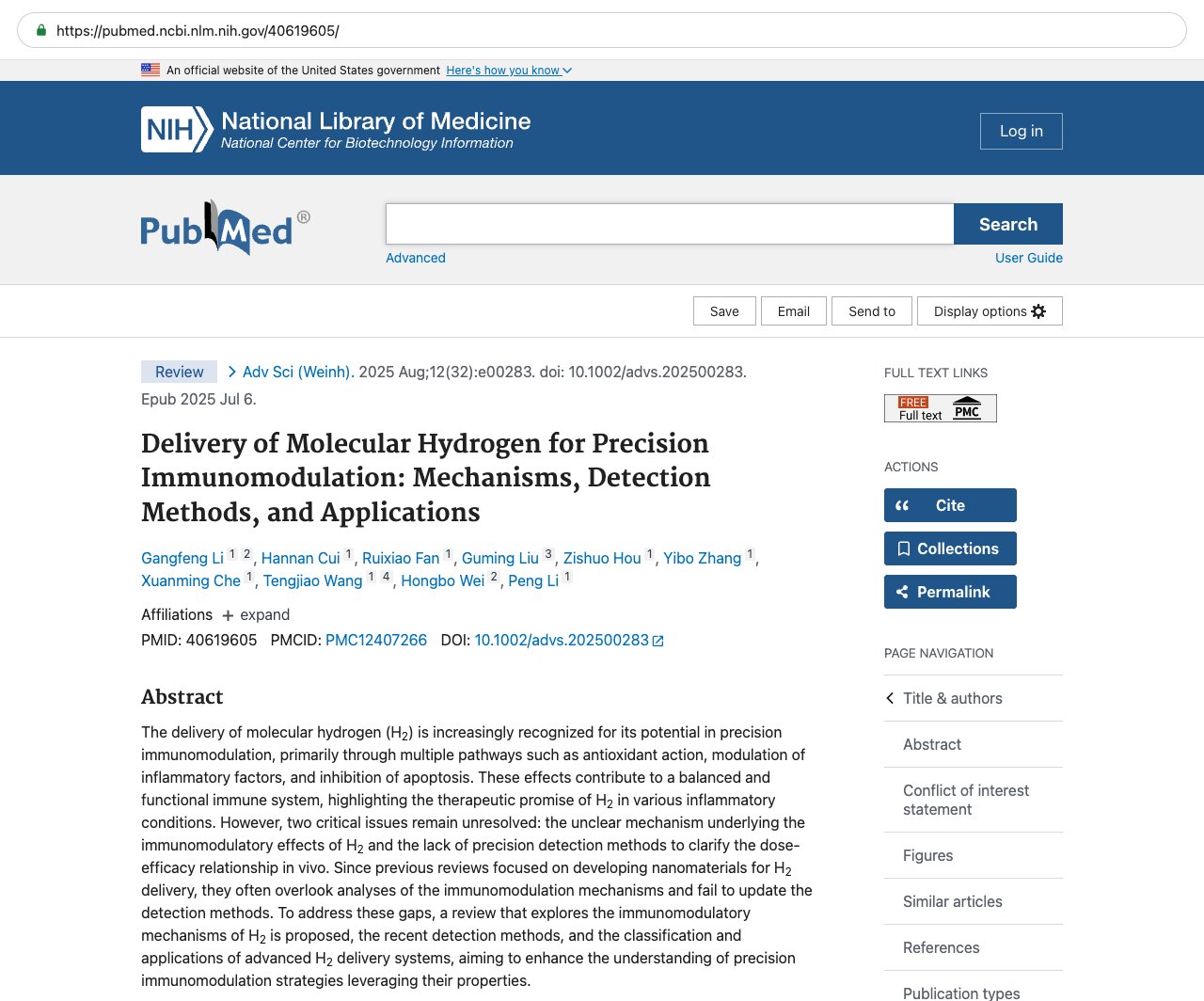
This page mirrors the published abstract (© the authors / publisher) for reference and citation. The canonical source is the PubMed record linked above. This is not medical advice.