2016 · Lin — Molecular Hydrogen Suppresses Activated Wnt/β-catenin Signaling
Super-Abstract
In cell culture and a rat osteoarthritis model, molecular hydrogen (H₂) suppressed abnormally activated Wnt/β-catenin signalling — a pathway implicated in cartilage breakdown — by promoting degradation of β-catenin, and tended to reduce cartilage loss in rats drinking H₂ water. These are preclinical findings in cells and animals; their relevance to human joint disease is not yet established. (Scientific Reports, 2016.)
Commentary
The Wnt/β-catenin signalling pathway plays a critical role in cell proliferation, differentiation, and tissue homeostasis; its abnormal activation is linked to cartilage degradation in osteoarthritis, as well as to several cancers. This study demonstrates that H₂ can suppress overactivated Wnt/β-catenin signalling in cell models by promoting phosphorylation and subsequent degradation of β-catenin — a process requiring intact CK1/GSK3 phosphorylation sites and the β-catenin destruction complex (CK1, GSK3, APC, Axin1). The authors also found that H₂ reduces Wnt/β-catenin activation in human osteoarthritis chondrocytes in vitro, and that oral intake of H₂ water showed a trend toward reduced cartilage degradation in a surgically-induced rat osteoarthritis model — though this was described as a tendency, not a statistically definitive result. The finding that H₂ functions as a signal modulator (not merely a radical scavenger) is mechanistically significant, but requires validation in human trials.
Key quotes
- „H2 suppresses activated Wnt/β-catenin signaling by promoting phosphorylation and degradation of β-catenin.“ — the core molecular mechanism identified
- „H2 reduces the activation of Wnt/β-catenin signaling in human osteoarthritis chondrocytes.“ — cell-level finding in disease-relevant human cells — still in vitro
- „Oral intake of H2 water tended to ameliorate cartilage degradation in a surgery-induced rat osteoarthritis model through attenuating β-catenin accumulation.“ — animal trend: cartilage protection noted but not definitive; important limitation
Our assessment
This is a preclinical study combining cell culture and a rat animal model. The mechanistic finding — that H₂ can modulate a major oncogenic and pro-degenerative signalling pathway — is scientifically novel. However, the animal result is reported as a „tendency”, not a significant effect, and no human data are presented. Results in rats and cell cultures cannot be directly transferred to humans. This study identifies a potential new mechanism of action for H₂ that warrants further investigation, particularly for osteoarthritis and cancer-related signalling contexts.
Study design
- Type: in-vitro + animal study · Model: multiple cell lines; human osteoarthritis chondrocytes; surgery-induced rat osteoarthritis (oral H₂ water) · H₂ delivery: hydrogen-rich water (oral, rat model); hydrogen gas-saturated medium (cell experiments)
- Result: H₂ promotes β-catenin phosphorylation and degradation; suppresses Wnt/β-catenin pathway activation in cells and human chondrocytes; oral H₂ water showed a trend toward reduced cartilage degradation in rats (tendency, not definitive); H₂ does not act directly on GSK3
Abstract
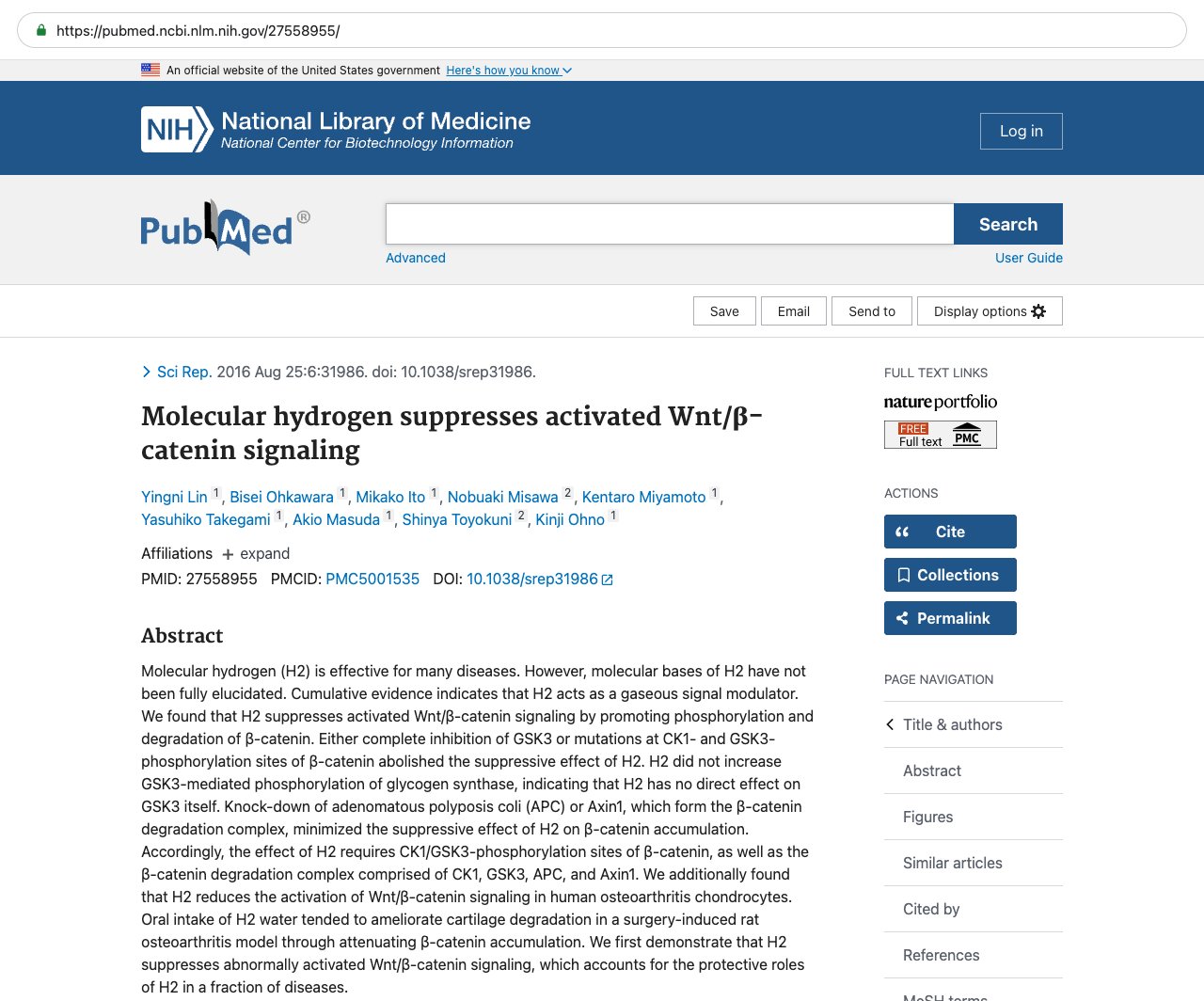
Molecular hydrogen (H2) is effective for many diseases. However, molecular bases of H2 have not been fully elucidated. Cumulative evidence indicates that H2 acts as a gaseous signal modulator. We found that H2 suppresses activated Wnt/β-catenin signaling by promoting phosphorylation and degradation οf β-catenin. Either complete inhibition of GSK3 or mutations at CK1- and GSK3-phosphorylation sites of β-catenin abolished the suppressive effect of H2. H2 did not increase GSK3-mediated phosphorylation of glycogen synthase, indicating that H2 has no direct effect on GSK3 itself. Knock-down of adenomatous polyposis coli (APC) or Axin1, which form the β-catenin degradation complex, minimized the suppressive effect of H2 on β-catenin accumulation. Accordingly, the effect of H2 requires CK1/GSK3-phosphorylation sites of β-catenin, as well as the β-catenin degradation complex comprised of CK1, GSK3, APC, and Axin1. We additionally found that H2 reduces the activation of Wnt/β-catenin signaling in human osteoarthritis chondrocytes. Oral intake of H2 water tended to ameliorate cartilage degradation in a surgery-induced rat osteoarthritis model through attenuating β-catenin accumulation. We first demonstrate that H2 suppresses abnormally activated Wnt/β-catenin signaling, which accounts for the protective roles of H2 in a fraction of diseases.
Source & links
Screenshot of the PubMed page
This page mirrors the published abstract (© the authors / publisher) for reference and citation. The canonical source is the PubMed record linked above. This is not medical advice.