2022 · Lippi — Impact of nutraceuticals and dietary supplements on mitochondria modifications in healthy aging: a systematic review of randomized controlled trials
Super-Abstract
This systematic review of 6 randomized controlled trials found that dietary supplements — including hydrogen-rich water — show positive effects on mitochondrial function markers in healthy older adults, but the total evidence base is small and further research is needed. As a review article, it synthesizes existing studies rather than generating new data; H₂ is one of six supplements evaluated, not the sole focus.
Commentary
Mitochondrial decline is increasingly recognized as a central mechanism of biological aging, making mitochondria-targeted interventions an active area of research. This systematic review searched four major databases (PubMed, Scopus, Web of Science, Cochrane) for randomized controlled trials in healthy older adults and found only 6 eligible studies — a notably small evidence base. The supplements covered include sodium nitrite, omega-3 fatty acids, hydrogen-rich water, nicotinamide riboside, urolithin A, and whey protein. Hydrogen-rich water was among those reporting positive effects on mitochondrial oxidative capacity, but the review does not single out H₂ as superior; all six supplements showed some benefit. A key limitation acknowledged by the authors is the small number of included studies, the variability in outcome measures, and the generally healthy (non-diseased) population — meaning these results cannot be generalized to patients with mitochondrial disorders or age-related diseases. The review used the Jadad scale for quality assessment and found all included studies to be of good quality.
Key quotes
- „The dietary supplements assessed were sodium nitrite, N-3 polyunsaturated fatty acids, hydrogen-rich water, nicotinamide riboside, urolithin A, and whey protein powder.“ — H₂-rich water is one of six supplements evaluated — not the sole subject of the review
- „Positive effects were reported in terms of mitochondrial oxidative and antioxidant capacity, volume, bioenergetic capacity, and mitochondrial transcriptome based on the nutritional supplements.“ — the overall finding across all supplements: various mitochondrial parameters improved
- „Further studies are needed to better elucidate the reciprocal and multilevel interactions between nutraceuticals, mitochondria, and environmental stressors in healthy older adults.“ — the authors' honest conclusion: evidence is currently insufficient
Our assessment
This is a systematic review of RCTs — methodologically a high-quality study type (evidence level 4 as a review). However, with only 6 included trials covering 201 participants and 6 different supplements, the evidence base for any individual supplement (including H₂-rich water) is extremely thin. The review cannot be used to make strong therapeutic claims about hydrogen-rich water specifically, as H₂ is just one of multiple supplements examined and individual study results are not disaggregated in full detail for H₂ alone. The honest takeaway: there are early positive signals for several mitochondria-targeting supplements in healthy aging, but the field is in its infancy and requires much larger, longer-term trials.
Study design
- Type: systematic review of randomized controlled trials · Population: healthy older adults (mean age 67–76 years) · n: 201 total participants across 6 included studies · H₂ delivery: hydrogen-rich water (among 5 other supplement types)
- Databases searched: PubMed, Scopus, Web of Science, Cochrane (inception to February 2022)
- Result: all 6 supplements reported positive effects on at least one mitochondrial parameter (oxidative capacity, volume, bioenergetics, transcriptome); all included studies rated good quality (Jadad scale); authors call for larger trials
Abstract
BACKGROUND: To date, the mitochondrial function has been related to several pathways involved in the cellular aging process. Dietary supplements might have reciprocal and multilevel interactions with mitochondria network; however, no systematic review assessed the role of different nutraceuticals in mitochondria modification of healthy older adults. AIM: To assess the effects of different dietary supplements on mitochondria modifications in older adults. METHODS: On February 22, 2022, PubMed, Scopus, Web of Science, and Cochrane were systematically searched from inception for randomized controlled trials (RCTs). According to PICO model, we considered healthy older adults as participants, nutraceutical treatment as intervention, any treatment as comparator, mitochondrial modifications as outcome. Jadad scale was used for the quality assessment. RESULTS: Altogether, 8489 records were identified and screened until 6 studies were included. A total of 201 healthy older adults were included in the systematic review (mean age ranged from 67.0 ± 1.0 years to 76.0 ± 5.6 years). The dietary supplements assessed were sodium nitrite, N-3 polyunsaturated fatty acids, hydrogen-rich water, nicotinamide riboside, urolithin A, and whey protein powder. Positive effects were reported in terms of mitochondrial oxidative and antioxidant capacity, volume, bioenergetic capacity, and mitochondrial transcriptome based on the nutritional supplements. The quality assessment underlined that all the studies included were of good quality. DISCUSSION: Although dietary supplements might provide positive effects on mitochondria modifications, few studies are currently available in this field. CONCLUSION: Further studies are needed to better elucidate the reciprocal and multilevel interactions between nutraceuticals, mitochondria, and environmental stressors in healthy older adults.
Source & links
Screenshot of the PubMed page
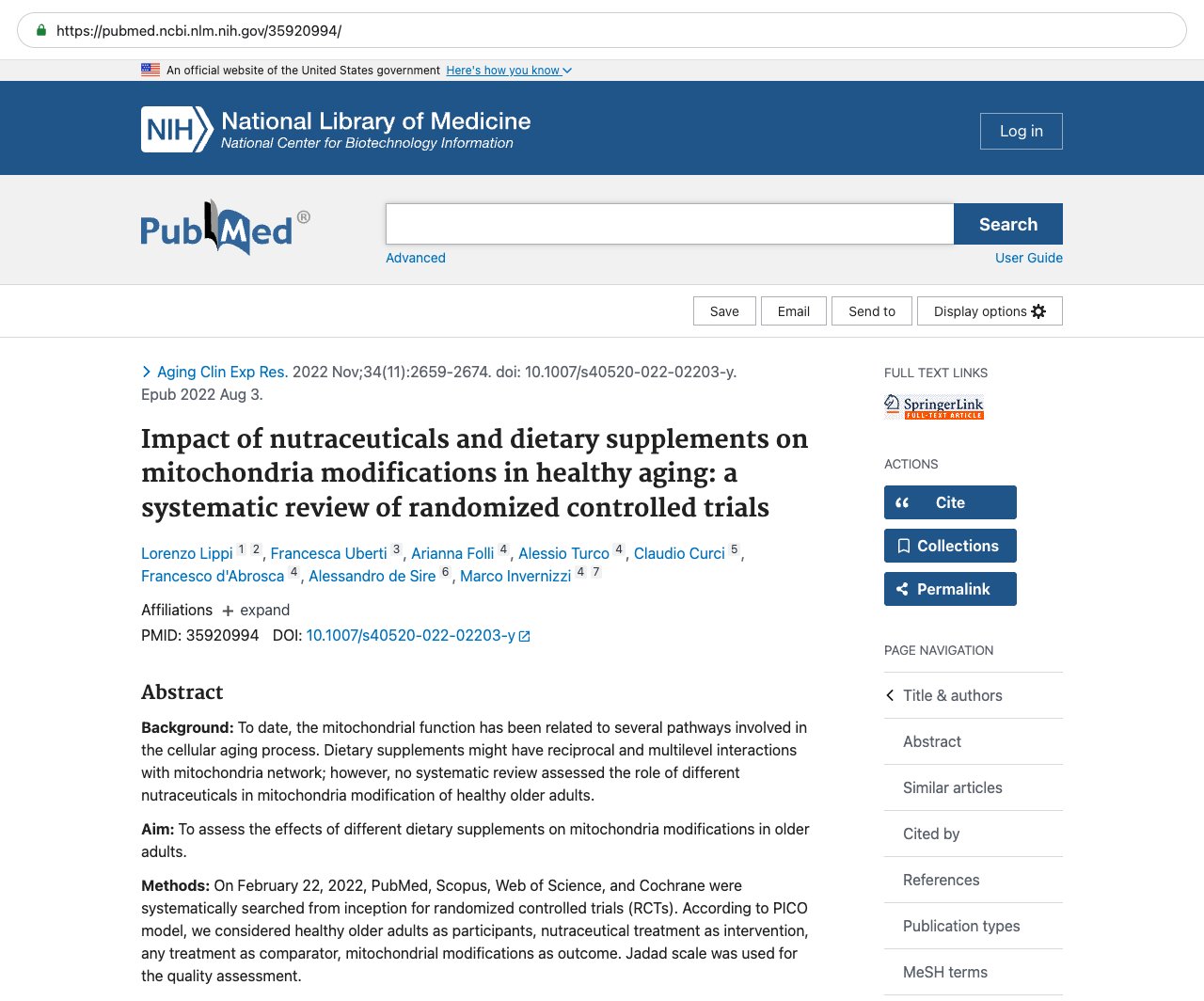
This page mirrors the published abstract (© the authors / publisher) for reference and citation. The canonical source is the PubMed record linked above. This is not medical advice.