2015 · Ma et al. — Discovery of novel quinoline-based mTOR inhibitors via introducing intra-molecular hydrogen bonding scaffold (iMHBS): The design, synthesis and biological evaluation.
Super-Abstract
Researchers designed and synthesized a series of quinoline compounds that use intramolecular hydrogen bonding to inhibit the mTOR enzyme — a key cancer growth regulator — with several candidates showing potent activity against cancer cell lines. This is a medicinal chemistry in-vitro study; it does not investigate molecular hydrogen as a medical gas. (Bioorganic and Medicinal Chemistry, 2015.)
Commentary
This study is about intramolecular hydrogen bonding in synthetic drug molecules — a chemical structure concept used in drug design. The „hydrogen“ in question is the hydrogen atom within a chemical bond, not the molecular hydrogen gas (H₂) studied in hydrogen medicine. The most potent compound identified (compound 15a) showed IC₅₀ values in the nanomolar range against mTOR and inhibited three cancer cell lines. The study demonstrates a viable drug design strategy but is entirely a laboratory chemistry and cell biology study. No animal experiments or human trials are described. The connection to H₂ medicine is purely nominal — a shared word.
Key quotes
- „Six compounds exhibited significant inhibition against mTOR with IC50 values below 35nM.“ — the in-vitro potency range achieved — strong, but in-vitro results only
- „Compound 15a, the most potent mTOR inhibitor reported herein (IC50=14nM), also displayed the most favorable cellular activities.“ — lead compound identified for further investigation
- „15a demonstrated acceptable stability in simulated gastric fluid (SGF), simulated intestinal fluid (SIF) and liver microsome, thereby being valuable for extensive in vivo investigation.“ — metabolic stability data suggesting suitability for future animal studies
Our assessment
This is an in-vitro medicinal chemistry study about intramolecular hydrogen bonding in cancer drug design — not a study on molecular hydrogen (H₂) as a therapeutic agent. The word „hydrogen“ here refers to hydrogen atoms within chemical bonds, a different concept entirely. The results are promising at the cell culture level but require extensive animal and eventually human testing before any clinical conclusions can be drawn. This study provides no evidence for or against hydrogen gas therapy.
Study design
- Type: in-vitro medicinal chemistry study · Model: HCT-116, PC-3, MCF-7 cancer cell lines · H₂ context: intramolecular hydrogen bonds in synthetic compounds — not molecular H₂ gas
- Result: compound 15a (IC₅₀ = 14 nM against mTOR) showed strongest anti-proliferative activity; metabolic stability confirmed in simulated biological fluids; dual mTORC1/mTORC2 inhibition demonstrated for representative compound 16b
Abstract
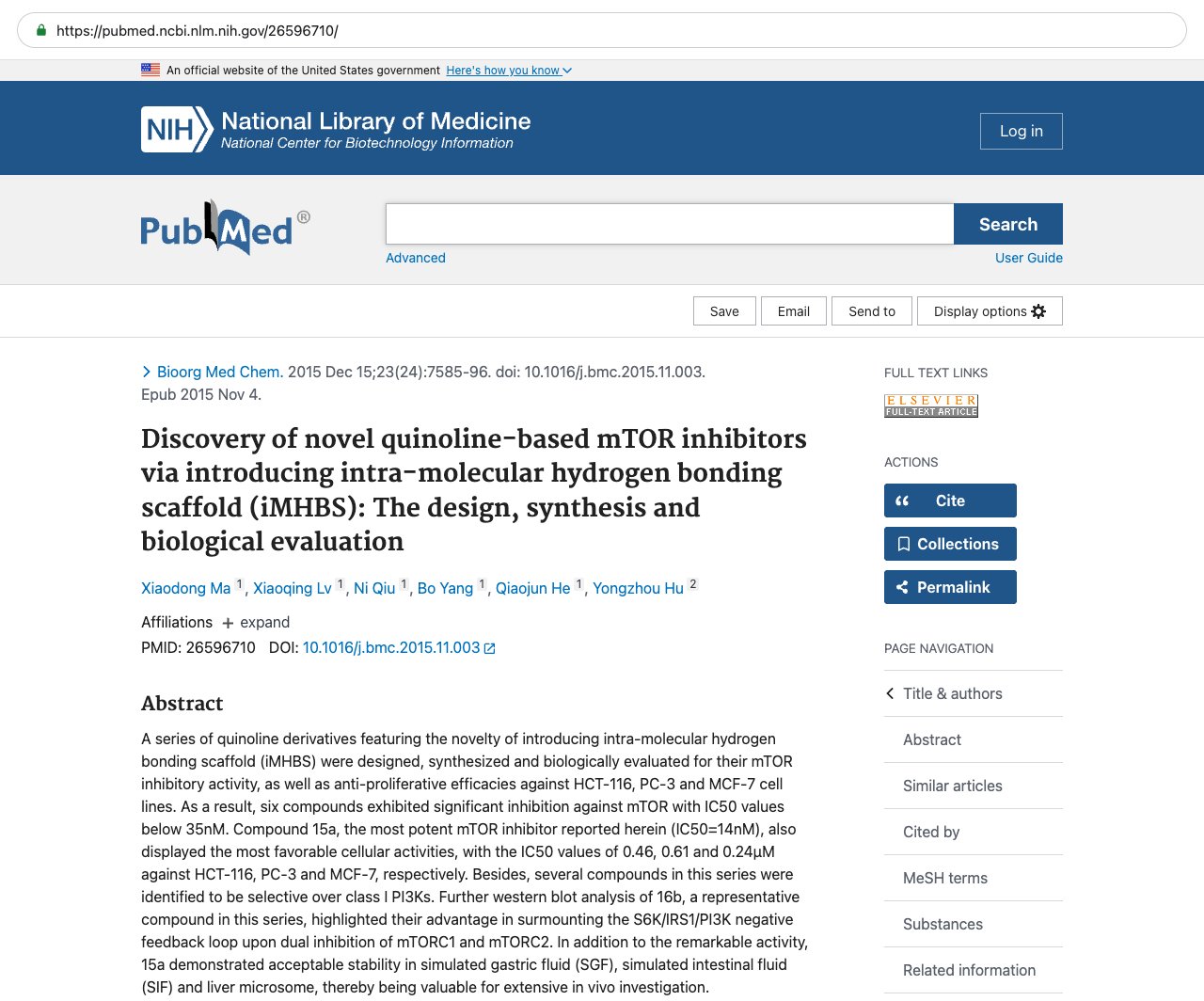
A series of quinoline derivatives featuring the novelty of introducing intra-molecular hydrogen bonding scaffold (iMHBS) were designed, synthesized and biologically evaluated for their mTOR inhibitory activity, as well as anti-proliferative efficacies against HCT-116, PC-3 and MCF-7 cell lines. As a result, six compounds exhibited significant inhibition against mTOR with IC50 values below 35nM. Compound 15a, the most potent mTOR inhibitor reported herein (IC50=14nM), also displayed the most favorable cellular activities, with the IC50 values of 0.46, 0.61 and 0.24μM against HCT-116, PC-3 and MCF-7, respectively. Besides, several compounds in this series were identified to be selective over class I PI3Ks. Further western blot analysis of 16b, a representative compound in this series, highlighted their advantage in surmounting the S6K/IRS1/PI3K negative feedback loop upon dual inhibition of mTORC1 and mTORC2. In addition to the remarkable activity, 15a demonstrated acceptable stability in simulated gastric fluid (SGF), simulated intestinal fluid (SIF) and liver microsome, thereby being valuable for extensive in vivo investigation.
Source & links
Screenshot of the PubMed page
This page mirrors the published abstract (© the authors / publisher) for reference and citation. The canonical source is the PubMed record linked above. This is not medical advice.