1990 · Makino — Measurement of Hepatic Blood Flow by the Hydrogen Gas Clearance Method: Experimental and Clinical Observations
Super-Abstract
Inhaled hydrogen gas serves as a highly accurate and minimally invasive tool for measuring liver blood flow in real time. In both animal experiments and patients with various liver diseases, the H₂ clearance method correlated closely with established reference techniques and revealed characteristic blood-flow patterns in hepatitis, cirrhosis, fatty liver, and liver tumours. (Nihon Ika Daigaku Zasshi, 1990.)
Commentary
This paper describes and validates the inhaled-hydrogen clearance technique (i-H₂) for quantifying hepatic blood flow (HBF) — a diagnostic method, not a therapy. H₂ gas is inhaled; its disappearance from the hepatic tissue, measured by an electrode probe, reflects local perfusion. The study is methodologically thorough: it validates i-H₂ against electromagnetic flowmetry in rabbits, tests the response to vasoactive drugs (norepinephrine, propranolol, glucagon, vasopressin), and then applies the method in patients with a range of liver conditions. Key clinical findings include markedly reduced HBF in cirrhosis and hepatitis, recovery of flow as acute hepatitis resolves, and a striking difference in tumour-to-normal-tissue flow ratio between hepatocellular carcinoma (> 1.0) and metastatic liver cancer (< 1.0). This distinction has potential diagnostic value. For the H₂ therapy context: this paper confirms that inhaled H₂ is physiologically inert and rapidly distributed to internal organs — useful background for understanding H₂ pharmacokinetics.
Key quotes
- „Simultaneous determinations of HBF by i-H2 and electromagnetic flowmetry in rabbits revealed an excellent correlation between the values obtained by the two methods.“ — validation of the H₂ clearance method against a gold standard
- „HBF as determined by i-H2 was significantly decreased in acute hepatitis (AH), chronic inactive hepatitis (CIH), chronic active hepatitis (CAH), liver cirrhosis (LC) and fatty liver.“ — clinical finding across liver disease spectrum
- „The ratio of HBF in tumor/normal tissue was greater than 1.0 for hepatocellular carcinoma in contrast to the ratio of less than 1.0 for metastatic liver carcinoma.“ — potential diagnostic differentiation between liver tumour types
Our assessment
Important note on scope: This is a diagnostic methodology study, not a therapeutic H₂ study. Hydrogen gas is used solely as an inert tracer for blood-flow measurement — no antioxidant or anti-inflammatory therapeutic intent is present. The study includes both animal experiments (rabbits, carbon-tetrachloride-treated rats) and human patients; the human clinical portion covers liver diseases. Methodologically solid, though sample sizes per subgroup are not specified in the abstract. Limitations: no therapeutic H₂ endpoint; mixed animal/human design; the clinical sections lack precise n values per disease category.
Study design
- Type: diagnostic methodology validation study (animal + human clinical observations) · n: not fully specified per subgroup · H₂ delivery: inhalation of H₂ gas as diagnostic tracer for hepatic blood flow clearance
- Result: excellent correlation between i-H₂ and electromagnetic flowmetry; HBF significantly reduced in all chronic liver diseases tested; HBF normalised with recovery from acute hepatitis; hepatocellular carcinoma shows higher tumour-to-normal flow ratio than metastatic carcinoma · Therapeutic relevance: none — diagnostic tracer application only
Abstract
In this study, the author intended to examine the validity of the inhaled hydrogen gas clearance method (i-H2) for determination of the hepatic blood flow (HBF), and also to show some applicabilities of the method in experimental animals and patients with liver diseases. Simultaneous determinations of HBF by i-H2 and electromagnetic flowmetry in rabbits revealed an excellent correlation between the values obtained by the two methods. Moreover, HBF in rabbits measured by i-H2 varied in parallel with that by thermocouple flowmetry or laser Doppler velocimetry after administration of norepinephrine, propranolol or glucagon. In carbon tetrachloride-treated rats, HBF measured by i-H2 correlated better with the severity of damage in the sinusoidal structure than the severity of hepatic cell injury or the serum levels of transaminases. HBF as determined by i-H2 was significantly decreased in acute hepatitis (AH), chronic inactive hepatitis (CIH), chronic active hepatitis (CAH), liver cirrhosis (LC) and fatty liver. Reduced HBF in AH returned to normal during recovery of the disease. The ratio of HBF in tumor/normal tissue was greater than 1.0 for hepatocellular carcinoma in contrast to the ratio of less than 1.0 for metastatic liver carcinoma. Propranolol caused a decrease in HBF by 31%, and vasopressin by 39% in patients with CIH or LC. In contrast, glucagon induced its increase by 65%, 35% and 17%, respectively, in patients with CIH, AH and LC.
Source & links
Screenshot of the PubMed page
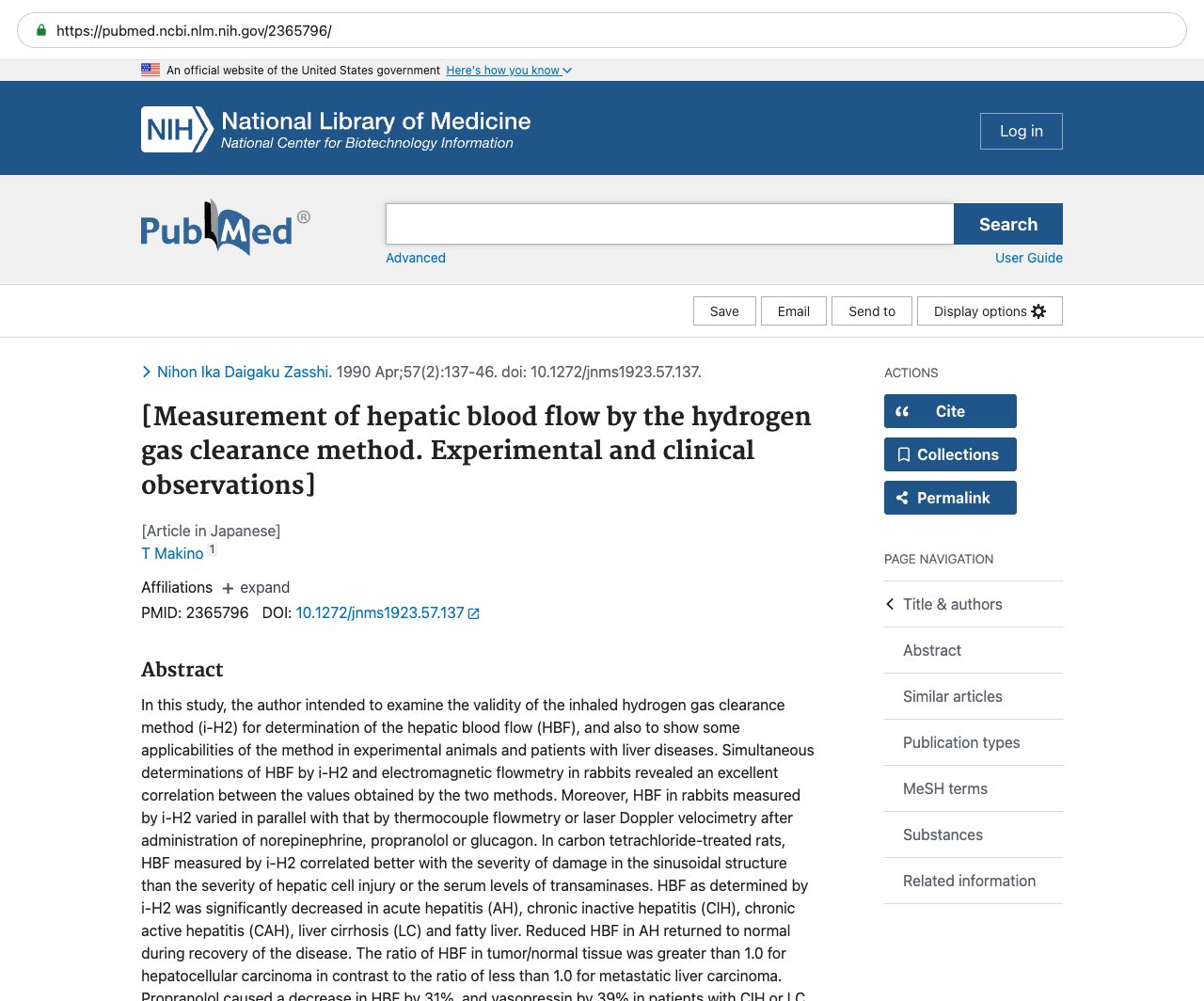
This page mirrors the published abstract (© the authors / publisher) for reference and citation. The canonical source is the PubMed record linked above. This is not medical advice.