2025 · Maruyama et al. — Efficacy of Oral Intake of Hydrogen-Rich Jelly Intake on Gingival Inflammation: A Double-Blind, Placebo-Controlled and Exploratory Randomized Clinical Trial
Super-Abstract
In people with gingivitis, eating hydrogen-rich jelly three times a day for 14 days showed no statistically significant difference from placebo jelly in the percentage of sites that bled on probing, the primary endpoint (p > 0.05). Bleeding on probing and periodontal inflamed surface area fell significantly in both groups compared with baseline, so the improvement was not specific to hydrogen. The full text reports 20 participants (10 per group); the abstract gives no separate results for the secondary outcomes and adverse events. (Healthcare, 2025.)
Commentary
Oxidative stress is involved in the start and progression of periodontal disease, and the authors tested whether hydrogen taken by mouth helps against gingivitis. In this exploratory, randomized, double-blind, placebo-controlled trial, participants with gingivitis ate 30 g of a jelly containing 40 ppm hydrogen, or a placebo jelly, three times a day for 14 consecutive days. The primary endpoint was the percentage of sites with bleeding on probing. Secondary outcomes were other oral parameters, serum reactive oxygen metabolites, antioxidant capacity and oxidative index, the cytokines interleukin (IL)-1β, IL-6, IL-10, IL-17 and tumor necrosis factor-alpha in gingival crevicular fluid, and adverse events. Groups were compared with the Mann-Whitney U test, plus an analysis of covariance adjusted for baseline periodontal inflamed surface area (PISA). The abstract does not state the number of participants; the full text (PMC11898518) reports 20, 10 per group, with no drop-outs.
Key quotes
- „However, no significant differences were found between groups (p > 0.05).“ — the between-group comparison, which is the test of the hydrogen effect
- „In the experiment and control groups, the percentage of sites with BOP and PISA significantly decreased at the end of the experiment compared to the baseline.“ — both groups improved, including the placebo group
- „Administration of hydrogen-rich jelly for 14 days decreased gingival inflammation. However, no significant differences were identified compared to the control group.“ — the authors' conclusion; the decrease also occurred with placebo jelly
Our assessment
The trial was randomized, double-blind and placebo-controlled and named a primary endpoint, so its null result is informative within its limits. Hydrogen-rich jelly did not reduce gum bleeding more than placebo jelly. Both groups improved, so the decrease seen with hydrogen cannot be credited to hydrogen. The first sentence of the authors' conclusion, that the jelly decreased gingival inflammation, describes a change from baseline that also happened with placebo. Limitations: Only 20 participants (10 per group, per full text). The authors call the trial exploratory. Only 14 days of intake. Results for the secondary outcomes (oxidative stress markers, cytokines) and for adverse events are not reported in the abstract, so safety cannot be judged from it.
Study design
- Type: exploratory, randomized, double-blind, placebo-controlled trial · n: 20 (10 per group, per full text) · H₂ delivery: oral hydrogen-rich jelly (40 ppm), 30 g three times a day for 14 days
- Comparator: placebo jelly on the same schedule
- Result: primary endpoint (percentage of sites with bleeding on probing): no significant difference between groups (p > 0.05). Bleeding on probing and PISA decreased significantly from baseline in both groups. Results for secondary outcomes and adverse events not given in the abstract
Abstract
Background/Objectives: Initiation and progression of periodontal disease include oxidative stress. Systemic application of antioxidants may provide clinical benefits against periodontal disease including gingivitis. Recently, a jelly containing a high concentration of hydrogen (40 ppm) was developed. We hypothesized that oral intake of this hydrogen-rich jelly may be safe and effective on gingivitis. This clinical trial was designed to investigate the safety and efficacy of oral intake of hydrogen-rich jelly against gingival inflammation. Methods: Participants with gingivitis were instructed to orally ingest 30 g of hydrogen-rich jelly (experimental group) or placebo jelly (control group) three times a day for 14 consecutive days. The primary outcome of this trial was the percentage of bleeding on probing (BOP) sites. Secondary outcomes were oral parameters, serum reactive oxygen metabolites, antioxidant capacity, oxidative index, concentrations of cytokine (interleukin [IL]-1β, IL-6, IL-10, IL-17, and tumor necrosis factor-alpha) in gingival crevicular fluid, and adverse events. For all parameters, Mann-Whitney U test was used for comparison between experimental and control groups. Analysis of covariance, controlling for baseline periodontal inflamed surface area, was performed to evaluate the association between the effect of the hydrogen-rich jelly and gingival inflammation. Results: In the experiment and control groups, the percentage of sites with BOP and PISA significantly decreased at the end of the experiment compared to the baseline. However, no significant differences were found between groups (p > 0.05). Conclusions: Administration of hydrogen-rich jelly for 14 days decreased gingival inflammation. However, no significant differences were identified compared to the control group.
Source & links
Screenshot of the PubMed page
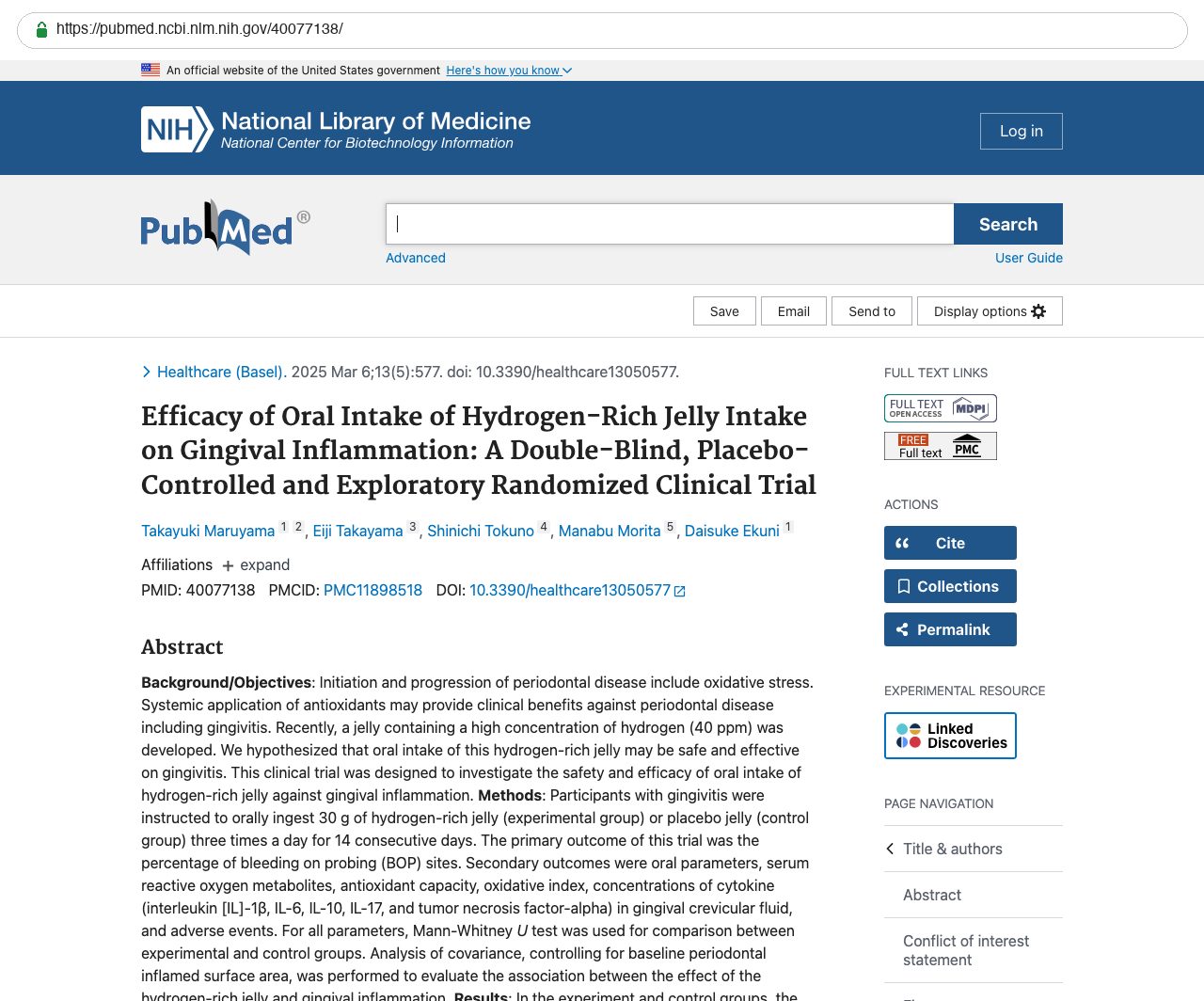
This page mirrors the published abstract (© the authors / publisher) for reference and citation. The canonical source is the PubMed record linked above. This is not medical advice.