2015 Antioxidants (Basel, Switzerland) RCT Human H₂ therapy Drinking (HRW) Oral healthOxidative stress
2015 · Azuma et al. — Drinking Hydrogen-Rich Water Has Additive Effects on Non-Surgical Periodontal Treatment of Improving Periodontitis: A Pilot Study
Super-Abstract
In 13 patients with periodontitis, drinking hydrogen-rich water for eight weeks alongside non-surgical periodontal treatment gave greater improvements in probing pocket depth and clinical attachment level than treatment alone at two, four and eight weeks (p < 0.05). In the hydrogen water group, serum total antioxidant capacity was higher at four weeks than at baseline. With six and seven patients per group and no placebo drink described, the result is a first signal only. (Antioxidants, 2015.)
Commentary
Oxidative stress is involved in periodontitis, and the authors asked whether drinking hydrogen-rich water adds to the effect of standard non-surgical periodontal treatment. This pilot study included 13 patients with periodontitis (3 women, 10 men), 6 in a control group and 7 in a hydrogen water group. Per full text, participants were randomly assigned at baseline, and the dentist who performed the oral examinations was blinded to the treatment. The hydrogen water group drank hydrogen-rich water 4–5 times a day for eight weeks, per full text 200–300 mL each time, made by placing a magnesium stick in drinking water. The hydrogen concentration is not reported. All participants received non-surgical periodontal treatment between weeks two and four. Oral examinations and serum measurements of oxidative stress were done at baseline and at two, four and eight weeks. The abstract does not name a primary endpoint or report adverse events.
Key quotes
- „The HW group showed greater improvements in probing pocket depth and clinical attachment level than the control group at two, four and eight weeks (p < 0.05).“ — the main clinical result, from a sample of 13 patients
- „The HW group also exhibited an increased serum level of total antioxidant capacity at four weeks, compared to baseline (p < 0.05).“ — a change within one group compared with its own baseline, not a comparison between groups
- „Drinking HW enhanced the effects of non-surgical periodontal treatment, thus improving periodontitis.“ — the authors' conclusion, worded more firmly than a pilot study allows
Our assessment
The study compared periodontal treatment with and without hydrogen water and, per full text, used a blinded examiner. Pocket depth and attachment level improved more in the hydrogen water group (p < 0.05). The abstract gives no effect sizes, and the antioxidant result is a change within one group compared with its own baseline, not a difference between groups. Limitations: 13 patients, six and seven per group, eight weeks of follow-up and clinical surrogate measures. The abstract does not name a primary endpoint, does not describe a placebo drink for the control group and does not report adverse events. Participant blinding is not reported, and the hydrogen concentration of the water is unknown. The abstract does not use the word randomised. In this small sample the results suggest an additive effect that a larger randomised, placebo-controlled trial would need to confirm.
Study design
- Type: pilot study with two parallel groups, randomly assigned per full text · n: 13 (7 hydrogen water, 6 control) · H₂ delivery: drinking hydrogen-rich water 4–5 times a day for eight weeks (per full text 200–300 mL each time, concentration not reported)
- Comparator: non-surgical periodontal treatment without hydrogen water. Both groups received the periodontal treatment between weeks two and four
- Result: greater improvement in probing pocket depth and clinical attachment level with hydrogen water at weeks two, four and eight (p < 0.05). Serum total antioxidant capacity higher at week four than at baseline in the hydrogen water group (p < 0.05). No differences in periodontal status at baseline
Abstract
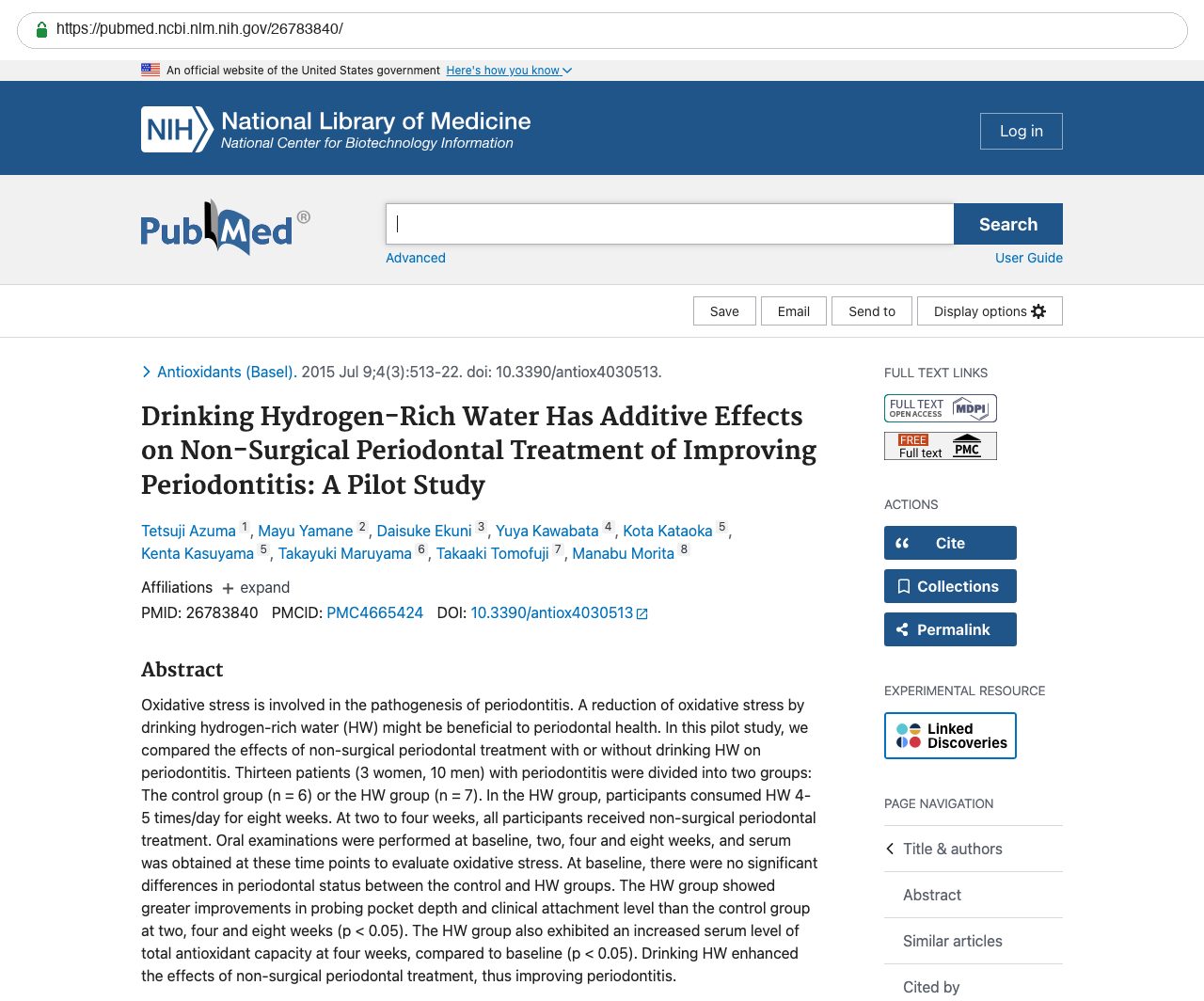
Oxidative stress is involved in the pathogenesis of periodontitis. A reduction of oxidative stress by drinking hydrogen-rich water (HW) might be beneficial to periodontal health. In this pilot study, we compared the effects of non-surgical periodontal treatment with or without drinking HW on periodontitis. Thirteen patients (3 women, 10 men) with periodontitis were divided into two groups: The control group (n = 6) or the HW group (n = 7). In the HW group, participants consumed HW 4-5 times/day for eight weeks. At two to four weeks, all participants received non-surgical periodontal treatment. Oral examinations were performed at baseline, two, four and eight weeks, and serum was obtained at these time points to evaluate oxidative stress. At baseline, there were no significant differences in periodontal status between the control and HW groups. The HW group showed greater improvements in probing pocket depth and clinical attachment level than the control group at two, four and eight weeks (p < 0.05). The HW group also exhibited an increased serum level of total antioxidant capacity at four weeks, compared to baseline (p < 0.05). Drinking HW enhanced the effects of non-surgical periodontal treatment, thus improving periodontitis.
Source & links
Screenshot of the PubMed page
This page mirrors the published abstract (© the authors / publisher) for reference and citation. The canonical source is the PubMed record linked above. This is not medical advice.