2026 International journal of sports physiology and performance RCT Human H₂ therapy Drinking (HRW) Sports & Exercise
2026 · Sládečková et al. — Hydrogen-Rich Water as a Performance-Enhancing Aid in National-Level Finswimmers: A Randomized, Double-Blind, Placebo-Controlled Crossover Study
Super-Abstract
In 12 national-level finswimmers, four days of hydrogen-rich water (0.9 ppm) improved 400-m time-trial performance by 0.6% compared with placebo (P = .003), while 50-m sprint times showed no statistically significant difference (0.5%, P = .12). Blood lactate, perceived exertion and the oxidative stress marker plasma protein carbonyls also did not differ significantly between conditions (all P ≥ .12). The crossover trial was small, and the 400-m result rests on one time trial per condition. (Int J Sports Physiol Perform, 2026.)
Commentary
The study asked whether a short course of hydrogen-rich water changes swimming performance and physiological markers. Eight female and four male national-level finswimmers, with mean ages of 21 and 19 years, took part in a randomised, double-blind, placebo-controlled crossover trial. They drank hydrogen-rich water with a hydrogen concentration of 0.9 ppm, or placebo, starting 3 days before the test sessions. Intake was 1260 mL per day for 3 days and, in the abstract's wording, 1680 mL on the day before the 400-m time trial. On the test day they swam 3 sets of 4 × 50-m surface sprints in the morning and a 400-m surface time trial in the afternoon. Blood lactate and rating of perceived exertion were measured after each sprint set and after the time trial. Plasma protein carbonyls served as a marker of oxidative stress. After a 1-week washout the swimmers repeated the protocol with the other drink. The abstract does not name a primary endpoint, describe the placebo or report adverse events. The same group of swimmers and the same trial registration also appear in Sládečková 2024.
Key quotes
- „HRW did not significantly improve morning 50-m sprint times (0.5%, P = .12) but afternoon 400-m time trial was improved by 0.6% (P = .003).“ — the two performance results: no significant sprint effect, a small time-trial gain
- „The differences between HRW and placebo administration on blood lactate, rating of perceived exertion, and protein carbonyls were not significant (all P ≥ .12).“ — physiological and perceptual markers, including oxidative stress, showed no significant differences
- „Short-term HRW supplementation provides a modest yet meaningful performance improvement of 0.6% in middle-distance (400-m surface) finswimming. However, its effects on repeated sprint performance, blood lactate, perceived exertion, and oxidative stress appear limited.“ — the authors' conclusion: a small time-trial gain, limited effects elsewhere
Our assessment
This is a registered, randomised, double-blind crossover trial, so each swimmer served as their own control. Of the reported outcomes, only the 400-m time trial differed significantly, by 0.6%. Sprint times, blood lactate, perceived exertion and protein carbonyls showed no statistically significant differences. The authors call the time-trial gain modest yet meaningful. Whether a difference of this size holds in other swimmers or in competition cannot be judged from one small trial. Limitations: 12 participants, one 400-m time trial per condition, four days of supplementation, several outcomes without a named primary endpoint, and no information on adverse events or the placebo in the abstract.
Study design
- Type: randomised, double-blind crossover trial with a 1-week washout · n: 12 finswimmers at national level (eight women, four men) · H₂ delivery: hydrogen-rich water (0.9 ppm), 1260 mL per day for 3 days plus 1680 mL on the day before the 400-m time trial
- Comparator: placebo drink (composition not described in the abstract)
- Result: no primary endpoint named. 400-m time trial improved by 0.6% with hydrogen-rich water (P = .003). 50-m sprint times: 0.5% difference, not significant (P = .12). Blood lactate, rating of perceived exertion and plasma protein carbonyls: no significant differences (all P ≥ .12)
Abstract
PURPOSE: We investigated whether a 4-day intake of hydrogen-rich water (HRW) improves finswimming performance and alters physiological and perceptual markers including blood lactate, rating of perceived exertion, and oxidative stress. METHODS: Eight females and 4 males, age 21 (5) and 19 (1) years, maximal oxygen consumption 45.0 (2.5) and 52.2 (1.7) mL·kg-1·min-1, performed 3 sets of 4 reps of 50-m surface finswimming sprints in a morning session, and a 400-m surface time trial in the afternoon on the same day. Participants consumed either HRW (hydrogen concentration 0.9 ppm) or placebo, starting 3 days prior to the experimental sessions. Intake was 1260 mL per day for 3 days, and 1680 mL on the day before the 400-m time trial. After each 4 × 50-m set and 400-m trial, blood lactate and rating of perceived exertion were measured. Oxidative stress was evaluated by plasma protein carbonyls at scheduled time points. After a 1-week washout period, the experiment was repeated with participants receiving the alternate intervention. CLINICAL TRIALS REGISTRATION: NCT05799911. RESULTS: HRW did not significantly improve morning 50-m sprint times (0.5%, P = .12) but afternoon 400-m time trial was improved by 0.6% (P = .003). The differences between HRW and placebo administration on blood lactate, rating of perceived exertion, and protein carbonyls were not significant (all P ≥ .12). CONCLUSIONS: Short-term HRW supplementation provides a modest yet meaningful performance improvement of 0.6% in middle-distance (400-m surface) finswimming. However, its effects on repeated sprint performance, blood lactate, perceived exertion, and oxidative stress appear limited.
Source & links
Screenshot of the PubMed page
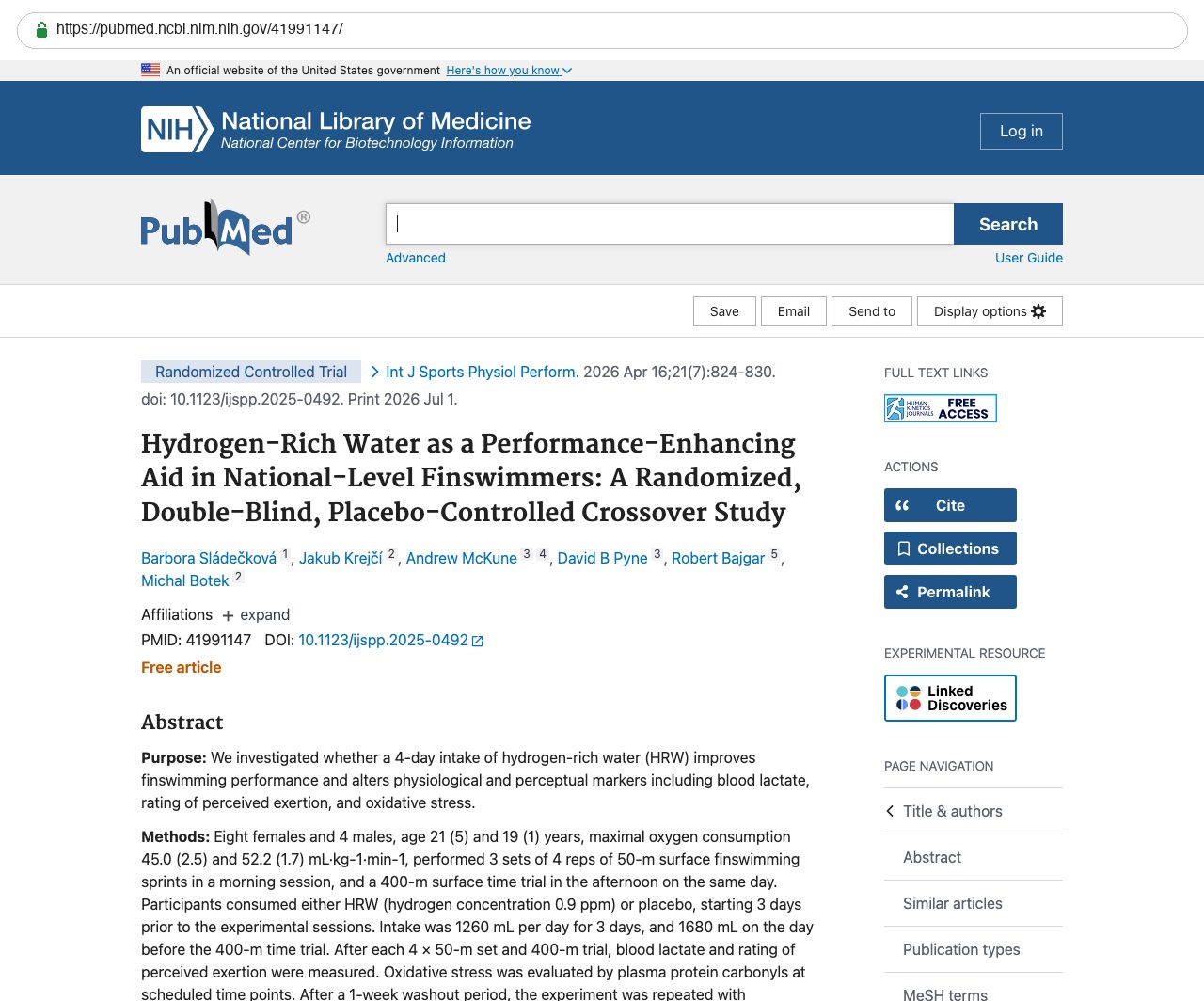
This page mirrors the published abstract (© the authors / publisher) for reference and citation. The canonical source is the PubMed record linked above. This is not medical advice.