1994 · McGown — Regeneration of Functional Hemoglobin from Partially Oxidized Hemoglobin in the Presence of Molecular Hydrogen and a Multicomponent Redox Catalyst
Super-Abstract
This in-vitro study demonstrated that molecular hydrogen (H₂) can reduce partially oxidized (met-)hemoglobin back to functional hemoglobin when a multicomponent redox catalyst is present — a proof-of-concept for H₂ as a biochemical reducing agent. No abstract is publicly available in the database record; details are accessible via the original publication. (Methods in Enzymology, 1994.)
Commentary
This work by McGown and colleagues is a biochemical proof-of-concept study: using H₂ gas and a catalyst system to chemically reduce methemoglobin (oxidized, non-functional hemoglobin) back to functional oxyhemoglobin. The connection to hydrogen medicine lies in H₂'s capacity as a selective reducing agent — a theme also central to its antioxidant action in cells. However, this is a purely in-vitro biochemical study using a multicomponent redox catalyst; it does not represent physiological conditions, and no conclusions about therapeutic H₂ administration in humans can be drawn from this paper alone. No abstract is available in the database entry.
Key quotes
- „Regeneration of functional hemoglobin from partially oxidized hemoglobin in the presence of molecular hydrogen and a multicomponent redox catalyst.“ — title only — no abstract available; the core finding is stated in the title
Our assessment
This is an in-vitro biochemistry study demonstrating H₂ as a reducing agent for methemoglobin — not a therapeutic study. It is mechanistically interesting as an early demonstration of H₂ reactivity in biological molecules, but cannot serve as clinical evidence for therapeutic H₂. The use of an external multicomponent redox catalyst means the conditions are far from physiological. No abstract is available; a complete evaluation requires access to the original publication in Methods in Enzymology (1994).
Study design
- Type: in-vitro biochemistry study · Model: isolated hemoglobin (partial methemoglobin) · H₂ delivery: molecular H₂ gas with multicomponent redox catalyst
- Result: no abstract available — refer to original publication in Methods in Enzymology (1994)
Source & links
Screenshot of the PubMed page
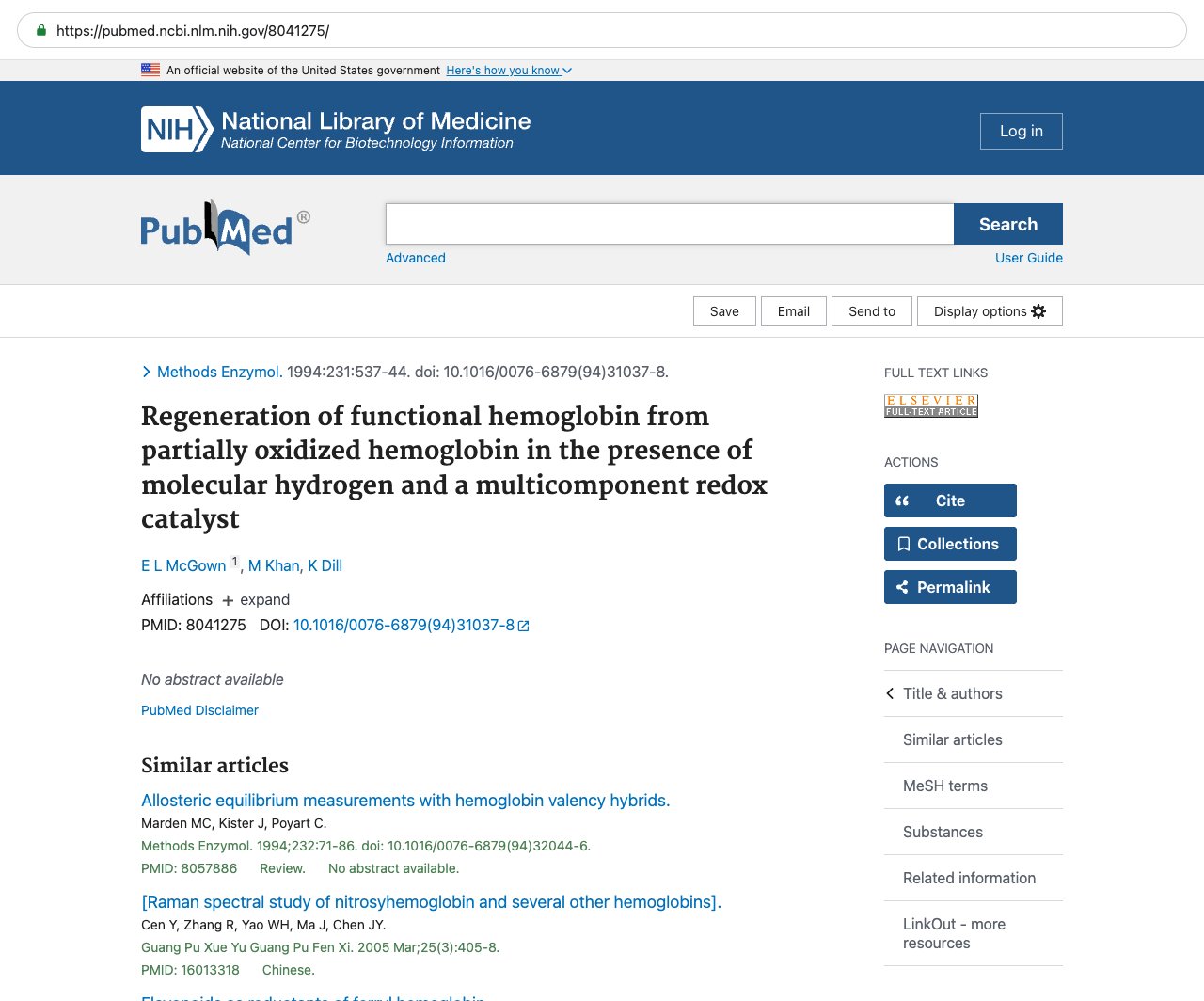
This page mirrors the published abstract (© the authors / publisher) for reference and citation. The canonical source is the PubMed record linked above. This is not medical advice.