2019 · Mikami — Drinking hydrogen water enhances endurance and relieves psychometric fatigue: a randomized, double-blind, placebo-controlled study
Super-Abstract
Hydrogen water shortly before exercise lowered the sensation of fatigue and increased endurance. In two randomized, double-blind, placebo-controlled experiments (n = 99 untrained; n = 60 trained), subjective fatigue, maximal oxygen consumption and the Borg scale improved. (Can J Physiol Pharmacol, 2019.)
Commentary
This study comes from the circle of Shigeo Ohta, one of the pioneers of H₂ research, and delivers a positive endurance and anti-fatigue finding. It consists of two experiments on a cycle ergometer. In the first, 99 healthy, untrained people drank either placebo or H₂ water 30 minutes before light exercise — and fatigue measured by visual analogue scale was significantly lower in the H₂ group. Interestingly: when the group was split, those with higher initial fatigue scores benefited most — so those who start more tired seem to gain more from H₂. In the second experiment, 60 trained people were tested at moderate exertion, this time only 10 minutes after drinking. Here both endurance, measured by maximal oxygen consumption, and fatigue, measured by the Borg scale, improved — both significantly. In summary: H₂ water right before exercise showed anti-fatigue and endurance effects. Honestly for context: the endpoints are partly subjective (fatigue scales), and this fits the mixed overall picture of the sports studies — others found no effect at a small dose.
Key quotes
- „In these healthy non-trained participants (n = 99), psychometric fatigue judged by visual analogue scales was significantly decreased in the H2 group after mild exercise.“ — significantly lower fatigue in untrained participants
- „When each group was divided into 2 subgroups, the subgroup with higher visual analogue scale values was more sensitive to the effect of H2.“ — those who start more tired benefit more
- „Endurance and fatigue were significantly improved in the H2 group as judged by maximal oxygen consumption and Borg's scale, respectively.“ — endurance and fatigue improved in trained participants
Our assessment
A comparatively large, doubled RCT (159 participants in total) with two separate experiments — making the finding more robust than many mini-studies in the sports field. Especially valuable as an educational argument is the observation that more fatigued people benefit more — consistent with the idea that H₂ works mainly where oxidative stress is high. A co-author is Tyler W. LeBaron (Molecular Hydrogen Institute), alongside Shigeo Ohta — this strengthens subject-matter proximity but must also be noted as a possible conflict of interest. Limitations, stated honestly: some of the endpoints are subjective (fatigue scales, Borg), which are susceptible to expectancy effects, even though the design is double-blind and placebo-controlled. In the overall picture this positive finding stands alongside honest null results of other sports studies — dose, training status and exercise type seem to be co-decisive.
Study design
- Type: RCT (randomized, double-blind, placebo-controlled; 2 experiments) · n: 99 untrained (Exp. 1) + 60 trained (Exp. 2) · Duration: acute (drinking 30 min or 10 min before exercise) · H₂ delivery: drinking H₂ water vs. placebo water, cycle ergometer
- Result metrics: Exp. 1: psychometric fatigue (VAS) significantly lower in the H₂ group after mild exercise; subgroup with higher VAS more sensitive. Exp. 2: endurance (VO₂max) and fatigue (Borg scale) significantly improved (abstract without exact p-values)
Abstract
Acute physical exercise increases reactive oxygen species in skeletal muscle, leading to tissue damage and fatigue. Molecular hydrogen (H2) acts as a therapeutic antioxidant directly or indirectly by inducing antioxidative enzymes. Here, we examined the effects of drinking H2 water (H2-infused water) on psychometric fatigue and endurance capacity in a randomized, double-blind, placebo-controlled fashion. In Experiment 1, all participants drank only placebo water in the first cycle ergometer exercise session, and for comparison they drank either H2 water or placebo water 30 min before exercise in the second examination. In these healthy non-trained participants (n = 99), psychometric fatigue judged by visual analogue scales was significantly decreased in the H2 group after mild exercise. When each group was divided into 2 subgroups, the subgroup with higher visual analogue scale values was more sensitive to the effect of H2. In Experiment 2, trained participants (n = 60) were subjected to moderate exercise by cycle ergometer in a similar way as in Experiment 1, but exercise was performed 10 min after drinking H2 water. Endurance and fatigue were significantly improved in the H2 group as judged by maximal oxygen consumption and Borg's scale, respectively. Taken together, drinking H2 water just before exercise exhibited anti-fatigue and endurance effects.
Source & links
Screenshot of the PubMed page
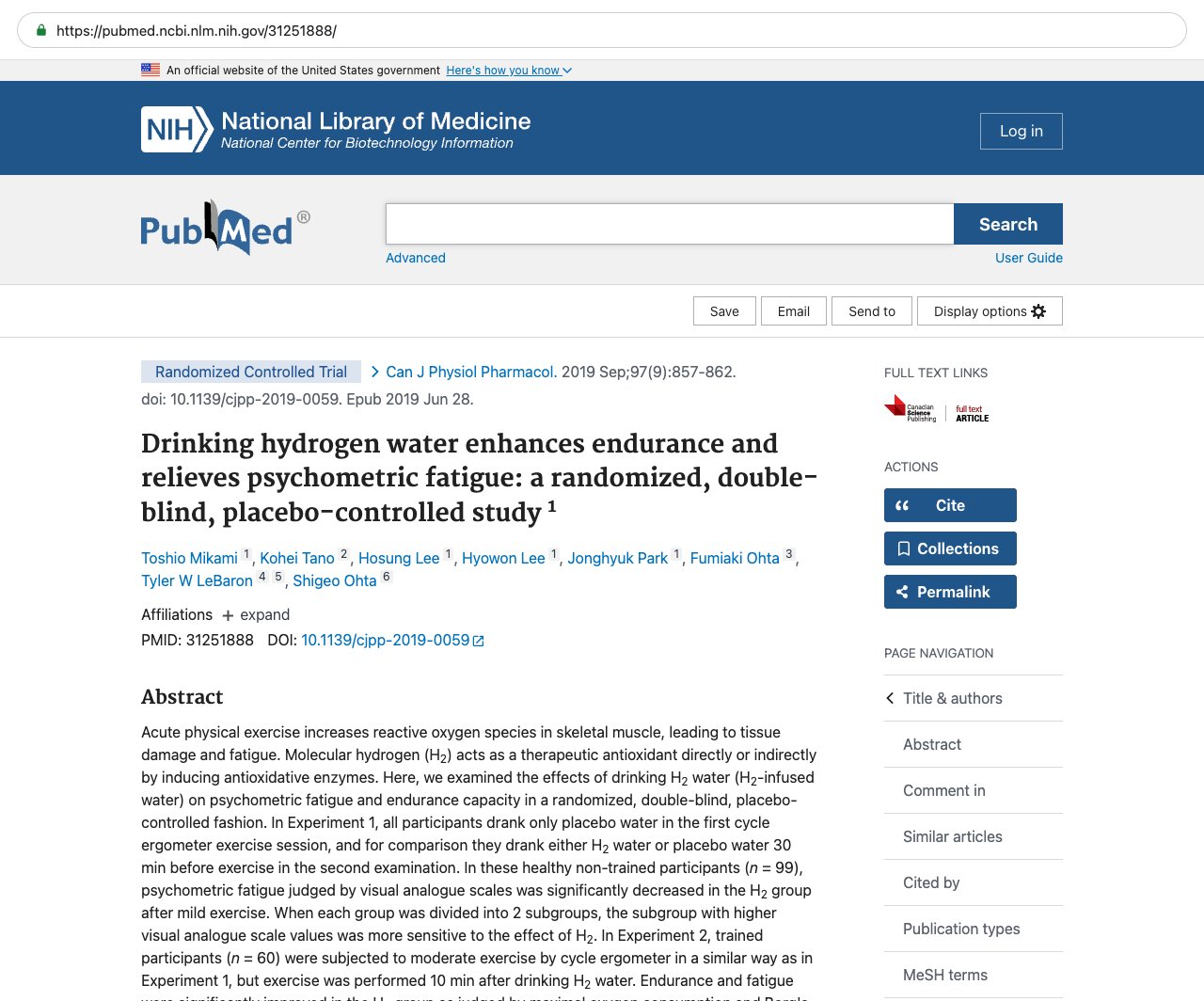
This page mirrors the published abstract (© the authors / publisher) for reference and citation. The canonical source is the PubMed record linked above. This is not medical advice.