2023 · Mohd Noor — A Systematic Review of Molecular Hydrogen Therapy in Cancer Management
Super-Abstract
A systematic review of 27 studies classifies molecular hydrogen as a promising adjunctive cancer therapy. Across different cancer types and H₂ delivery routes, the authors found consistent improvements in survival, quality of life, blood values and tumour reduction. (Asian Pacific J. Cancer Prevention, 2023.)
Commentary
Cancer remains hard to treat, and established therapies are often associated with severe side effects. This systematic review summarises what research knows about molecular hydrogen as an adjunctive cancer therapy. The authors searched Cochrane, PubMed and Google Scholar, screened 677 articles and ultimately included 27 that met their criteria — English-language, full text, within ten years. The reported mechanism: H₂ acts antiproliferatively, antioxidatively, pro-apoptotically and anti-tumourally. Across the different delivery forms, study designs and cancer types, the results were strikingly consistent — improvements in survivability, quality of life, blood parameters and tumour reduction. Important for an honest framing: a review is not a new study of its own but a synthesis — it is only as strong as the individual studies it bundles, and many of those are small or uncontrolled. The authors themselves phrase things deliberately cautiously: H₂ is „worth considering“ as a complement, and more comprehensive research is needed. This is explicitly about an accompanying role, not a replacement for standard therapy.
Key quotes
- „Molecular hydrogen (H2) has been reported to be a promising adjunctive therapy for cancer treatment, having the capability to induce anti-proliferative, anti-oxidative, pro-apoptotic and anti-tumoural effects.“ — the reported mechanisms of action of H₂ in oncology
- „Out of the 677 articles, 27 articles fulfilled the eligibility criteria ... Throughout the different forms of H2 administration, study design and types of cancers reported, outcomes were found to be consistent.“ — methodology and consistent findings across 27 studies
- „H2 plays a promising therapeutic role as an independent therapy as well as an adjuvant in combination therapy, resulting in an overall improvement in survivability, quality of life, blood parameters, and tumour reduction.“ — the authors' overall assessment
Our assessment
A useful overview document that bundles the breadth of H₂ cancer research in one place — well suited to convey plausibility and the state of research without relying on a single small study. It serves as serious evidence that H₂ is being seriously investigated as an adjunctive (adjuvant) option. Limitation, stated honestly: as a review it generates no primary evidence of its own; its strength depends on the quality of the 27 included studies, which are heterogeneous and partly small/uncontrolled, with a risk of publication bias. Important in communication: H₂ is discussed here as a complement to standard therapy, not as a cure or replacement — curative claims would be inadmissible.
Study design
- Type: systematic review · n: 27 included articles (out of 677 screened) · Duration: publications of the last 10 years · H₂ delivery: various forms (across the individual studies)
- Result: consistent improvements in survivability, quality of life, blood parameters and tumour reduction (qualitative synthesis, no pooled effect measures)
Abstract
BACKGROUND: Cancer remains a challenging target to cure, with present therapeutic methods unable to exhibit restorative outcomes without causing severe negative effects. Molecular hydrogen (H2) has been reported to be a promising adjunctive therapy for cancer treatment, having the capability to induce anti-proliferative, anti-oxidative, pro-apoptotic and anti-tumoural effects. This review summarises the findings from various articles on the mechanism, treatment outcomes, and overall effectiveness of H2 therapy on cancer management. METHODS: Using Cochrane, PubMed, and Google Scholar as the search engines, full-text articles in the scope of the study, written in English and within 10 years of publication were selected. RESULTS: Out of the 677 articles, 27 articles fulfilled the eligibility criteria, where data was compiled into a table, outlining the general characteristics and findings. Throughout the different forms of H2 administration, study design and types of cancers reported, outcomes were found to be consistent. CONCLUSION: From our analysis, H2 plays a promising therapeutic role as an independent therapy as well as an adjuvant in combination therapy, resulting in an overall improvement in survivability, quality of life, blood parameters, and tumour reduction. Although more comprehensive research is needed, given the promising outcomes, H2 is worth considering for use as a complement to current cancer therapy.
Source & links
Screenshot of the PubMed page
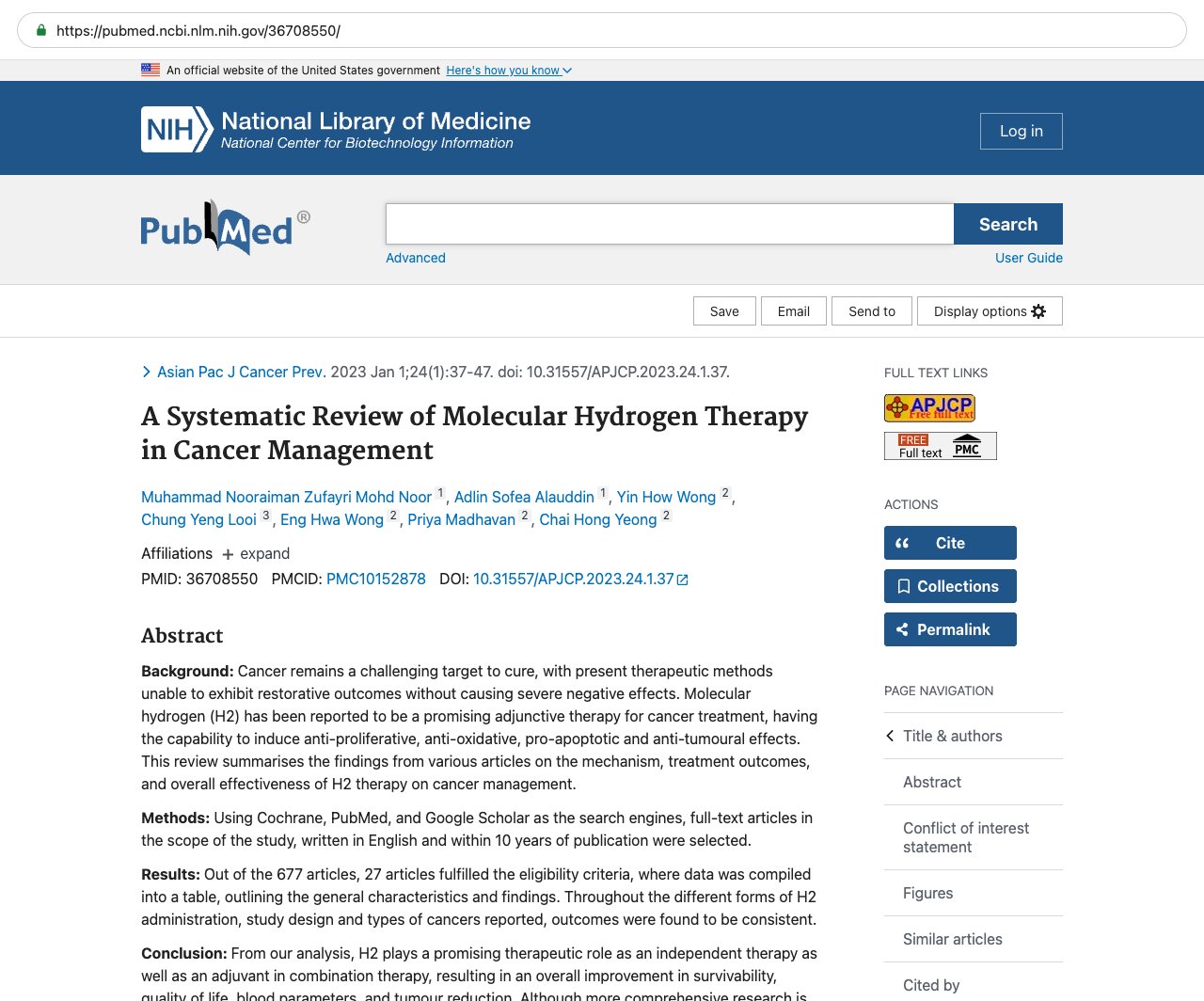
This page mirrors the published abstract (© the authors / publisher) for reference and citation. The canonical source is the PubMed record linked above. This is not medical advice.