2011 · Naeem et al. — Defective protein folding and aggregation as the basis of neurodegenerative diseases: the darker aspect of proteins.
Super-Abstract
When proteins fail to fold correctly, they can form toxic aggregates — a process central to Alzheimer's, Parkinson's, Huntington's, ALS, and other neurodegenerative diseases. This review examines the molecular mechanisms of protein misfolding and aggregation, the role of molecular chaperones in quality control, and the consequences when this system fails. The connection to „hydrogen" in this paper is indirect: intermolecular hydrogen bonding between misfolded protein molecules drives the aggregation process. This is not a study of molecular H₂ as a therapeutic gas.
Commentary
This review is a protein biochemistry and disease mechanism paper, not a molecular hydrogen biology study. The word „hydrogen" in the abstract refers to intermolecular hydrogen bonds (H-bonds) — chemical bonds between protein chains that stabilize pathological protein aggregates such as amyloid fibrils. This is a fundamental concept in structural biochemistry and has no direct connection to molecular hydrogen (H₂) gas as a therapeutic or antioxidant agent. The paper provides a useful scientific review of the molecular basis of conformational diseases (prion-like protein aggregation diseases), but appears in H₂ research databases solely due to keyword overlap. Researchers interested in H₂ and neurodegeneration should search specifically for studies where H₂ is the intervention.
Key quotes
- „Partially folded and misfolded proteins that escape the cellular quality control mechanism have the high tendency to form inter-molecular hydrogen bonding between the same protein molecules resulting in aggregation.“ — the key sentence: „hydrogen" here means H-bonds between proteins — not H₂ gas
- „Every polypeptide has a finite tendency to misfold and this forms the darker side of the protein world.“ — the conceptual framing — protein misfolding as a universal risk
- „This will encourage a more proactive approach to the early diagnosis of conformational diseases and nutritional counseling for patients.“ — the authors' practical outlook — diagnosis and nutrition, not H₂ therapy
Our assessment
This paper is not relevant to molecular hydrogen (H₂) therapy or biology. It reviews the mechanisms of protein misfolding and aggregation in neurodegenerative diseases. The term „hydrogen" refers to intermolecular hydrogen bonds in protein aggregates — a standard biochemical concept with no connection to dissolved H₂ gas. No conclusions about H₂ health effects can be drawn from this study. It appears in H₂ research databases as an indexing artifact.
Study design
- Type: narrative review (protein biochemistry / disease mechanism) · n: n/a (literature synthesis) · H₂ relevance: none — „hydrogen" refers to intermolecular H-bonds in protein aggregation, not to H₂ gas
- Result: no experimental data; reviews protein folding/misfolding mechanisms, chaperone function, and aggregation pathways in Alzheimer's, Parkinson's, Huntington's, ALS, cystic fibrosis, and cancer
Abstract
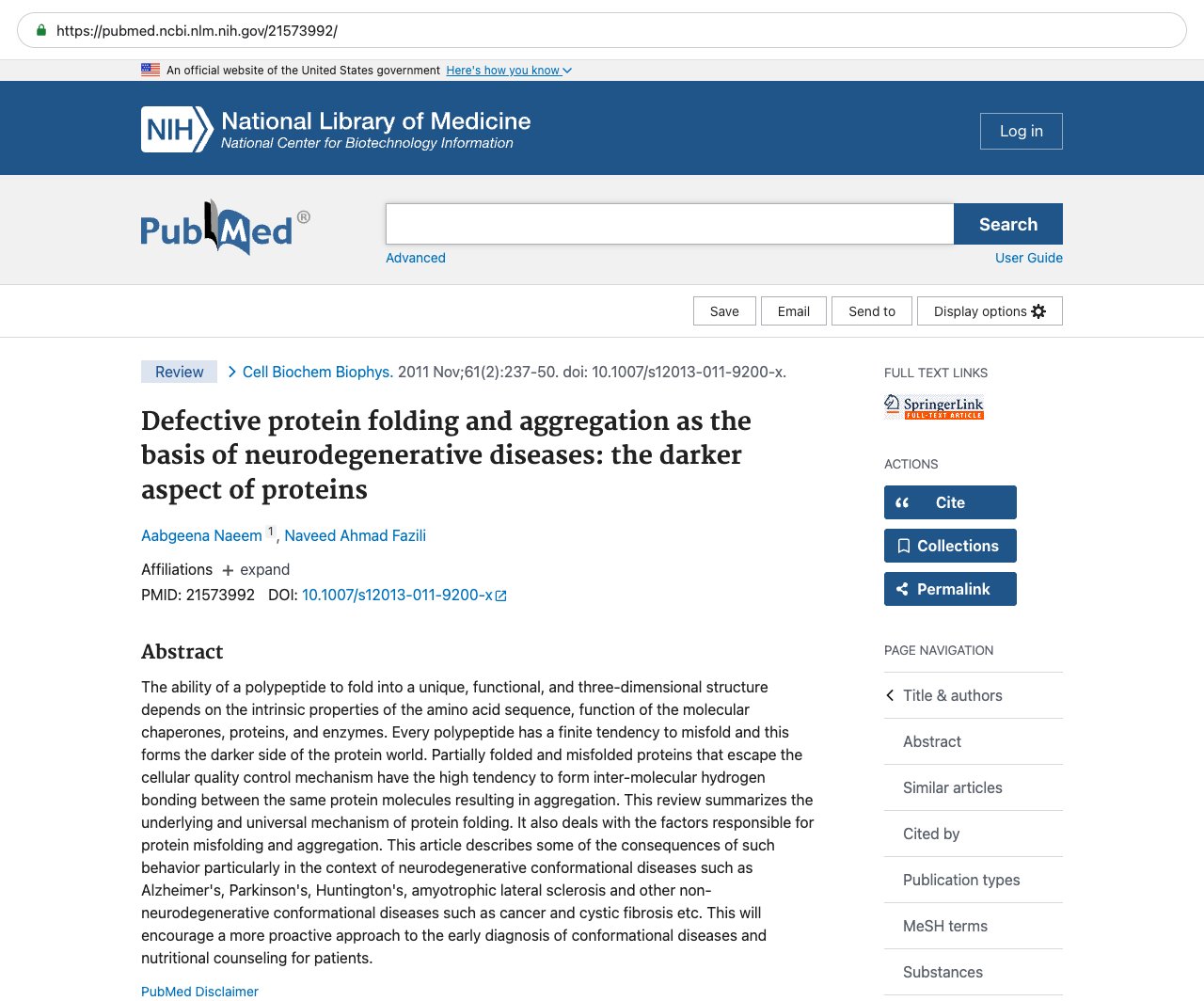
The ability of a polypeptide to fold into a unique, functional, and three-dimensional structure depends on the intrinsic properties of the amino acid sequence, function of the molecular chaperones, proteins, and enzymes. Every polypeptide has a finite tendency to misfold and this forms the darker side of the protein world. Partially folded and misfolded proteins that escape the cellular quality control mechanism have the high tendency to form inter-molecular hydrogen bonding between the same protein molecules resulting in aggregation. This review summarizes the underlying and universal mechanism of protein folding. It also deals with the factors responsible for protein misfolding and aggregation. This article describes some of the consequences of such behavior particularly in the context of neurodegenerative conformational diseases such as Alzheimer's, Parkinson's, Huntington's, amyotrophic lateral sclerosis and other non-neurodegenerative conformational diseases such as cancer and cystic fibrosis etc. This will encourage a more proactive approach to the early diagnosis of conformational diseases and nutritional counseling for patients.
Source & links
Screenshot of the PubMed page
This page mirrors the published abstract (© the authors / publisher) for reference and citation. The canonical source is the PubMed record linked above. This is not medical advice.