2023 · Najmanová — Effect of Acute Hydrogen-Rich Water Intake on Intraocular Pressure in Healthy Subjects
Super-Abstract
Rapidly drinking 1260 ml of fluid raises intraocular pressure — and with hydrogen-rich water (HRW) it does so clinically relevantly more often than with placebo. In this randomized double-blind crossover study (24 healthy subjects), intraocular pressure rose by up to 2.7 mmHg on average after HRW; in 58 % of HRW drinkers the rise was clinically meaningful (placebo: 25 %). (Česká a slovenská oftalmologie, 2023 — an important safety signal for glaucoma risk groups.)
Commentary
This study is interesting precisely because it does not show the usual benefit aspect of hydrogen but honestly examines a safety question — and exactly such studies belong in a serious database. The design is clean: randomized, double-blind, crossover, 24 healthy subjects (5 men, 19 women, 20–33 years), each subject received H₂ water on one day and hydrogen-free placebo on another. In both cases, 1260 ml was drunk in just 15 minutes. The result: both waters raised intraocular pressure significantly — this is the well-known „water-drinking test“ effect, caused by the rapid large fluid volume, not by hydrogen itself. The maximum rise was 2.7 mmHg (HRW, minute 25) versus 1.4 mmHg (placebo, minute 35). What is notable, though: with HRW the rise was clinically relevant far more often (58 % vs. 25 %). Corneal thickness did not change. From this the authors draw the cautious conclusion that rapid HRW drinking could pose a higher risk for risk groups such as glaucoma patients — but this must first be confirmed by further studies in those groups. To be honest: the sample is small and healthy, the effect comes mainly from the drinking volume, and the difference from placebo concerns the frequency of clinically relevant rises, not the mean.
Key quotes
- „Administration of both HRW and the placebo caused a significant increase in IOP.“ — the pressure rise comes primarily from the rapid drinking volume, not specifically from hydrogen
- „there were significantly more clinically significant individual IOP increases after HRW intake (58%) compared to the placebo (25%).“ — the actual HRW-specific difference: more frequent clinically relevant rises
- „in the case of risk groups such as subjects with glaucoma, ocular hypertension or suspected glaucoma, it is necessary to verify this conclusion by further studies.“ — honest caveat: still unclear for risk groups
Our assessment
This study is valuable because it shows seriousness: not only positive findings are collected but also safety/caution signals. The clean differentiation is important — the main rise in intraocular pressure is a known effect of rapidly taking in large fluid volumes (1260 ml in 15 minutes is an extreme drinking amount, not normal drinking behaviour) and is not attributable to hydrogen. The HRW-specific effect (more frequent clinically relevant rises) is hypothesis-generating, not conclusive. Practical consequence: drink H₂ water in normal portions spread over the day; those affected by glaucoma should consult their ophthalmologist. Limitation, stated honestly: small sample (n = 24), only healthy young adults, examines an unrealistically high rapid-drinking volume, no glaucoma patients tested.
Study design
- Type: RCT, randomized/double-blind/crossover · n: 24 healthy subjects (5 m / 19 f, 20–33 yrs) · Duration: 75 min measurement window per experiment day · H₂ delivery: 1260 ml hydrogen-rich water (HRW) in 3 doses over 15 min, vs. hydrogen-free placebo
- Result: max. intraocular pressure rise HRW 2.7 ± 2.0 mmHg (min. 25) vs. placebo 1.4 ± 2.0 mmHg (min. 35); no significant mean difference between the parts; clinically relevant individual rises HRW 58 % vs. placebo 25 %; corneal thickness (CCT) unchanged
Abstract
PURPOSES: The primary aim of the study was to assess the response of intraocular pressure (IOP) to the acute ingestion of hydrogen-rich water (HRW) compared to hydrogen-free water (placebo) in healthy subjects. The effect of HRW intake on central corneal thickness (CCT) was also monitored. SUBJECTS AND METHODS: Twenty-four healthy volunteers (5 men, 19 women) aged between 20 and 33 were included in the study, in which one eye of each subject was measured. The study was prospective, randomized and double-blind, with crossover design. Each subject underwent two parts of the experiment, each part on a different day and in random order. In each part of experiment, a total volume of 1260 ml of HRW or placebo was administered over 15 minutes in three doses. IOP and CCT were measured before and during the course of 75 minutes from the start of the HRW or placebo intake. RESULTS: Administration of both HRW and the placebo caused a significant increase in IOP. The maximum IOP increase was 2.7 mmHg ±2.0 mmHg in minute 25 after the commencement of the experiment (HRW intake), and 1.4 mmHg ±2.0 mmHg in minute 35 (placebo intake). The values of IOP did not differ significantly between both parts, but there were significantly more clinically significant individual IOP increases after HRW intake (58%) compared to the placebo (25%). CCT did not change significantly during the experiment. CONCLUSION: The rapid intake of 1260 ml of both HRW and hydrogen-free water causes a statistically significant increase in IOP compared to the baseline in healthy individuals. In the case of HRW, the increase was also clinically significant in most of the subjects. Thus, the results indicate that acute intake of HRW may pose a higher risk than placebo intake in terms of IOP. However, in the case of risk groups such as subjects with glaucoma, ocular hypertension or suspected glaucoma, it is necessary to verify this conclusion by further studies.
Source & links
Screenshot of the PubMed page
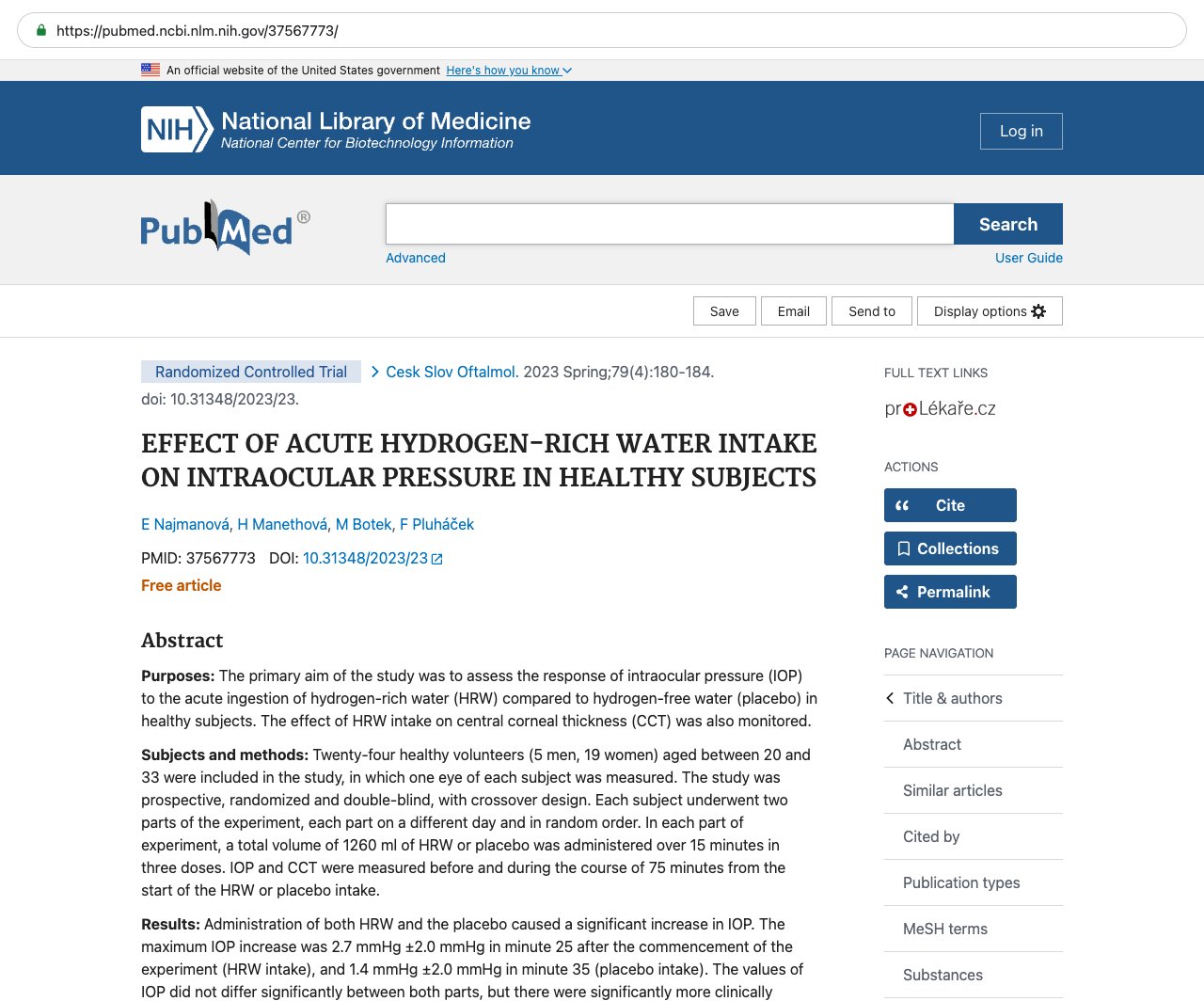
This page mirrors the published abstract (© the authors / publisher) for reference and citation. The canonical source is the PubMed record linked above. This is not medical advice.