1994 · Nakahara et al. — Evaluation of tracheal mucosal blood flow during an extended radical operation for esophageal carcinoma
Super-Abstract
Extended radical surgery for esophageal cancer significantly reduced tracheal mucosal blood flow, from 40 to 13 ml/100 g per minute, while preserving the right bronchial artery appeared protective. The hydrogen gas clearance method was used as a blood flow measurement tool during surgery — not as a therapeutic agent. (Surgery Today, 1994.)
Commentary
This is a surgical physiology study examining how radical lymph node dissection during esophageal cancer surgery affects tracheal blood supply. The hydrogen gas clearance method serves as a real-time vascular monitoring tool: a probe on the endotracheal cuff detects how quickly inhaled hydrogen washes out of the tracheal mucosa — faster washout equals higher blood flow, slower washout signals ischemia. This is a purely diagnostic, research-grade vascular physiology technique with no connection to molecular hydrogen therapy. The study also uses a dog model for the experimental component.
Key quotes
- „The tracheal mucosal blood flow was 40.1 ml/100 g per minute after they had undergone a right thoracotomy and then decreased to 13.0 ml/100 g per minute after they had further received an extended radical operation preserving the right bronchial artery.“ — dramatic intraoperative reduction in tracheal perfusion despite bronchial artery preservation
- „The right bronchial artery contributes about one-third of the total blood flow to the trachea.“ — surgical anatomy finding — clinically important for avoiding tracheal ischemia
- „Using the hydrogen gas clearance method, a plate-type probe was attached to the surface of the cuff of an endotracheal tube in order to measure the ischemic changes in the tracheal mucosa.“ — H₂ clearance as intraoperative blood flow monitoring — not therapeutic
Our assessment
Important context: this study does not investigate molecular hydrogen (H₂) as a therapeutic intervention. Hydrogen gas clearance is used as an intraoperative vascular physiology measurement technique. Additionally, the experimental component uses a dog model, with human data limited to 8 surgical patients. Limitations: small human cohort (n = 8), combined human/animal design, highly specialised surgical setting. Not relevant to H₂ therapy.
Study design
- Type: surgical observational study + animal experiment · n (human): 8 patients with intrathoracic esophageal carcinoma · H₂ delivery: inhalation as intraoperative blood flow measurement tool — not therapeutic
- Result: tracheal mucosal blood flow fell from 40.1 to 13.0 ml/100 g/min during extended radical surgery; right bronchial artery provides ~33% of tracheal blood supply; no tracheal ulcers observed
Abstract
Using the hydrogen gas clearance method, a plate-type probe was attached to the surface of the cuff of an endotracheal tube in order to measure the ischemic changes in the tracheal mucosa produced by peritracheal lymph node dissection. In eight human subjects with intrathoracic esophageal carcinoma, the tracheal mucosal blood flow was 40.1 ml/100 g per minute after they had undergone a right thoracotomy and then decreased to 13.0 ml/100 g per minute after they had further received an extended radical operation preserving the right bronchial artery. No tracheal ulcers were seen. The same ischemic changes in the tracheal mucosa were also measured in dogs. The right bronchial artery contributes about one-third of the total blood flow to the trachea and this was thus calculated to be about 10-14 ml/100 g per minute.
Source & links
Screenshot of the PubMed page
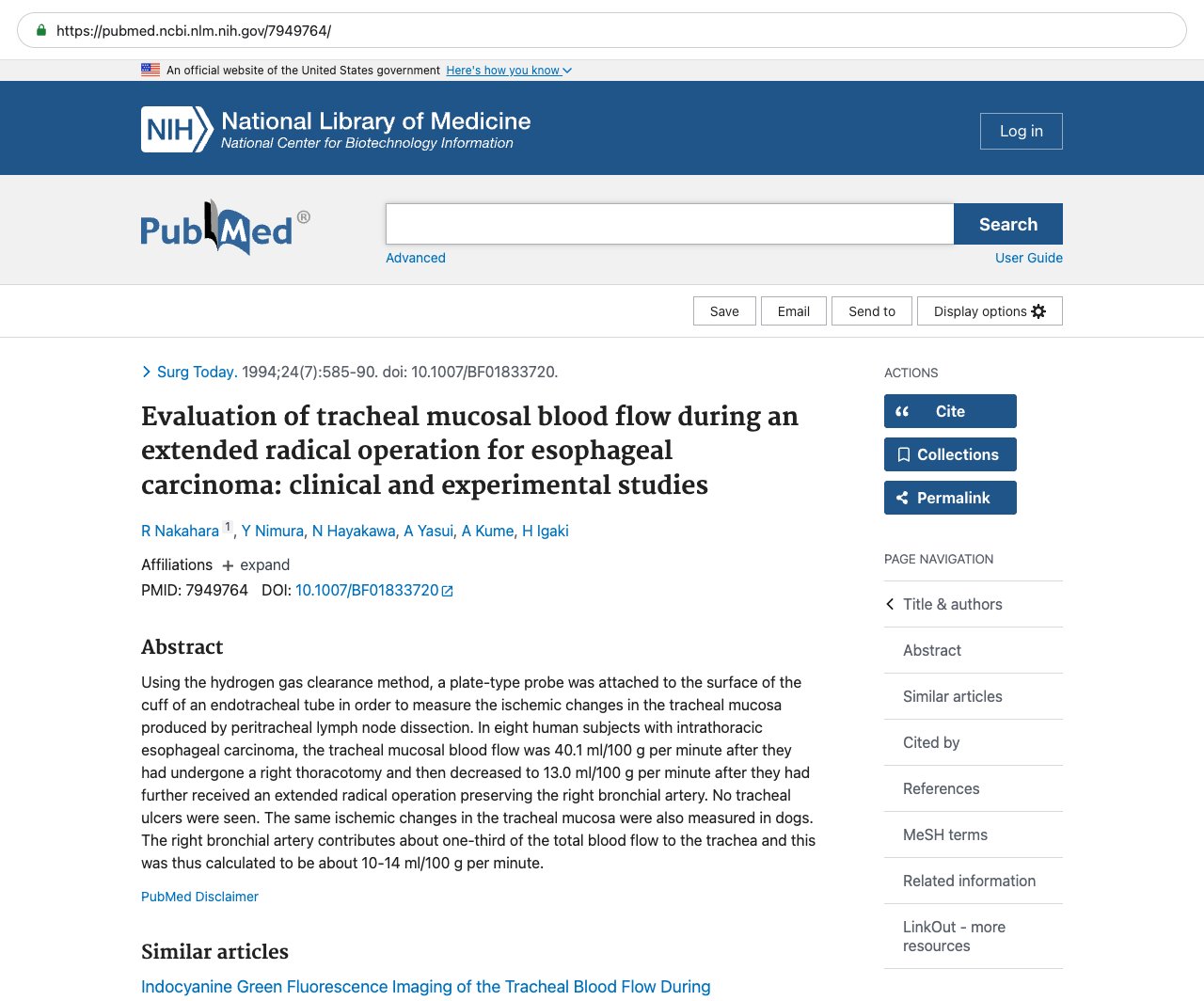
This page mirrors the published abstract (© the authors / publisher) for reference and citation. The canonical source is the PubMed record linked above. This is not medical advice.