2018 · Nakayama — Novel Haemodialysis Treatment Employing Molecular Hydrogen-Enriched Dialysis Solution Improves Prognosis of Chronic Dialysis Patients: A Prospective Observational Study
Super-Abstract
Over a mean observation period of 3.28 years, chronic haemodialysis patients treated with H₂-enriched dialysis solution had a 41% lower risk of combined all-cause mortality and major cardiovascular events compared to conventional haemodialysis (hazard ratio 0.59, 95% CI 0.38–0.92). This is one of the largest and longest H₂ outcome studies in a high-risk patient population. (Scientific Reports, 2018.)
Commentary
Chronic kidney disease patients on haemodialysis carry an exceptionally high burden of cardiovascular morbidity and mortality. Oxidative stress and inflammation — both of which H₂ is known to modulate — are particularly pronounced during dialysis due to the contact of blood with the dialysis membrane. Nakayama's group developed a novel haemodialysis system (E-HD) that delivers H₂-enriched dialysis solution (30–80 ppb) by in-line water electrolysis, thereby delivering H₂ directly into the bloodstream during each session — a fundamentally different route from drinking or inhalation. The prospective observational study enrolled 309 prevalent chronic HD patients allocated to E-HD (n=161) or conventional HD (n=148). The primary composite endpoint was all-cause mortality and non-lethal cardio-cerebrovascular events over a mean 3.28 years. E-HD patients had 41 events vs. 50 in the C-HD group. Multivariate Cox regression identified E-HD as an independent protective factor (HR 0.59, P significant) after adjustment for age, cardiovascular history, albumin, and CRP. Additionally, E-HD patients showed amelioration of post-dialysis hypertension with reduced need for antihypertensive medications.
Key quotes
- „Multivariate analysis of the Cox proportional hazards model revealed E-HD as an independent significant factor for the primary endpoint (hazard ratio 0.59; [95% confidence interval: 0.38-0.92]) after adjusting for confounding factors.“ — the key survival analysis: 41% risk reduction, independent of major confounders
- „post-dialysis hypertension was ameliorated with significant reductions in antihypertensive agents in the E-HD patients.“ — secondary benefit: blood pressure improvement — clinically relevant and objective
- „HD applying an H2-dissolved HD solution could improve the prognosis of chronic HD patients.“ — the authors' clinical conclusion after 3+ years of follow-up
Our assessment
This is one of the most impressive H₂ clinical studies in terms of outcome relevance — a 41% hazard reduction in all-cause mortality plus cardiovascular events over 3+ years in a high-risk population is clinically meaningful if valid. Published in Scientific Reports (Nature group). Limitations: this is a non-randomized, non-blinded observational study — allocation to E-HD vs. C-HD was not random, and residual confounding cannot be excluded despite the multivariate adjustment; both groups received identical dialysis protocols except for H₂, but baseline differences between groups are not fully described; 30–80 ppb H₂ is a relatively low concentration compared to drinking water studies; the study is from a single research group in Japan. These limitations mean this study, while compelling, cannot be considered proof of causal efficacy — a randomized controlled trial is urgently needed to confirm this result.
Study design
- Type: non-randomized, non-blinded, prospective observational study · n: 309 (E-HD: 161; C-HD: 148) · H₂ delivery: H₂-enriched dialysis solution (30–80 ppb) via in-line water electrolysis during standard haemodialysis sessions
- Follow-up: mean 3.28 years · Primary endpoint: composite of all-cause mortality + non-lethal cardio-cerebrovascular events (cardiac disease, stroke, peripheral arterial amputation)
- Result: 41 events E-HD vs. 50 events C-HD; HR 0.59 (95% CI 0.38–0.92) after multivariate adjustment; post-dialysis hypertension reduced; antihypertensive medication significantly reduced in E-HD group
Abstract
Recent studies have revealed unique biological characteristics of molecular hydrogen (H2) as an anti-inflammatory agent. We developed a novel haemodialysis (E-HD) system delivering an H2 (30-80 ppb)-enriched dialysis solution by water electrolysis, and conducted a non-randomized, non-blinded, prospective observational study exploring its clinical impact. Prevalent chronic HD patients were allocated to either the E-HD (n = 161) group or the conventional HD (C-HD: n = 148) group, and received the respective HD treatments during the study. The primary endpoint was a composite of all-cause mortality and development of non-lethal cardio-cerebrovascular events (cardiac disease, apoplexy, and leg amputation due to peripheral artery disease). During the 3.28-year mean observation period, there were no differences in dialysis parameters between the two groups; however, post-dialysis hypertension was ameliorated with significant reductions in antihypertensive agents in the E-HD patients. There were 91 events (50 in the C-HD group and 41 in the E-HD group). Multivariate analysis of the Cox proportional hazards model revealed E-HD as an independent significant factor for the primary endpoint (hazard ratio 0.59; [95% confidence interval: 0.38-0.92]) after adjusting for confounding factors (age, cardiovascular disease history, serum albumin, and C-reactive protein). HD applying an H2-dissolved HD solution could improve the prognosis of chronic HD patients.
Source & links
Screenshot of the PubMed page
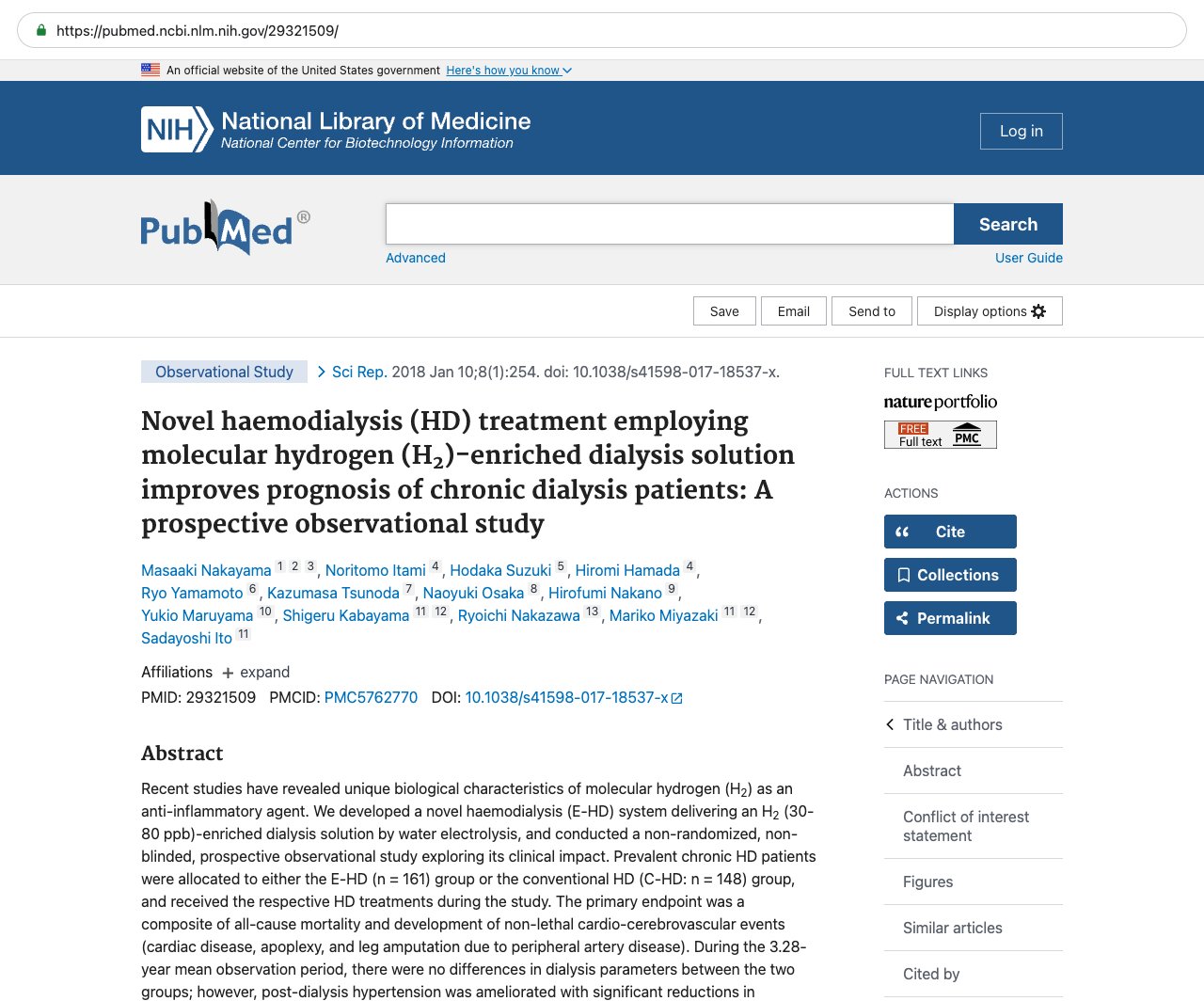
This page mirrors the published abstract (© the authors / publisher) for reference and citation. The canonical source is the PubMed record linked above. This is not medical advice.