2025 · Nakayama et al. — Hemodialysis Employing Molecular Hydrogen (H₂) Enriched Dialysis Solution May Improve Dialysis-Related Fatigue Through Impact on Energy Metabolism
Super-Abstract
Fatigue is one of the most debilitating aspects of life on hemodialysis — and it remains largely unaddressed by standard care. This prospective study of 81 hemodialysis patients over 12 months found that H₂-enriched electrolytic hemodialysis (E-HD) significantly reduced fatigue specifically in patients who had fatigue with activity reduction at baseline, while patients without fatigue remained unaffected. Metabolic pathway analysis points to altered energy metabolism — fatty acid metabolism, citric acid cycle, glycolysis — as a possible mechanism. (Scientific Reports, 2025.)
Commentary
This is one of the more methodologically substantial H₂ studies in this batch. With 81 patients, a 12-month follow-up, subgroup stratification by fatigue type, body composition analysis, and enrichment-based metabolomics, it goes well beyond a case report. The finding that E-HD selectively reduces fatigue only in those who had fatigue with activity reduction (Group A) — while leaving fatigue-free patients (Group C) unchanged — is a precision-medicine signal: H₂ appears to restore a dysregulated metabolic state rather than blanket-suppressing a physiological process. The metabolomics enrichment data, showing differences in fatty acid oxidation and citric acid cycle activity at baseline between fatigued and non-fatigued patients, is the mechanistic backbone — and these pathway differences were mitigated by E-HD. Body composition changes (reduced fat, increased muscle mass in Group A2) further support a metabolic mechanism. Limitations: no control arm without H₂ dialysis — all 81 patients received E-HD.
Key quotes
- „Over the 12 months after E-HD initiation, fatigue in Group A significantly decreased, while no changes in Group-B and C.“ — selective fatigue reduction — only in those with baseline fatigue and activity impairment
- „Enrichment analysis suggested significant differences in metabolic pathways such as fatty acid metabolism, citric acid cycle, and glycolysis between Groups A and C at baseline, and these differences were mitigated by E-HD.“ — metabolomics evidence for a metabolic mechanism of H₂ anti-fatigue effect
- „E-HD may represent a new paradigm for uremia treatment beyond traditional solute removal-based dialysis therapies.“ — authors' broader claim: H₂-enriched dialysis as a conceptual advance in nephrology
Our assessment
This is the strongest study in this batch — prospective, n=81, 12-month follow-up, metabolomics, body composition — though it lacks a randomized control arm. All patients received E-HD (no standard HD comparison), so the improvement in Group A cannot be attributed exclusively to H₂ versus other aspects of the treatment protocol. The subgroup finding is biologically coherent and the metabolomics data provide mechanistic depth. Honest note on body composition: the significant reduction in body fat and increase in muscle mass in Group A2 (fatigue only on dialysis days) without significant weight change is a surprising and potentially important finding that deserves independent replication. The authors' claim of a „new paradigm“ is aspirational but not unreasonable given the biological plausibility and 12-month durability of the effect.
Study design
- Type: prospective single-arm cohort · n: 81 patients on standard hemodialysis (Group A fatigue+activity reduction n=25, Group B fatigue only n=24, Group C no fatigue n=32) · H₂ delivery: electrolysis-generated H₂-enriched dialysis solution (E-HD), 12 months
- Endpoints: fatigue (validated questionnaire), body composition (bio-impedance), metabolomics (enrichment pathway analysis)
- Result: significant fatigue decrease in Group A only; Group A2 showed body fat reduction + muscle mass increase; metabolic pathway differences (fatty acid metabolism, TCA cycle, glycolysis) at baseline mitigated by E-HD; no significant changes in Groups B and C
Abstract
Hemodialysis employing molecular hydrogen (H2)-enriched dialysis solution rendered by water electrolysis (E-HD), has been reported to alleviate dialysis-related fatigue, but its association with metabolic profiles remains unclear. Eighty-one patients undergoing standard HD were classified into 3 groups [Group A (n = 25, 30.9%): fatigue with activity reduction-subgroups A1: chronic persistent fatigue (n = 11), A2: fatigue only on dialysis days (n = 14); Group B: fatigue without activity reduction (n = 24, 29.6%); Group C (n = 32, 39.5%): no fatigue], and their changes in fatigue, body composition, and metabolic profiles were studied following 12 months of E-HD. There were no significant differences in baseline characteristics among the groups. Over the 12 months after E-HD initiation, fatigue in Group A significantly decreased, while no changes in Group-B and C. Bio-impedance analysis revealed no significant changes in A1, but significant reductions in body fat and increases in skeletal muscle mass were observed despite no significant weight change in A2. Enrichment analysis suggested significant differences in metabolic pathways such as fatty acid metabolism, citric acid cycle, and glycolysis between Groups A and C at baseline, and these differences were mitigated by E-HD. E-HD could suppress dialysis-related fatigue, through possible involvement of altered energy metabolism of patients. E-HD may represent a new paradigm for uremia treatment beyond traditional solute removal-based dialysis therapies.
Source & links
Screenshot of the PubMed page
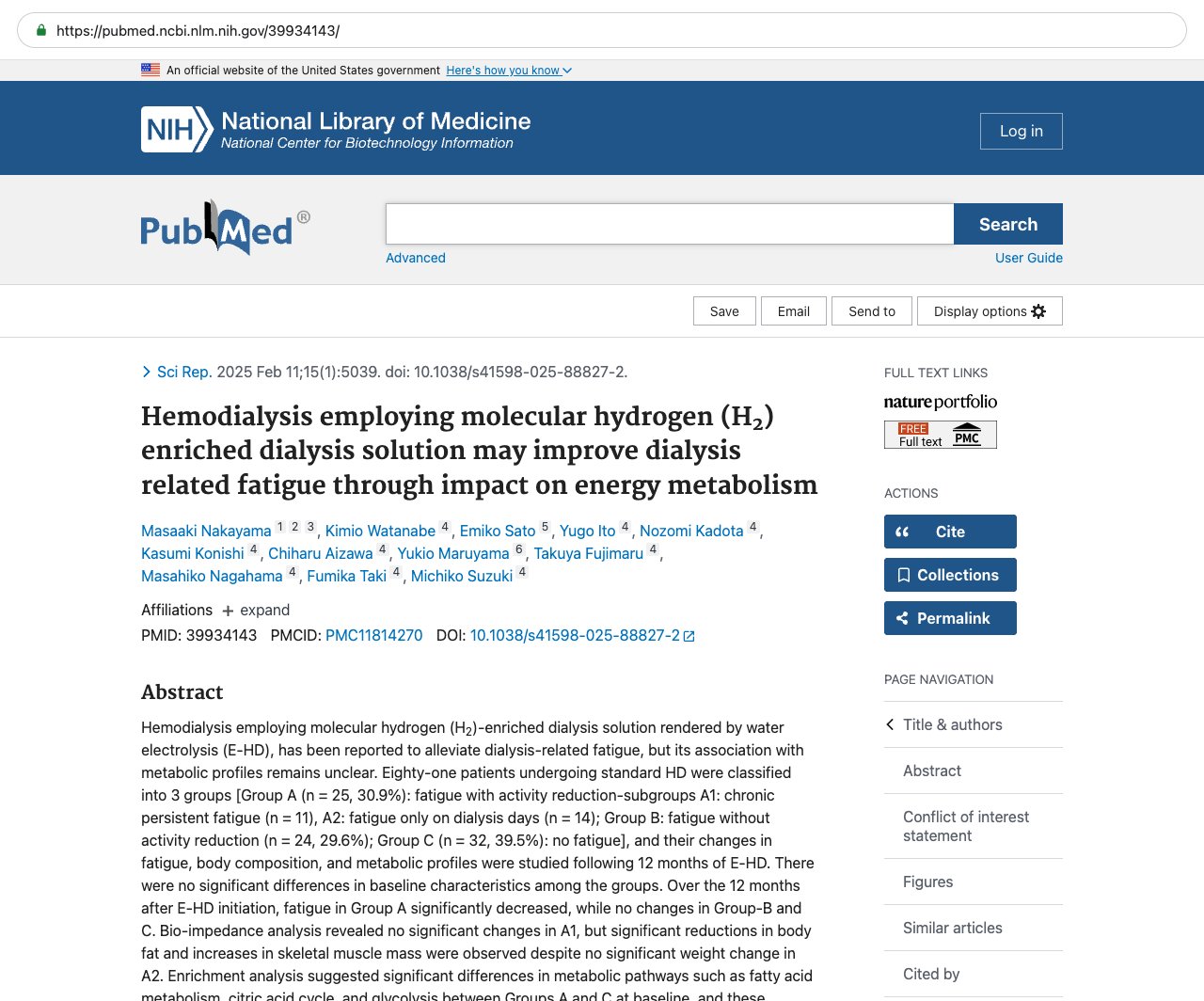
This page mirrors the published abstract (© the authors / publisher) for reference and citation. The canonical source is the PubMed record linked above. This is not medical advice.