1988 · Neale — Dietary Fibre and Health: The Role of Hydrogen Production
Super-Abstract
A hypothesis paper proposing that molecular hydrogen, produced in large amounts during gut fermentation of dietary fibre, may be a key mediator of fibre's protective health effects — acting as a natural antioxidant against damaging free radicals in body tissues. This early 1988 work predates the modern H₂ therapy field by nearly two decades, yet anticipates its central mechanism. (Medical Hypotheses, 1988.)
Commentary
Neale's paper is historically remarkable: it was published in 1988 — almost 20 years before the landmark Ohsawa et al. 2007 Nature Medicine study that launched the modern H₂ therapy field — and already articulated the core hypothesis that endogenous H₂ from gut fermentation functions as a selective antioxidant against singlet oxygen and other reactive oxygen species. The author links the epidemiological observation that high-fibre diets correlate with lower disease incidence to the metabolic production of H₂ by colonic bacteria. While the paper is a hypothesis with no primary experimental data, it laid conceptual groundwork that later researchers confirmed. The irony: one of the most ordinary components of human gut metabolism may have been quietly contributing to health all along. This also raises the question whether the therapeutic effects attributed to H₂-rich water or H₂ inhalation in later clinical trials partly replicate an effect that fibre-rich diets already achieve endogenously.
Key quotes
- „molecular hydrogen, produced in quite large amounts as a by-product of colonic fermentation of dietary fibre and unabsorbed carbohydrate may play an important role.“ — the central hypothesis: gut-derived H₂ as health mediator
- „Hydrogen in the tissues may act as a powerful reducing agent (antioxidant) of potentially damaging free radical species (e.g. singlet oxygen) and in so doing, along with other antioxidants would help in the control of these potentially damaging species and their known involvement in disease causation.“ — the proposed antioxidant mechanism — stated 19 years before Ohsawa 2007
Our assessment
This is a hypothesis paper with no primary data — no clinical trial, no animal experiment, no in-vitro assay is presented. Its value is purely conceptual and historical: it correctly anticipated the selective antioxidant hypothesis of H₂ that became the foundation of modern H₂ medicine. It should be cited as conceptual background, not as evidence. Limitations: no experimental data; speculative by design; the proposed mechanism (reduction of singlet oxygen by H₂ in tissues) was not directly tested here; the paper does not distinguish between endogenously produced H₂ and exogenously administered H₂.
Study design
- Type: hypothesis / theoretical paper · n: n/a (no experimental component) · H₂ source: endogenous colonic fermentation of dietary fibre (not administered H₂)
- Result: no measured outcomes; theoretical proposal that gut-produced H₂ acts as a tissue antioxidant and mediates the health benefits of dietary fibre · Experimental evidence: none in this paper
Abstract
The biological basis for the epidemiological association between high dietary fibre intakes and reduced disease incidence in Man is not fully understood. It is proposed that molecular hydrogen, produced in quite large amounts as a by-product of colonic fermentation of dietary fibre and unabsorbed carbohydrate may play an important role. Hydrogen in the tissues may act as a powerful reducing agent (antioxidant) of potentially damaging free radical species (e.g. singlet oxygen) and in so doing, along with other antioxidants would help in the control of these potentially damaging species and their known involvement in disease causation.
Source & links
Screenshot of the PubMed page
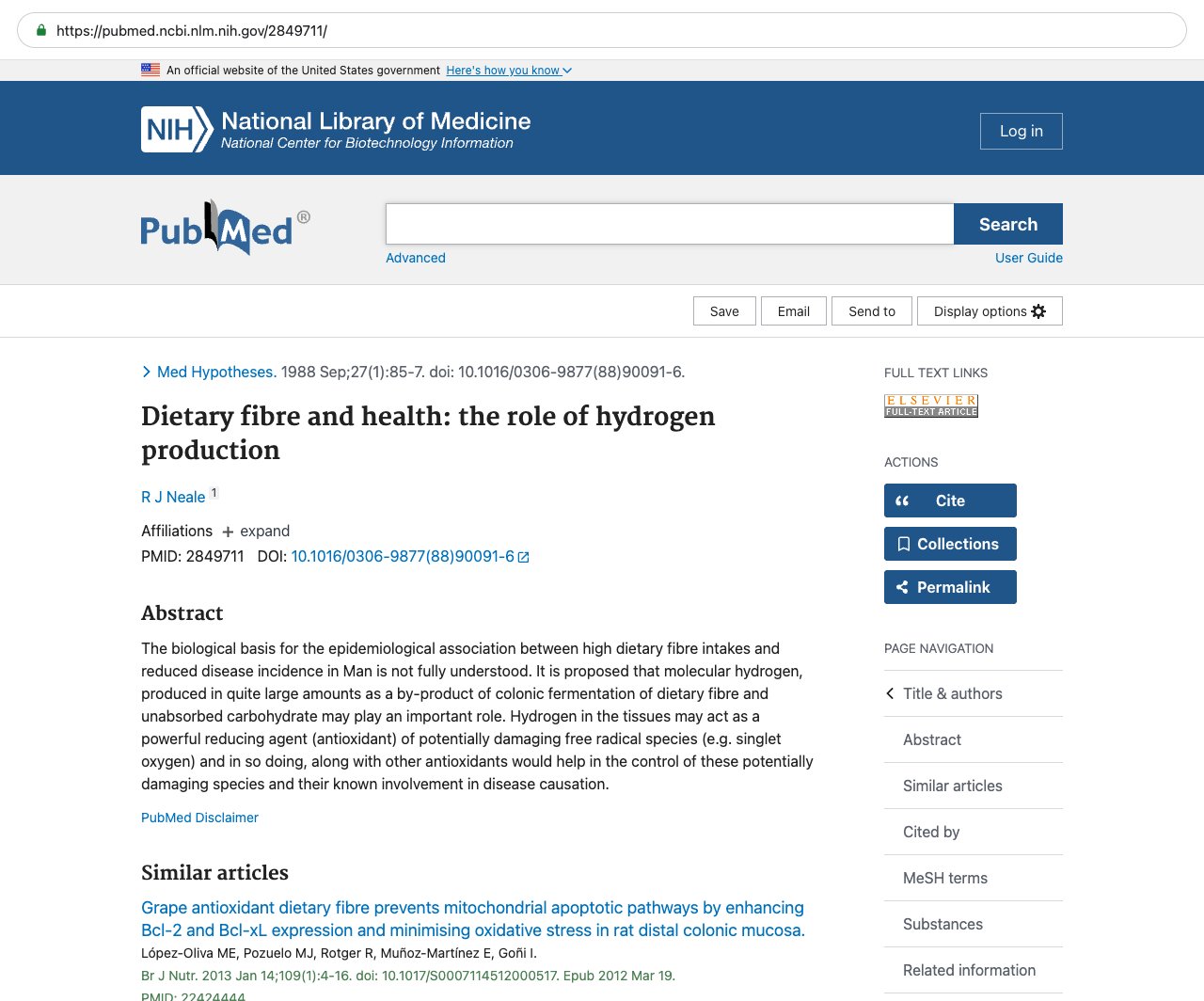
This page mirrors the published abstract (© the authors / publisher) for reference and citation. The canonical source is the PubMed record linked above. This is not medical advice.