1987 · Niggemann et al. — Detection of Intracardiac Left-to-Right Shunting in Adults: A Prospective Analysis of the Variability of the Standard Indocyanine Green Technique
Super-Abstract
In 66 adult patients confirmed shunt-free by the ultrasensitive hydrogen inhalation method, the indocyanine green dye technique showed percentage „shunts“ ranging from −9 % to +26 % — establishing for the first time the normal variability range for this diagnostic test. The practical implication: indocyanine green results below +26 % cannot reliably diagnose a true shunt. (The American Journal of Cardiology, 1987.)
Commentary
This study uses hydrogen inhalation as the reference truth — because H₂ inhalation is known to be the most sensitive technique for detecting even very small left-to-right intracardiac shunts. In 66 patients where H₂ inhalation confirmed no shunting existed, indocyanine green curves were generated. The resulting variability data defines the normal range for indocyanine green: up to +26 % apparent „shunting“ can occur even with no real shunt. This prevents false-positive diagnoses. H₂ is not a therapy here — it is the diagnostic gold standard used to confirm patient selection. This is a cardiac catheterisation methodology paper.
Key quotes
- „In 66 adult patients in whom hydrogen inhalation (an extremely sensitive technique for detecting even very small intracardiac left-to-right shunts) revealed no shunting, indocyanine green curves were generated.“ — H₂ inhalation as the gold-standard comparator to select true-negative patients
- „the percentage left-to-right shunt...ranged from -9% to +26% (+7 +/- 8%, mean +/- standard deviation).“ — the normal variability range for indocyanine green — the key finding
- „If this technique is to be used reliably to detect shunting, its results must demonstrate a percentage shunt in excess of +26%.“ — the diagnostic threshold for reliable indocyanine green interpretation
Our assessment
Important note on scope: This is a cardiac diagnostic methodology study. H₂ inhalation is used as the gold-standard method to confirm absence of shunting — it is the reference comparator, not a therapeutic intervention. The study is methodologically clean and the clinical impact is meaningful (establishing the normal range for a widely used diagnostic test). No H₂ therapy relevance. Limitations: the n = 66 is adequate for establishing a normal range but limited to adult patients; single-centre prospective design; H₂ as reference tool only.
Study design
- Type: prospective diagnostic methodology study · n: 66 adult patients (confirmed shunt-free by H₂ inhalation) · H₂ delivery: inhalation as gold-standard reference method to confirm no shunting — not therapeutic
- Result: indocyanine green normal variability range established (−9 % to +26 %); reliable shunt detection requires > +26 % by indocyanine green · H₂ therapy relevance: none
Abstract
Intracardiac left-to-right shunting may be detected and quantitated by an oximetric analysis of blood from the right-sided cardiac chambers and prominent early recirculation of indocyanine green after it is injected into the central venous circulation and sampled from a systemic artery. Although the variability of oximetric measurements has been established in patients without shunting and a range of normal has been determined for the technique, the variability of the indocyanine green method among persons without shunting has not been clarified; as a result, a range of normal for indocyanine green has not been established. In 66 adult patients in whom hydrogen inhalation (an extremely sensitive technique for detecting even very small intracardiac left-to-right shunts) revealed no shunting, indocyanine green curves were generated by injection into the pulmonary artery as blood was sampled from a systemic artery. In these patients the percentage left-to-right shunt (that is, the percentage of pulmonary blood flow reaching the lungs through an intracardiac shunt) (determined with the equation of Carter et al) ranged from -9% to +26% (+7 +/- 8%, mean +/- standard deviation). There was no definable relation between the percentage left-to-right shunt and the indicator dilution measurement of cardiac output. Thus, these data establish a range of normal for the indocyanine green technique of detecting and measuring intracardiac left-to-right shunting. If this technique is to be used reliably to detect shunting, its results must demonstrate a percentage shunt in excess of +26%.
Source & links
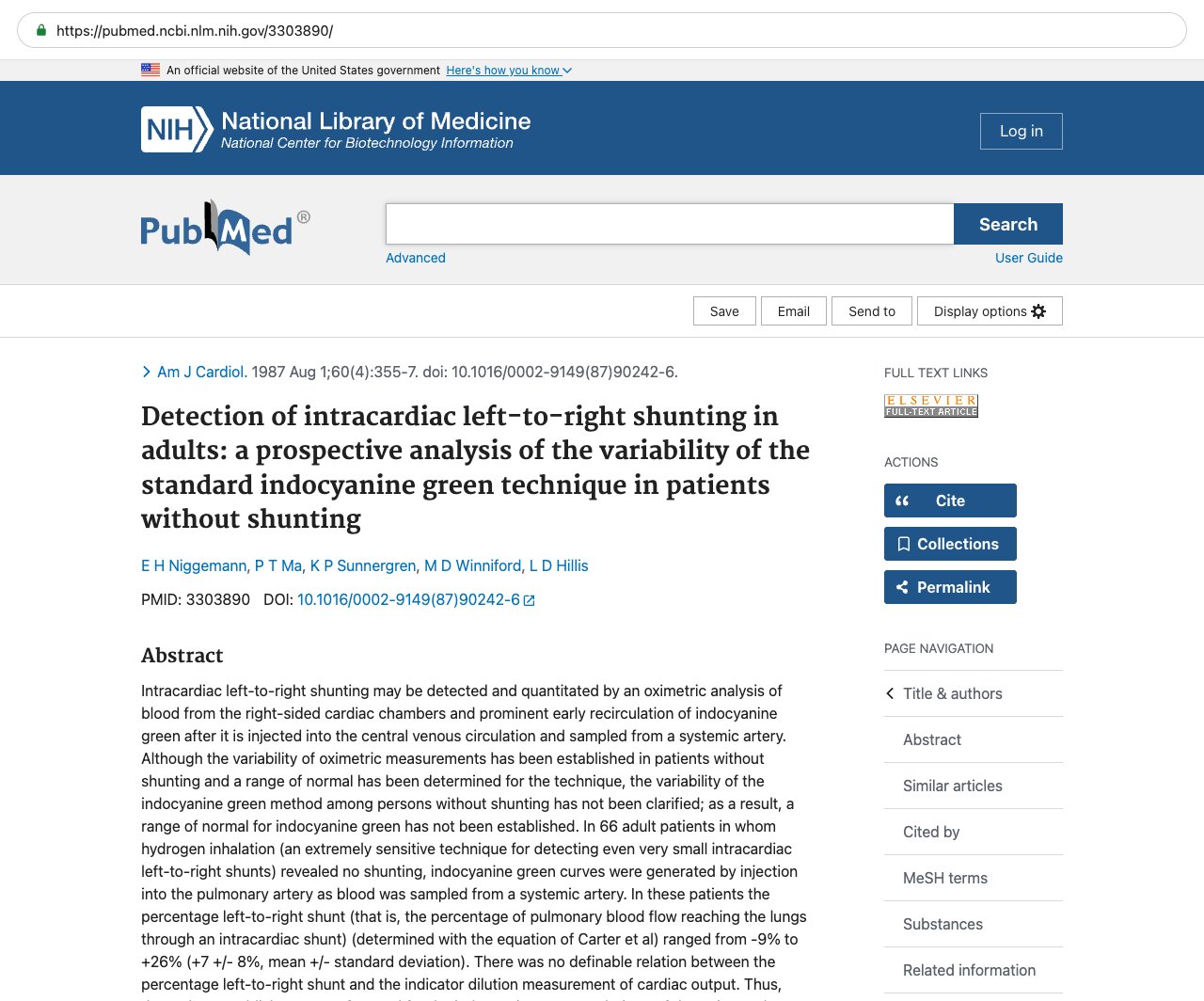
Screenshot of the PubMed page
This page mirrors the published abstract (© the authors / publisher) for reference and citation. The canonical source is the PubMed record linked above. This is not medical advice.