2019 · Noda et al. — Circulating messenger for neuroprotection induced by molecular hydrogen.
Super-Abstract
Drinking hydrogen-rich water does not only act while H₂ is present in the body — it can trigger lasting neuroprotection through an indirect hormonal mechanism involving ghrelin. This 2019 review by Noda and colleagues explains how H₂ in drinking water stimulates ghrelin release from the stomach, which then crosses the blood-brain barrier and activates neuroprotective pathways — even after H₂ itself has left the body.
Commentary
The central finding described here comes from Parkinson's disease model mice: a preconditioning period of about seven days of H₂-rich water consumption provided significant neuroprotection even after H₂ administration was stopped — suggesting an indirect, persistent signalling pathway rather than a purely direct antioxidant effect. The proposed mechanism involves H₂ stimulating β1-adrenergic receptors in the gut wall, leading to ghrelin production; released ghrelin then crosses the blood-brain barrier and activates the growth-hormone secretagogue receptor in the brain. This is a mechanistically compelling and testable hypothesis. The review synthesises animal data and cell-line studies (SG-1 ghrelin-producing cells), so these findings do not yet constitute human evidence.
Key quotes
- „after chronic administration of H2 in drinking water, oxidative-stress-induced nerve injury is significantly attenuated even in the absence of H2.“ — the key observation that prompted the indirect-signalling hypothesis
- „H2 in drinking water induces ghrelin production and release from the stomach via β1-adrenergic receptor stimulation.“ — the proposed indirect mechanism: gut → ghrelin → brain
- „These observations help with understanding the chronic effects of H2 and raise intriguing preventive and therapeutic options using H2.“ — cautious conclusion on translational potential
Our assessment
This is a review of preclinical (animal and cell-line) research. The ghrelin-mediated indirect neuroprotection hypothesis is scientifically interesting and distinguishes H₂ from a simple antioxidant supplement. Limitations: all mechanistic data cited are from rodent models and a ghrelin-producing cell line — not from humans. Whether this indirect pathway operates in people, at the H₂ doses achievable through drinking, remains to be demonstrated. Translating animal Parkinson's models to human neuroprotection is notoriously difficult. This is a hypothesis-generating review, not clinical proof.
Study design
- Type: mechanistic review · n: n/a (animal models, cell line SG-1) · H₂ delivery: drinking hydrogen-rich water (as reported in cited studies)
- Proposed mechanism: H₂ → β1-adrenergic stimulation in stomach → ghrelin release → blood-brain barrier crossing → GHS-R activation → neuroprotection · Models: Parkinson's disease mouse model, ghrelin-producing cell line
Abstract
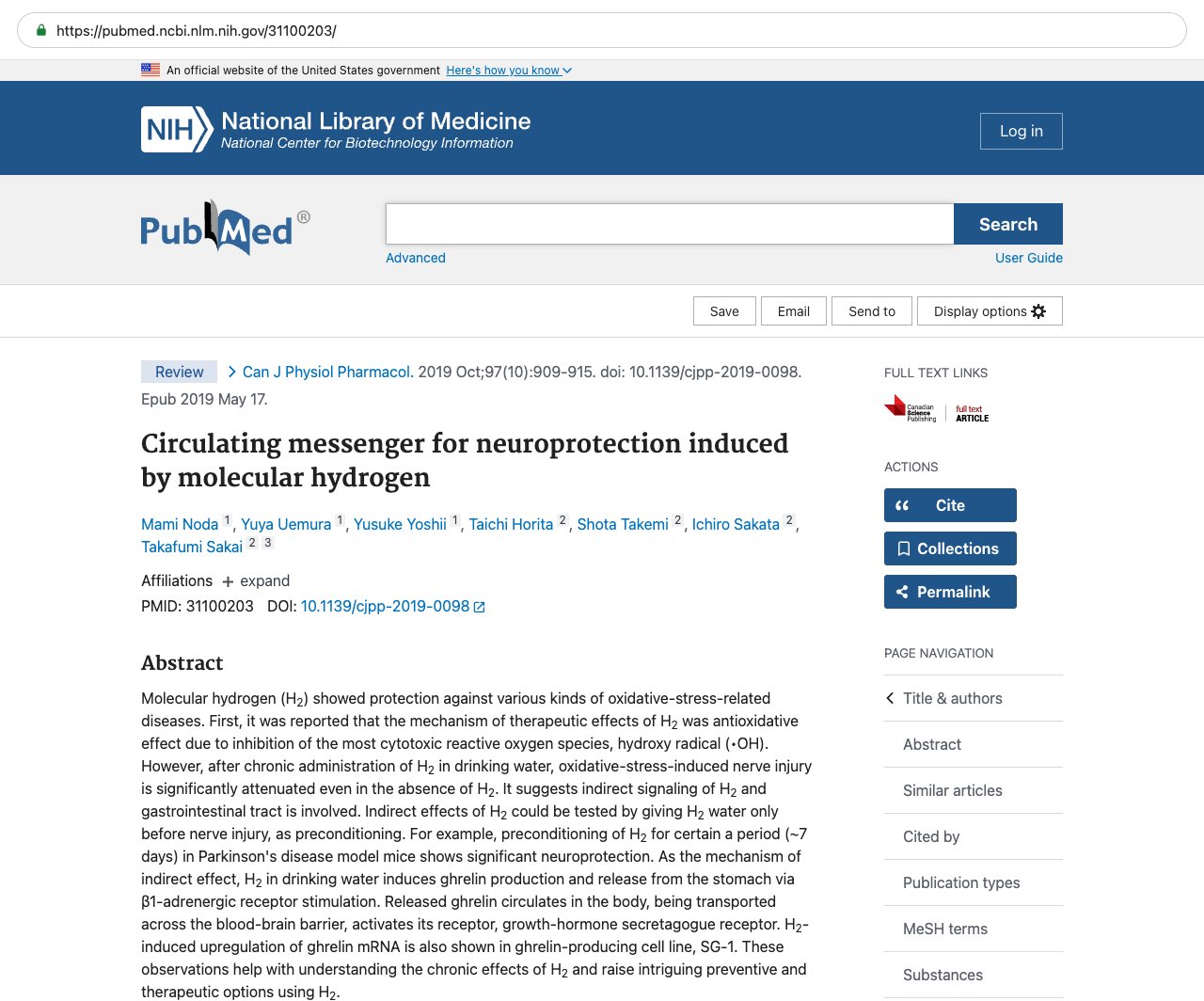
Molecular hydrogen (H2) showed protection against various kinds of oxidative-stress-related diseases. First, it was reported that the mechanism of therapeutic effects of H2 was antioxidative effect due to inhibition of the most cytotoxic reactive oxygen species, hydroxy radical (•OH). However, after chronic administration of H2 in drinking water, oxidative-stress-induced nerve injury is significantly attenuated even in the absence of H2. It suggests indirect signaling of H2 and gastrointestinal tract is involved. Indirect effects of H2 could be tested by giving H2 water only before nerve injury, as preconditioning. For example, preconditioning of H2 for certain a period (∼7 days) in Parkinson's disease model mice shows significant neuroprotection. As the mechanism of indirect effect, H2 in drinking water induces ghrelin production and release from the stomach via β1-adrenergic receptor stimulation. Released ghrelin circulates in the body, being transported across the blood-brain barrier, activates its receptor, growth-hormone secretagogue receptor. H2-induced upregulation of ghrelin mRNA is also shown in ghrelin-producing cell line, SG-1. These observations help with understanding the chronic effects of H2 and raise intriguing preventive and therapeutic options using H2.
Source & links
Screenshot of the PubMed page
This page mirrors the published abstract (© the authors / publisher) for reference and citation. The canonical source is the PubMed record linked above. This is not medical advice.