2020 · Oh — Untethered Soft Robotics with Fully Integrated Wireless Sensing and Actuating Systems for Somatosensory and Respiratory Functions.
Super-Abstract
This engineering study presents a wireless soft robotic hand that integrates flexible sensors — including a hydrogen gas sensor — for monitoring tactile pressure, temperature, and H₂ concentration via smartphone. The paper is a robotics/electronics engineering publication; molecular hydrogen (H₂) appears only as one of several gases the sensor detects. This study has no relevance to H₂ as a biomedical or therapeutic agent.
Commentary
This paper describes an untethered soft robotic hand driven by thermoresponsive elastomers with ethanol capsules and liquid metals. The system integrates wireless sensors for pressure, temperature, and gas detection — hydrogen gas being one detectable gas cited as relevant for monitoring explosive environments in disaster scenarios. The inclusion of H₂ is purely technical: H₂ is a detectable analyte for safety purposes, not a therapeutic or biological molecule. There is no connection to molecular hydrogen medicine, hydrogen-rich water, or any biomedical application of H₂.
Key quotes
- „the real-time detections of tactile pressures, temperatures, and hydrogen gas concentrations, are monitored or controlled wirelessly using a smartphone.“ — H₂ is monitored as a safety-relevant gas, not a therapeutic agent
- „There is now a strong demand for soft robots that can sense their surroundings and functions in harsh environments.“ — the application context: hazardous environment monitoring
- „This wireless sensing and actuating system for somatosensory and respiratory functions of a soft robot provides a promising strategy for next-generation robotics.“ — the paper's conclusion: a robotics engineering advance
Our assessment
This paper has no relevance to H₂ medicine. It is a robotics engineering publication in which H₂ gas detection is one technical feature among several. No therapeutic, biological, or biomedical conclusions about molecular hydrogen can be drawn from this study. It should not be interpreted in the context of H₂ supplementation or hydrogen health effects.
Study design
- Type: engineering prototype / in-vitro robotics study · System: thermoresponsive elastomer soft robotic hand with wireless electronics · H₂ relevance: H₂ gas sensor for environmental monitoring only — not biomedical
- Outcome: demonstration of wireless grip control and real-time sensing (pressure, temperature, H₂ concentration) via smartphone; no biological or clinical endpoints
Abstract
There has been a great deal of interest in designing soft robots that can mimic a human system with haptic and proprioceptive functions. There is now a strong demand for soft robots that can sense their surroundings and functions in harsh environments. This is because the wireless sensing and actuating capabilities of these soft robots are very important for monitoring explosive gases in disaster areas and for moving through contaminated environments. To develop these wireless systems, complex electronic circuits must be integrated with various sensors and actuators. However, the conventional electronic circuits based on silicon are rigid and fragile, which can limit their reliable integration with soft robots for achieving continuous locomotion. In our study, we developed an untethered, soft robotic hand that mimics human fingers. The soft robotic fingers are composed of a thermally responsive elastomer composite that includes capsules of ethanol and liquid metals for its shape deformation through an electrothermal phase transition. And these soft actuators are integrated fully with flexible forms of heaters, with pressure, temperature, and hydrogen gas sensors, and wireless electronic circuits. Entire functions of this soft hand, including the gripping motion of soft robotic fingers and the real-time detections of tactile pressures, temperatures, and hydrogen gas concentrations, are monitored or controlled wirelessly using a smartphone. This wireless sensing and actuating system for somatosensory and respiratory functions of a soft robot provides a promising strategy for next-generation robotics.
Source & links
Screenshot of the PubMed page
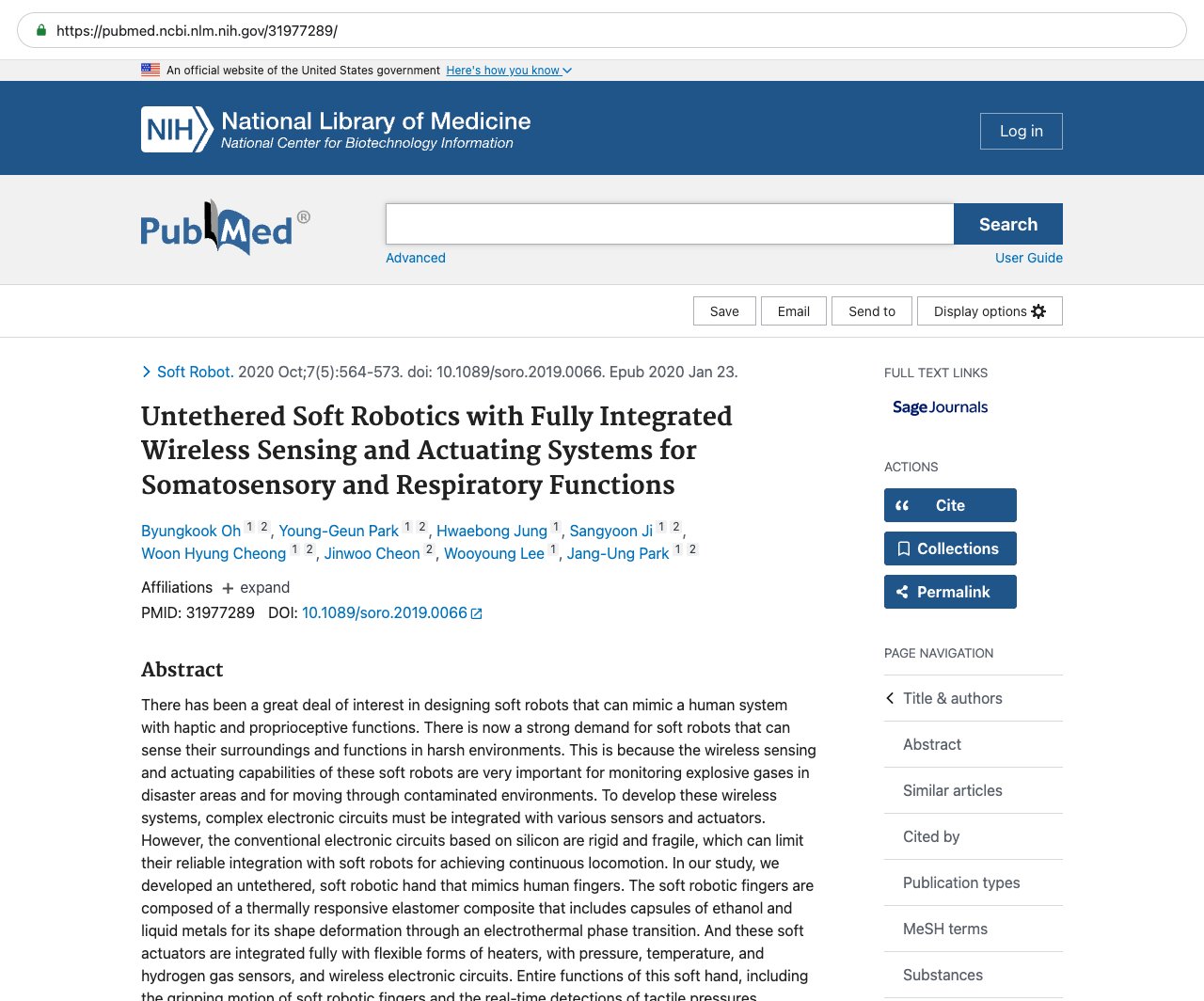
This page mirrors the published abstract (© the authors / publisher) for reference and citation. The canonical source is the PubMed record linked above. This is not medical advice.