2021 Inflammation research : official journal of the European Histamine Research Society ... [et al.] Mechanism / Preclinical Inhalation
2021 · Zhang — Molecular hydrogen alleviates asthma through inhibiting IL-33/ILC2 axis
Super-Abstract
In an OVA-sensitised mouse model of asthma and a bronchial epithelial cell model, hydrogen/oxygen gas mixture inhalation markedly reduced allergic inflammation by suppressing the IL-33/ILC2 signalling axis. The study combines in-vivo and in-vitro methods and proposes a miRNA-linked mechanism. All findings are preclinical — no human asthma patients were studied.
Commentary
Asthma driven by type-2 inflammation (involving innate lymphoid cells ILC2 and alarmins like IL-33) represents a significant unmet need, especially for patients who respond poorly to steroids. This paper methodically addresses whether H₂ can modulate this specific arm of airway inflammation. The results are internally consistent: H₂ reduced IL-33 and ST2 (its receptor), suppressed ILC2 expansion, restored airway epithelial integrity (E-cadherin, ZO-1), and attenuated apoptosis in house-dust-mite-exposed bronchial cells. A miRNA microarray identified differentially expressed miRNAs that may partly explain the transcriptional effects. The mechanistic depth is a strength, but the entire dataset is from mice and a single cell line (16HBE). Translation to human asthma cannot be assumed.
Key quotes
- „Serum and BALF levels of IL-33 and other alarmin and type II cytokines were greatly increased by OVA and inhibited by H2 in asthmatic mice.“ — core anti-inflammatory finding: H₂ suppresses the alarmin cascade driving asthmatic inflammation
- „ILC2 population was markedly increased in OVA-induced asthmatic mice, and such increase was inhibited by H2.“ — H₂ specifically curbs the innate lymphoid cell population central to type-2 asthma
- „These data demonstrated that H2 is efficient in suppressing allergen-induced asthma and could be developed as a therapeutics for asthma and other conditions of type II inflammation.“ — authors' conclusion — preclinical scope only
Our assessment
A well-designed preclinical study (mouse + bronchial cell line) that identifies a plausible molecular target (IL-33/ILC2) for H₂'s anti-asthmatic effects. The miRNA data add an additional mechanistic layer. Critical limitations: OVA sensitisation is a standard but highly artificial asthma model that does not fully recapitulate human atopic asthma; ILC2 biology in mice and humans differs in important ways. No clinical conclusions can be drawn. The study is a useful hypothesis generator for future human trials.
Study design
- Type: animal + in-vitro (preclinical) · Model: OVA-sensitised asthma mice; 16HBE bronchial epithelial cells (house-dust-mite) · H₂ delivery: hydrogen/oxygen gas mixture inhalation
- Endpoints: serum/BALF cytokines (ELISA), ILC2 frequency (flow cytometry), IL-33/ST2/NF-κB expression (qPCR, WB, IF), epithelial markers (E-cadherin, ZO-1), apoptosis (caspase 3/9), miRNA array
- Key finding: H₂ suppressed IL-33 and ST2, reduced ILC2 expansion, restored epithelial barrier, and attenuated allergen-induced apoptosis; differential miRNA expression identified as potential upstream regulator
Abstract
BACKGROUND: Asthma is one of the most common noninfectious chronic diseases characterized by type II inflammation. This study aimed to investigate the effects of molecular hydrogen on the pathogenesis of asthma. METHODS: OVA sensitized asthma mouse model and house dust mite treated 16HBE cellular model were established and hydrogen/oxygen mixture was used to treat asthmatic mice and 16HBE cells. Serum and BALF cytokines were measured with specific ELISA assays. E-cadherin and ZO-1 were detected by immunohistochemical staining and expression of caspase 3 and 9, NF-κB, IL-33 and ST2 was assessed by quantitative real-time PCR, western blot and/or immunofluorescence. IL-33 promoter activity was analyzed by dual-luciferase assay. ILC2 population was assayed by flow cytometry and differentially expressed miRNAs were detected using miRNA array. RESULTS: Serum and BALF levels of IL-33 and other alarmin and type II cytokines were greatly increased by OVA and inhibited by H2 in asthmatic mice. The expression of NF-κB (p65) and ST2 was upregulated by OVA and suppressed by H2. ILC2 population was markedly increased in OVA-induced asthmatic mice, and such increase was inhibited by H2. E-cadherin and ZO-1 levels in airway tissues of asthmatic mice were significantly lower than that of control mice, and the reduction was recovered by H2 treatment. H2 alleviated HDM induced apoptosis of 16HBE cells, upregulation of IL-33 and ST2, and elevation of IL-33 promoter activity. A group of miRNAs differentially expressed in HDM and HDM + H2 treated 16HBE cells were identified. CONCLUSIONS: These data demonstrated that H2 is efficient in suppressing allergen-induced asthma and could be developed as a therapeutics for asthma and other conditions of type II inflammation.
Source & links
Screenshot of the PubMed page
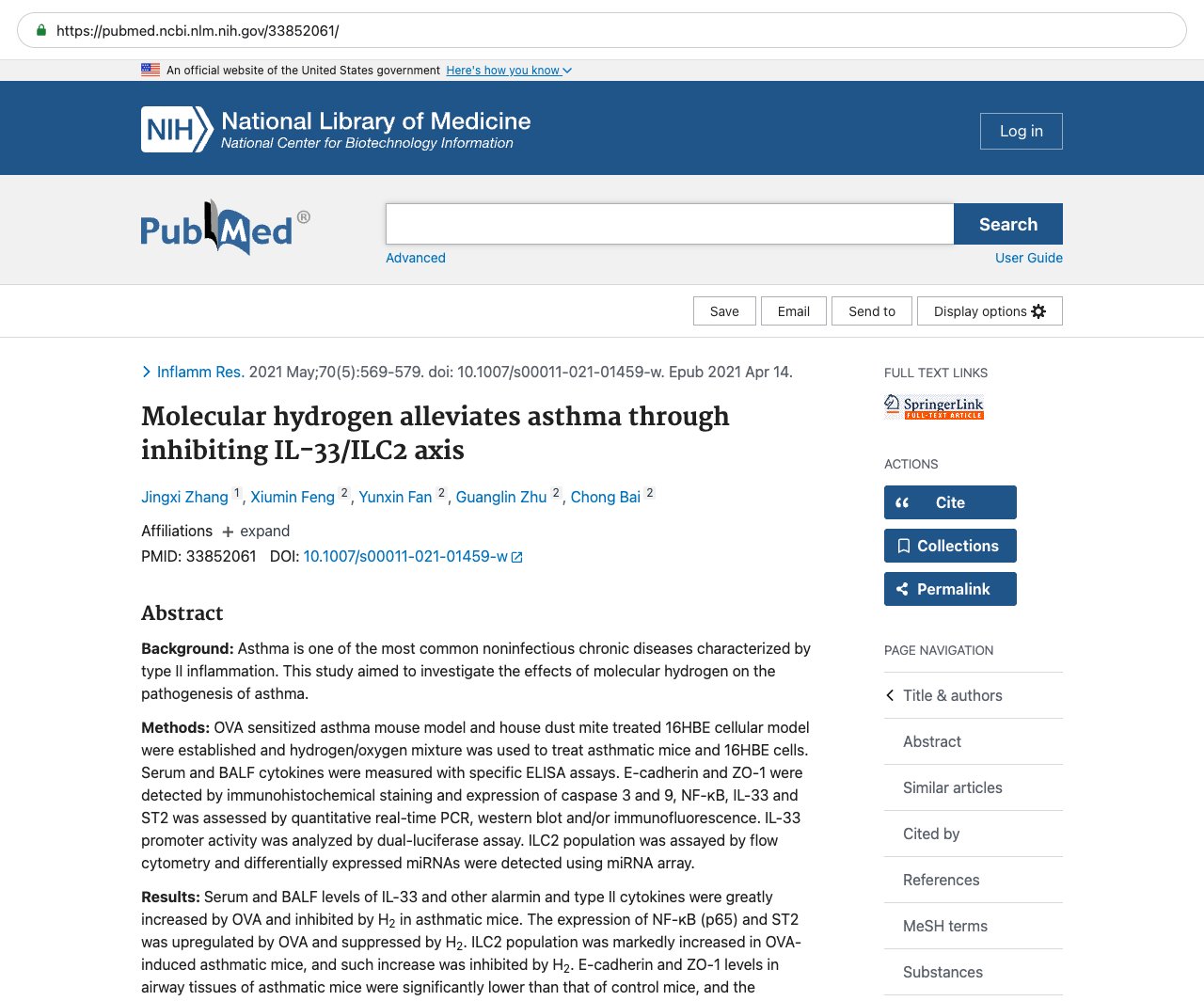
This page mirrors the published abstract (© the authors / publisher) for reference and citation. The canonical source is the PubMed record linked above. This is not medical advice.