2023 Pharmaceuticals (Basel, Switzerland) Pilot / Observational Human H₂ therapy Inhalation Neurology
2023 · Ono et al. — Therapeutic Inhalation of Hydrogen Gas for Alzheimer's Disease Patients and Subsequent Long-Term Follow-Up as a Disease-Modifying Treatment: An Open Label Pilot Study
Super-Abstract
In an open-label pilot study, eight patients with Alzheimer's disease who inhaled 3% hydrogen gas for one hour twice daily for 6 months improved on the ADAS-cog cognitive scale (mean change −4.1 points) while untreated patients worsened (+2.6), a difference reported as significant. Imaging of nerve fibre bundles through the hippocampus also improved compared with the start. Per full text, the untreated patients were drawn from the hospital's database rather than enrolled alongside, and the abstract gives no p-values. (Pharmaceuticals, 2023.)
Commentary
Alzheimer's disease is a progressive neurodegenerative disorder, and the authors tested whether inhaled hydrogen could act as a disease-modifying treatment. In this open-label pilot study, eight patients with Alzheimer's disease inhaled 3% hydrogen gas for one hour twice daily for 6 months, per full text through a facial mask at home or in a nursing home. They were then followed for 1 year without hydrogen. Per full text, patients kept taking their existing anti-dementia medication and were not randomised. Cognition was assessed with the ADAS-cog. Neuron integrity in fibre bundles passing through the hippocampus was assessed with diffusion tensor imaging (DTI) on MRI. Per full text, the untreated comparison data came from 19 patients in the hospital database for ADAS-cog and from 5 patients for DTI, and the staff who measured ADAS-cog and DTI did not know who was in the study. The abstract does not name a primary endpoint or report adverse events.
Key quotes
- „The mean individual ADAS-cog change showed significant improvement after 6 months of H2 treatment (-4.1) vs. untreated patients (+2.6).“ — the main cognitive result, compared with untreated patients rather than a placebo group
- „The improvement by ADAS-cog and DTI assessments were maintained during the follow-up after 6 months (significantly) or 1 year (non-significantly).“ — follow-up after stopping hydrogen: significant at 6 months, not at 1 year
- „This study suggests that H2 treatment not only relieves temporary symptoms, but also has disease-modifying effects, despite its limitations.“ — the authors' conclusion, which goes further than an eight-patient open study can support
Our assessment
The study followed eight patients through 6 months of treatment and 1 year of follow-up and combined a clinical score with an imaging measure. ADAS-cog improved by 4.1 points after 6 months of hydrogen, while untreated patients worsened by 2.6 points. The comparison group was not part of the trial: per full text it consisted of patients from the hospital database, so differences in selection and care cannot be excluded. Limitations: eight patients, open label, no randomisation, no placebo and no control group enrolled at the same time. The abstract gives no p-values, confidence intervals or adverse event data. The DTI improvement is a comparison with each patient's starting value, and fibre-bundle imaging is a surrogate marker. At 1 year of follow-up the improvement was no longer statistically significant. The claim of a disease-modifying effect rests on this small uncontrolled sample and would need a randomised, placebo-controlled trial. Per full text, the authors have applied for a patent based on this work.
Study design
- Type: open-label pilot study with 1-year follow-up, not randomised (per full text) · n: 8 · H₂ delivery: inhaled 3% hydrogen gas, 1 hour twice daily for 6 months (per full text by facial mask), then 1 year without hydrogen
- Comparator: untreated patients with Alzheimer's disease; per full text data from the hospital database (19 patients for ADAS-cog, 5 for DTI)
- Result: mean ADAS-cog change after 6 months −4.1 with hydrogen vs. +2.6 in untreated patients, reported as significant. DTI: improved integrity of fibre bundles through the hippocampus compared with the start. Improvement maintained at 6 months of follow-up (significant) and at 1 year (not significant). No p-values in the abstract
Abstract
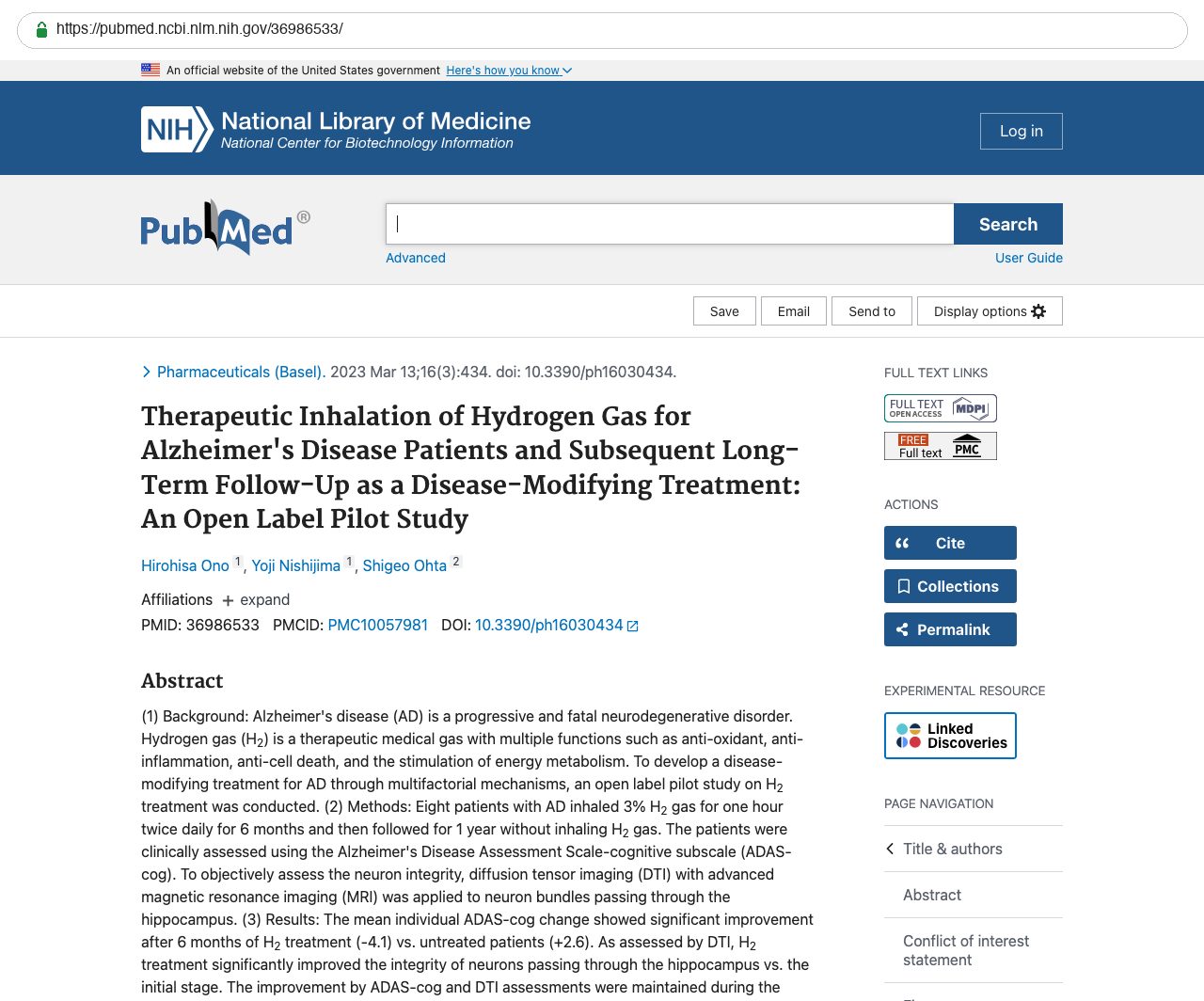
(1) Background: Alzheimer's disease (AD) is a progressive and fatal neurodegenerative disorder. Hydrogen gas (H2) is a therapeutic medical gas with multiple functions such as anti-oxidant, anti-inflammation, anti-cell death, and the stimulation of energy metabolism. To develop a disease-modifying treatment for AD through multifactorial mechanisms, an open label pilot study on H2 treatment was conducted. (2) Methods: Eight patients with AD inhaled 3% H2 gas for one hour twice daily for 6 months and then followed for 1 year without inhaling H2 gas. The patients were clinically assessed using the Alzheimer's Disease Assessment Scale-cognitive subscale (ADAS-cog). To objectively assess the neuron integrity, diffusion tensor imaging (DTI) with advanced magnetic resonance imaging (MRI) was applied to neuron bundles passing through the hippocampus. (3) Results: The mean individual ADAS-cog change showed significant improvement after 6 months of H2 treatment (-4.1) vs. untreated patients (+2.6). As assessed by DTI, H2 treatment significantly improved the integrity of neurons passing through the hippocampus vs. the initial stage. The improvement by ADAS-cog and DTI assessments were maintained during the follow-up after 6 months (significantly) or 1 year (non-significantly). (4) Conclusions: This study suggests that H2 treatment not only relieves temporary symptoms, but also has disease-modifying effects, despite its limitations.
Source & links
Screenshot of the PubMed page
This page mirrors the published abstract (© the authors / publisher) for reference and citation. The canonical source is the PubMed record linked above. This is not medical advice.