2015 · Ostojic — Molecular hydrogen: An inert gas turns clinically effective.
Super-Abstract
For decades considered biologically inert, molecular hydrogen (H₂) has in recent years accumulated clinical evidence — from metabolic diseases to chronic inflammation and cancer. This review by Ostojic summarizes available clinical trial data on H₂ and outlines practical considerations such as dosage, administration routes, and safety. (Annals of Medicine, 2015.)
Commentary
Ostojic provides an overview of the emerging clinical evidence base for molecular hydrogen, noting that the past five years before publication saw a meaningful expansion of trial data. The paper is explicit that H₂ improves clinical endpoints and surrogate markers across several conditions, but also acknowledges a significant gap: dosage standards and administration protocols are not yet well established, and data on adverse effects and use in specific populations (e.g., pregnant women, children) is limited. This is a narrative review synthesizing existing literature — it does not present new experimental findings.
Key quotes
- „H2 improves clinical end-points and surrogate markers in several clinical trials, from metabolic diseases to chronic systemic inflammatory disorders to cancer.“ — the breadth of conditions where clinical signals have been observed
- „Molecular hydrogen (H2) appeared as an experimental agent in biomedicine approximately 40 years ago, yet the past 5 years seem to confirm its medicinal value in the clinical environment.“ — the historical arc — from curiosity to clinical relevance
- „Clinical profiles of H2 provide evidence-based direction for practical application and future research on molecular hydrogen for the wider health care community.“ — the stated aim: building a usable evidence base for practitioners
Our assessment
This is a literature review, not a primary clinical study. Its value lies in aggregating early clinical signals across diverse disease areas rather than in original data. The honest picture it paints: H₂ shows promising signals in metabolic and inflammatory conditions, but dosage guidance and long-term safety data are explicitly insufficient at the time of writing. Practitioners should treat this as a synthesis of early-phase evidence, not as established treatment protocol. The single-author narrative format also means the selection and weighting of studies reflects one researcher's perspective.
Study design
- Type: narrative review · n: n/a (literature synthesis of clinical trials) · H₂ delivery: various — inhalation, H₂-rich water, H₂ saline (summarized across included trials)
- Result: clinical improvement signals reported across metabolic, inflammatory, and oncological conditions; dosage standards and safety profiles in special populations identified as major knowledge gaps
Abstract
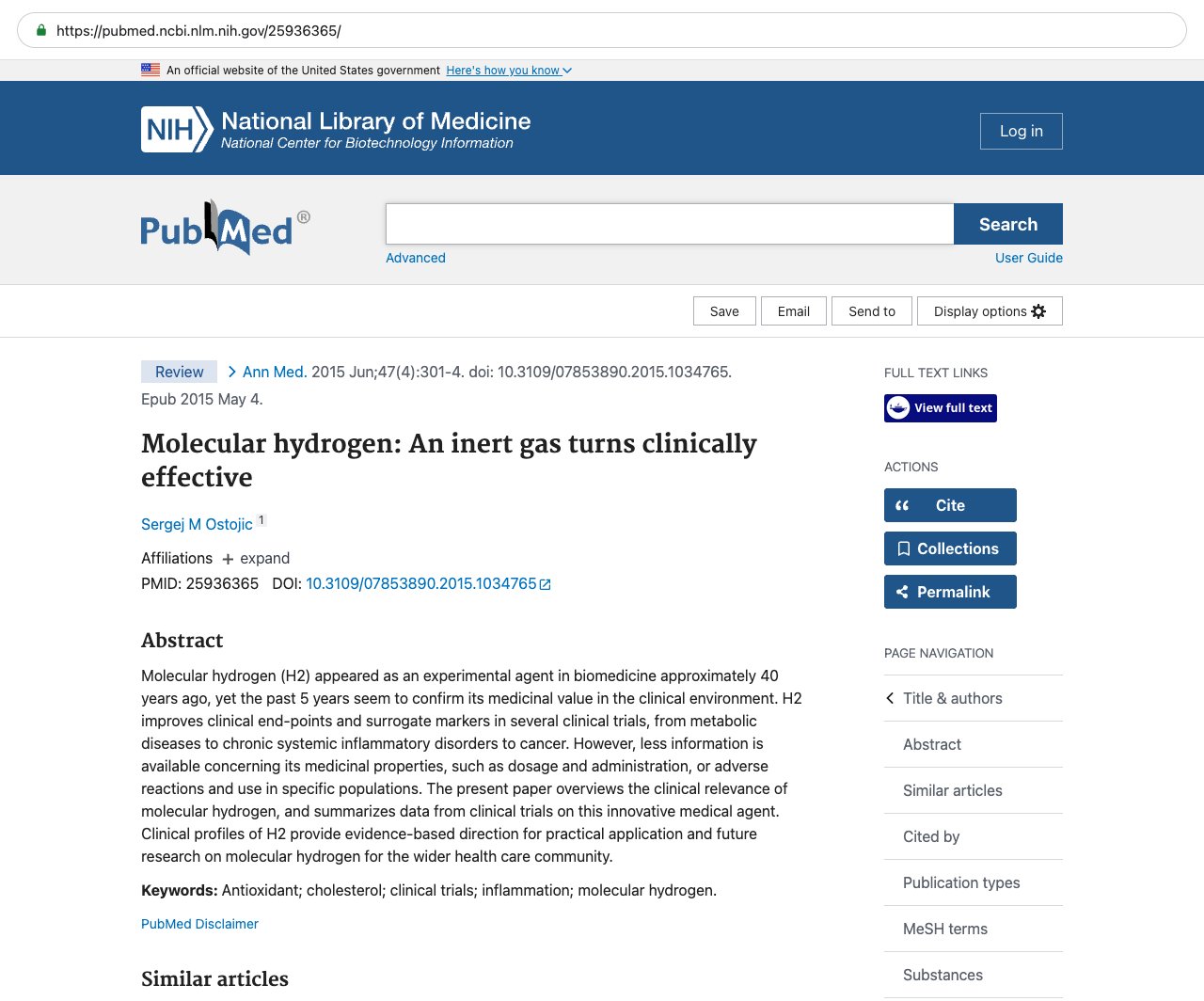
Molecular hydrogen (H2) appeared as an experimental agent in biomedicine approximately 40 years ago, yet the past 5 years seem to confirm its medicinal value in the clinical environment. H2 improves clinical end-points and surrogate markers in several clinical trials, from metabolic diseases to chronic systemic inflammatory disorders to cancer. However, less information is available concerning its medicinal properties, such as dosage and administration, or adverse reactions and use in specific populations. The present paper overviews the clinical relevance of molecular hydrogen, and summarizes data from clinical trials on this innovative medical agent. Clinical profiles of H2 provide evidence-based direction for practical application and future research on molecular hydrogen for the wider health care community.
Source & links
Screenshot of the PubMed page
This page mirrors the published abstract (© the authors / publisher) for reference and citation. The canonical source is the PubMed record linked above. This is not medical advice.