2015 · Ostojic — Targeting molecular hydrogen to mitochondria: barriers and gateways.
Super-Abstract
Mitochondria are a key target for hydrogen therapy, but the double-membrane structure and high membrane potential of these organelles create specific barriers to H₂ delivery that are not yet well understood. This perspective paper by Ostojic examines both the obstacles and potential advantages of getting H₂ into mitochondria. (Pharmacological Research, 2015.)
Commentary
This is a short theoretical perspective paper — not a systematic review or an experimental study. Ostojic raises an important mechanistic question: given that molecular hydrogen is small and lipid-permeable enough to diffuse through membranes, does the double-membrane system of mitochondria represent a significant barrier? The paper advances hypothetical considerations about the mitochondrial membrane potential and its effect on H₂ transport kinetics, but provides no new experimental data. It is best understood as a research-direction paper identifying an underexplored area rather than as a source of concluded findings.
Key quotes
- „Double-membrane organization of mitochondria and large membrane potential are important elements of mitochondrial stability that control the transport of the molecule into and out of the organelle.“ — the structural reasons why mitochondrial H₂ delivery is theoretically non-trivial
- „In this perspective paper, we advanced possible obstacles and advantages for H2 delivery to mitochondria.“ — the authors' own framing: hypotheses, not conclusions
- „Although the administration of molecular hydrogen (H2, dihydrogen) has been recognized as an effective innovative therapeutic procedure in biomedicine, H2 cellular kinetics and utilization seems to be less understood.“ — the knowledge gap this paper aims to address
Our assessment
This is a theoretical perspective piece — it poses hypotheses about mitochondrial H₂ pharmacokinetics but does not test them. No animal or human data is presented. Its value is in framing an important unsolved question in H₂ biology: do mitochondria receive meaningful H₂ concentrations, and how does membrane potential influence this? No practical conclusions for therapeutic use can be drawn from this paper alone. It is useful reading for researchers designing mechanistic or pharmacokinetic studies.
Study design
- Type: theoretical perspective / opinion paper · n: n/a (no experiment conducted) · H₂ delivery: not applicable (theoretical analysis only)
- Result: mitochondrial double membrane and high membrane potential identified as potential barriers to H₂ transport; both obstacles and theoretical gateways discussed; no experimental validation provided
Abstract
Although the administration of molecular hydrogen (H2, dihydrogen) has been recognized as an effective innovative therapeutic procedure in biomedicine, H2 cellular kinetics and utilization seems to be less understood. In particular, mitochondrial barriers might impact on H2 use in mitochondria-related diseases and conditions. Double-membrane organization of mitochondria and large membrane potential are important elements of mitochondrial stability that control the transport of the molecule into and out of the organelle. In this perspective paper, we advanced possible obstacles and advantages for H2 delivery to mitochondria.
Source & links
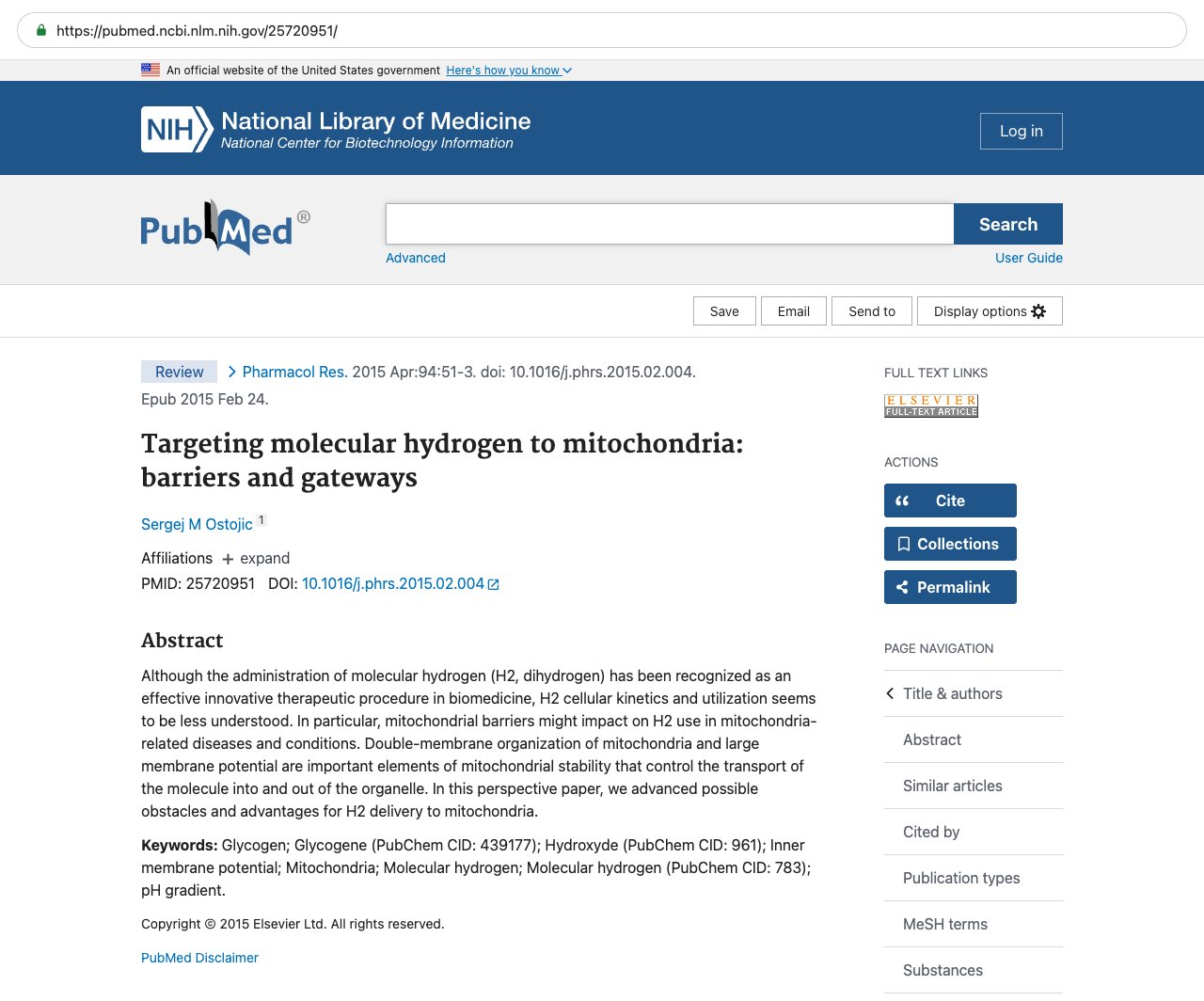
Screenshot of the PubMed page
This page mirrors the published abstract (© the authors / publisher) for reference and citation. The canonical source is the PubMed record linked above. This is not medical advice.