2026 · Ostojic — Revisiting molecular hydrogen signaling in mitochondria: Is the Rieske protein the entry point or a downstream sentinel?
Super-Abstract
A new paper demonstrated that H₂ rapidly inhibits mitochondrial Complex III via the Rieske iron-sulfur protein (RISP) — challenging the established view of H₂ as merely a free-radical scavenger. This commentary broadens that picture: RISP may not be the only mitochondrial entry point for H₂ signaling. Ostojic proposes that other iron-sulfur proteins (SDHB, Complex I subunits, CISD family) are equally credible candidates, and calls for comparative experimental studies to determine the true primary target. This is a perspective paper — no new experimental data. (Redox Biology, 2026.)
Commentary
This short commentary is a response to a significant mechanistic paper in Redox Biology (Volume 88, 2025) that identified the Rieske protein as a key mediator of H₂'s effects on Complex III. Ostojic, a prolific H₂ researcher, accepts the finding but argues it may be too narrow: the iron-sulfur protein family shares evolutionary architecture, and several other members have comparable redox logic and strategic placement in mitochondrial bioenergetic networks. The commentary adds scientific value by placing the RISP finding in a broader structural and evolutionary context, and by proposing a testable framework for identifying the true molecular entry point. However, this is theoretical reasoning — no new data, no experiments. It is an important stepping stone in mechanistic H₂ science, not a clinical finding.
Key quotes
- „its designation as the primary molecular target warrants broader consideration.“ — Ostojic's key challenge: RISP may be important but is unlikely to be the sole entry point
- „Proteins such as succinate dehydrogenase subunit B (SDHB), iron-sulfur subunits of Complex I, and CISD family [2Fe-2S] proteins share comparable redox logic and strategic positioning within mitochondrial bioenergetic networks.“ — alternative candidates proposed: other iron-sulfur proteins in the mitochondrial respiratory chain
- „specific comparative structural, biochemical, and proteostatic approaches are proposed to define the true molecular entry point of H2 signaling in human mitochondria.“ — constructive output: a research agenda to resolve the open mechanistic question
Our assessment
Evidence level: perspective/commentary (EV 4). No experimental data; responds to and extends an existing published finding. Ostojic is a recognized H₂ researcher with expertise in mitochondrial biochemistry, and the commentary is scientifically grounded. Limitations clearly stated: purely theoretical — the proposed alternative candidates (SDHB, Complex I subunits, CISD proteins) have not yet been experimentally tested as H₂ targets; the framework is a hypothesis, not a demonstrated result. Bottom line: a valuable mechanistic commentary that opens a testable scientific debate about how H₂ signals within mitochondria — no implications for current use or dosing.
Study design
- Type: perspective / commentary · n: n/a · H₂ delivery: not applicable (theoretical analysis of H₂ interaction with mitochondrial iron-sulfur proteins)
- Result: no experimental results; proposes a hierarchical, testable framework of alternative H₂ molecular targets (RISP, SDHB, Complex I subunits, CISD family); calls for comparative structural and biochemical studies
Abstract
A recent study published in Redox Biology (Volume 88, December 2025, 103952) demonstrates that molecular hydrogen (H2) rapidly suppresses mitochondrial Complex III activity through a mechanism involving the Rieske iron-sulfur protein (RISP) and subsequent LONP1-dependent proteolysis, challenging the long-standing view of H2 as merely a selective radical scavenger. While these findings compellingly identify RISP as a key mediator of mitochondrial responses to H2, its designation as the primary molecular target warrants broader consideration. From an evolutionary and structural standpoint, RISP belongs to a wider family of hydrogenase-like mitochondrial redox proteins that retain ancient iron-sulfur architectures. Proteins such as succinate dehydrogenase subunit B (SDHB), iron-sulfur subunits of Complex I, and CISD family [2Fe-2S] proteins share comparable redox logic and strategic positioning within mitochondrial bioenergetic networks. Here, these candidates are prioritized and placed into a hierarchical, testable framework, and specific comparative structural, biochemical, and proteostatic approaches are proposed to define the true molecular entry point of H2 signaling in human mitochondria.
Source & links
Screenshot of the PubMed page
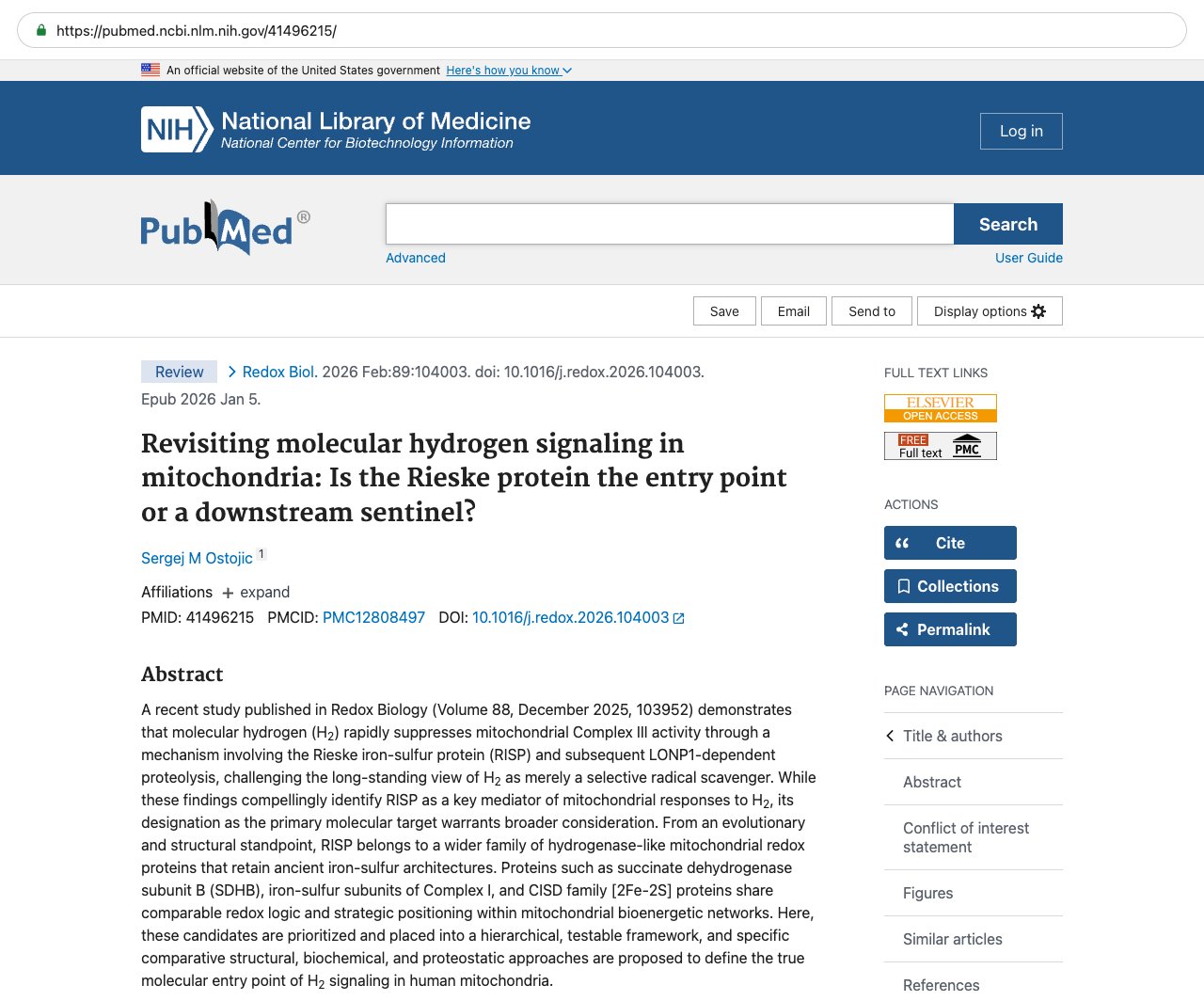
This page mirrors the published abstract (© the authors / publisher) for reference and citation. The canonical source is the PubMed record linked above. This is not medical advice.