1998 · Poppitt et al. — Energy expenditure and net substrate utilization in men ingesting usual and high amounts of nonstarch polysaccharides
Super-Abstract
A high-fibre (nonstarch polysaccharide) diet produced no measurable thermogenic effect and no short-term change in body composition in healthy men. Breath hydrogen and methane were measured as metabolic by-products of gut fermentation — not as therapeutic agents. The practical finding: simply eating more fibre does not boost calorie burning. (American Journal of Clinical Nutrition, 1998.)
Commentary
This metabolic ward study used indirect calorimetry in a rigorous crossover design. Breath hydrogen appears in the protocol as a fermentation marker — a sign of how much undigested carbohydrate reaches colonic bacteria — not as a therapeutic intervention. The diet context is relevant for gut microbiome research and weight management, but the study does not test molecular hydrogen as a health intervention. The null finding on thermogenesis is itself notable: increasing dietary fibre does not measurably raise energy expenditure under controlled conditions.
Key quotes
- „Differences between the 2 diets were only -0.005±0.130 MJ/d … and were nonsignificant (P> 0.2).“ — no thermogenic effect of the high-fibre diet
- „There was no thermogenic response to the high-NSP diet, which would be advantageous for body weight control, and no short-term influence on body composition.“ — clear null result on the primary hypothesis
- „Twenty-four-hour, indirect, open-circuit calorimetry was performed, including measurements of total hydrogen gas and methane.“ — hydrogen measured as a fermentation by-product, not as a therapeutic substance
Our assessment
Important context: this study does not investigate molecular hydrogen (H₂) as a therapeutic intervention. Breath hydrogen is used exclusively as a fermentation marker to assess carbohydrate malabsorption and gut bacterial activity — a standard gastroenterological tool. The primary topic is dietary fibre and energy metabolism. The study is well-designed (randomised crossover, metabolic ward, 24 h calorimetry, n = 12), and its null finding is clearly stated. Limitations: small sample, short duration (~3 weeks), controlled metabolic ward conditions may not reflect free-living behaviour. Not relevant to H₂ therapy.
Study design
- Type: randomised crossover · n: 12 healthy men · H₂ delivery: none — breath H₂ measured as colonic fermentation marker only
- Result: no difference in 24 h energy expenditure or macronutrient oxidation between usual and high-NSP diet; no thermogenic response to increased dietary fibre
Abstract
BACKGROUND: Diets intrinsically high in nonstarch polysaccharides (NSPs) are frequently advised for body weight regulation and health, but the consequences for energy expenditure and fuel selection are undetermined. OBJECTIVE: We determined whether energy expenditure and fuel selection differ when men consume a diet intrinsically higher in NSP than a usual mixed diet. DESIGN: A randomized crossover design was used in which 12 healthy men were fed a maintenance diet for approximately 3 wk in a metabolic suite. By judicial choice of food exchanges, the usual- and high-NSP diets were similar in protein, fat, and carbohydrate contents. Twenty-four-hour, indirect, open-circuit calorimetry was performed, including measurements of total hydrogen gas and methane. Participants were weight stable (within 2 kg for 3 wk), entered an 11-m3 calorimetry chamber for 36 h with measurements taken in the last 24 h, and underwent a strictly controlled program of moderate physical activity (1.3 x basal metabolic rate). RESULTS: The mean total 24-h energy expenditure and percentages from protein, fat, and carbohydrate metabolism were 10 MJ/d and 16%, 35%, and 48%, respectively. Differences (mean+/-SEM) between the 2 diets were only -0.005+/-0.130 MJ/d, -0.3+/-1.3%, -0.2+/-2.0%, and 0.6+/-2.2%, respectively, and were nonsignificant (P> 0.2). CONCLUSIONS: There was no thermogenic response to the high-NSP diet, which would be advantageous for body weight control, and no short-term influence on body composition, as may be judged from a lack of change in protein, fat, or carbohydrate metabolism.
Source & links
Screenshot of the PubMed page
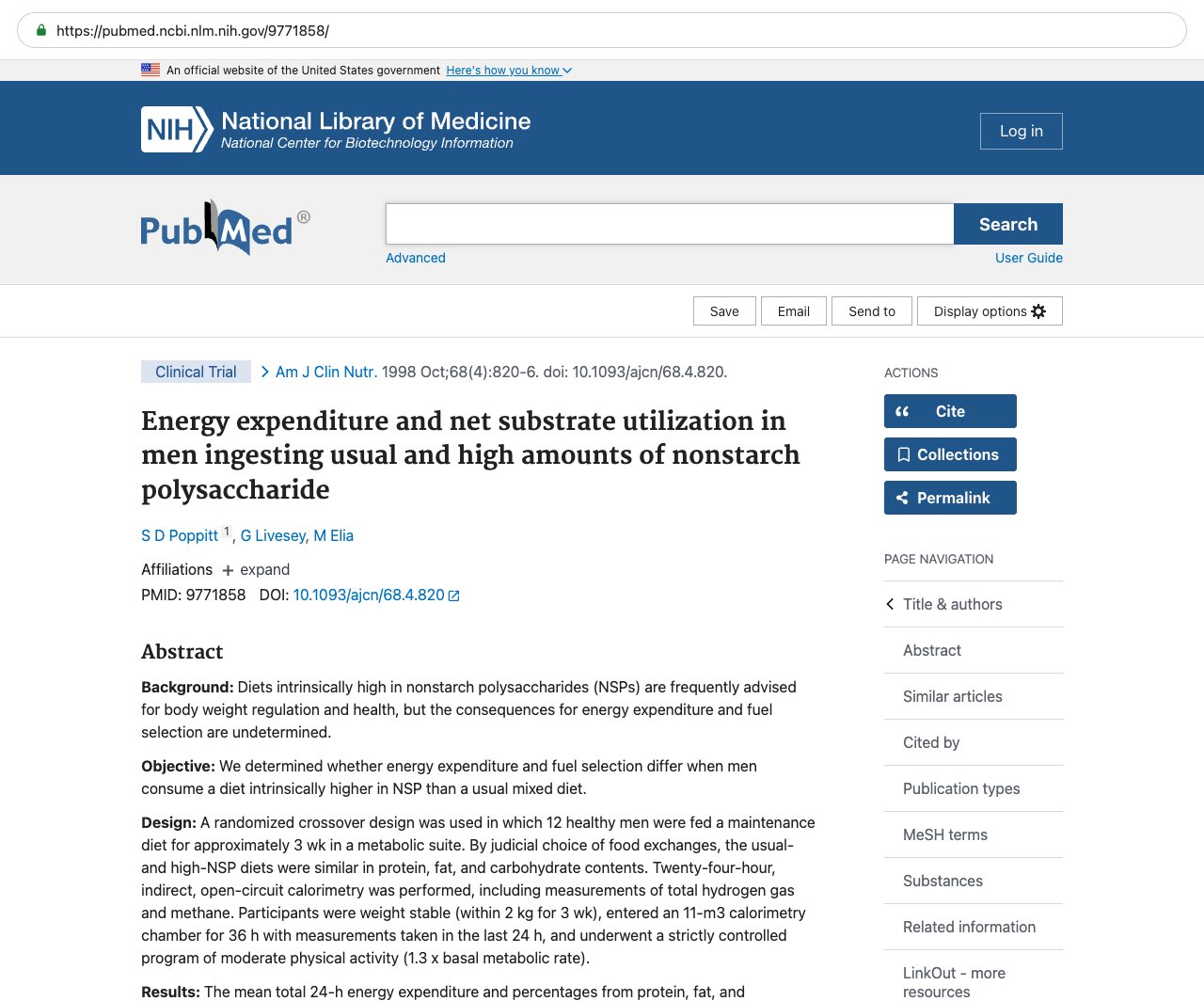
This page mirrors the published abstract (© the authors / publisher) for reference and citation. The canonical source is the PubMed record linked above. This is not medical advice.