2012 Medical science monitor : international medical journal of experimental and clinical research Mechanism / Preclinical Inhalation
2012 · Qian et al. — Hydrogen therapy may be an effective and specific novel treatment for aplastic anemia.
Super-Abstract
Aplastic anemia is a severe bone marrow failure disease with high mortality — and oxidative stress and inflammatory cytokines like TNF-α and IL-6 play a central role in its development. This theoretical paper proposes that molecular hydrogen (H₂), with its documented ability to selectively neutralize toxic oxygen radicals and suppress pro-inflammatory cytokines, could be a novel therapeutic approach to aplastic anemia. The authors present this as a hypothesis grounded in mechanistic reasoning, not a clinical study.
Commentary
This paper is a theoretical hypothesis, not an experimental study. The authors draw on the existing literature about H₂ — its antioxidant properties and capacity to modulate TNF-α and IL-6 levels — and extrapolate this to aplastic anemia, a disease where these same pathways are implicated in bone marrow destruction. The reasoning is plausible and internally consistent, but no actual experiments with aplastic anemia patients or animal models are conducted here. It represents early-stage scientific brainstorming: identifying a potential therapeutic target and connecting mechanistic dots. Such hypothesis papers are valuable for directing future research but carry no direct clinical weight.
Key quotes
- „hydrogen inhalation can selectively reduce cytotoxic oxygen radicals and exert antioxidant effects.“ — the mechanistic basis for the hypothesis
- „hydrogen could suppress the levels of TNF-α and IL-6.“ — the anti-inflammatory rationale relevant to aplastic anemia pathogenesis
- „we hypothesize that hydrogen therapy may be an effective, simple, economic and novel strategy in the treatment of aplastic anemia.“ — the core hypothesis — explicitly marked as such by the authors
Our assessment
This is a theoretical hypothesis paper — no animal model, no cell experiments, no patients. It proposes that H₂ could be useful in aplastic anemia based on mechanistic reasoning about oxidative stress and cytokine suppression. While the logic is coherent, no clinical or preclinical evidence for this specific indication is provided. The paper should be read as a research proposal, not as evidence of efficacy. Future experimental validation would be needed before any therapeutic conclusions can be drawn.
Study design
- Type: theoretical hypothesis paper · n: n/a (no experiments) · H₂ delivery: inhalation (proposed)
- Result: no experimental data; authors hypothesize that H₂ could reduce oxidative damage and suppress TNF-α / IL-6 in aplastic anemia based on existing mechanistic literature
Abstract
Aplastic anemia (AA) is a rare bone marrow failure disorder with high mortality rate, which is characterized by pancytopenia and an associated increase in the risk of hemorrhage, infection, organ dysfunction and death. The oxidation phenomenon and/or the formation of free radicals have been suggested to be causally related to various hematological disorders, including aplastic anemia. TNF-α, IL-6, and IL-2 also play important roles in the pathogenesis of AA. Recent studies have provided evidence that hydrogen inhalation can selectively reduce cytotoxic oxygen radicals and exert antioxidant effects. It was also reported that hydrogen could suppress the levels of TNF-α and IL-6. Based on these findings, we hypothesize that hydrogen therapy may be an effective, simple, economic and novel strategy in the treatment of aplastic anemia.
Source & links
Screenshot of the PubMed page
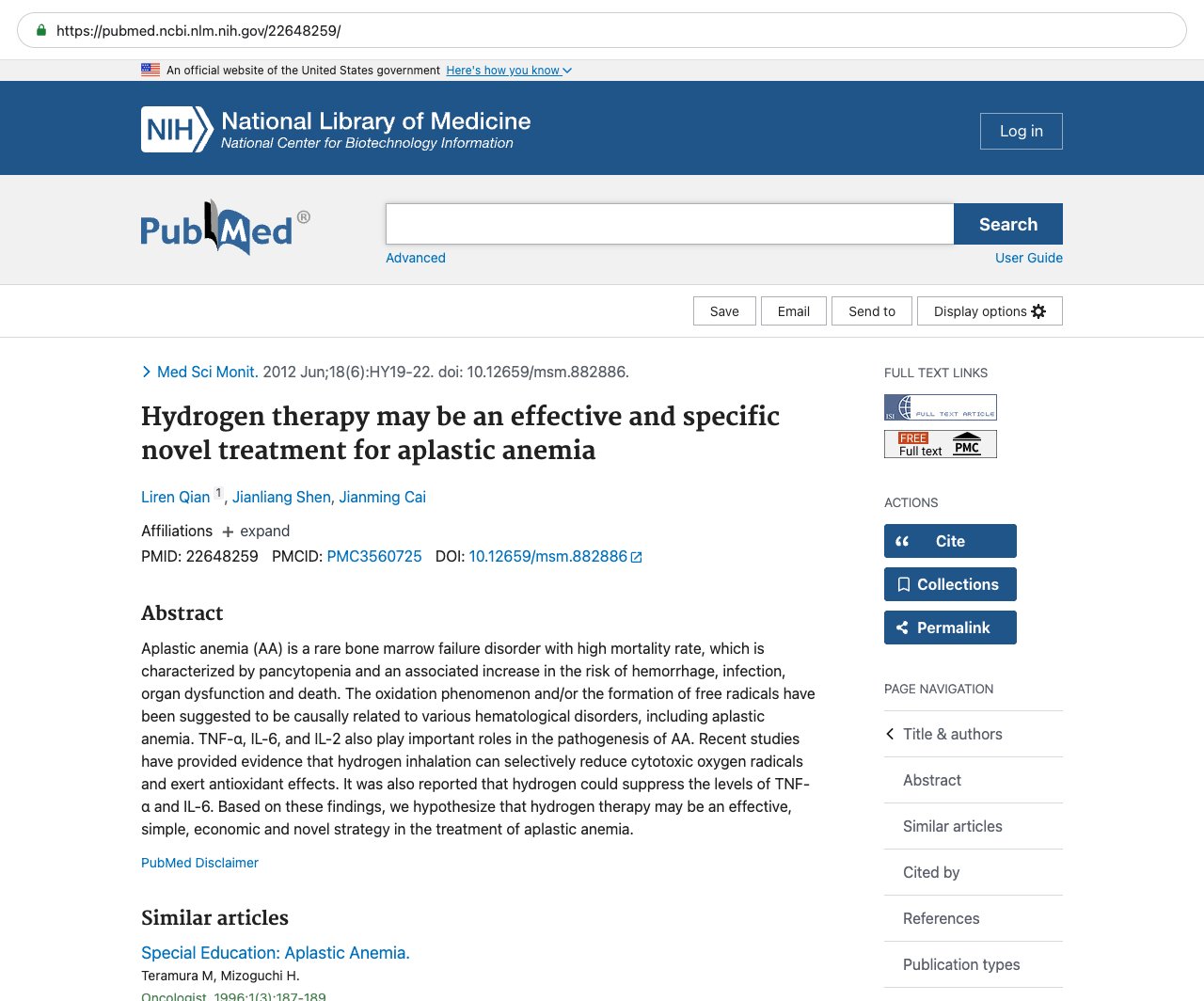
This page mirrors the published abstract (© the authors / publisher) for reference and citation. The canonical source is the PubMed record linked above. This is not medical advice.