2013 · Qian — Hydrogen as a new class of radioprotective agent
Super-Abstract
Molecular hydrogen (H₂) reduces radiation-induced oxidative damage by selectively neutralizing hydroxyl radicals — the main cause of ionizing radiation injury. This review summarizes the authors' own research and independent replications in animal models, plus one randomized placebo-controlled human study showing that hydrogen-rich water reduced oxidative stress markers in cancer patients undergoing radiotherapy without impairing the anti-tumor effect. (International Journal of Biological Sciences, 2013.)
Commentary
This is a review by the group that pioneered H₂ radioprotection research (Qian and colleagues). The paper traces the story from the initial in-vitro and in-vivo hypothesis through animal model replications at multiple institutions to a randomized controlled pilot study in human cancer patients. The human study is a genuine strength: it found that consumption of hydrogen-rich water during radiotherapy reduced oxidative stress biomarkers without compromising tumor treatment response. However, the authors themselves note that H₂ gas is explosive and therefore recommend hydrogen-rich solution (saline, pure water, or other H₂-saturated liquids) as the practical delivery form. As a review, this paper does not add new experimental data but synthesizes the radioprotection evidence base well. The clinical signal is promising but based on a single small trial at the time of writing.
Key quotes
- „most of the ionizing radiation-induced damage is caused by hydroxyl radicals (·OH) follows radiolysis of H2O.“ — mechanism: radiation creates ·OH from water — H₂ selectively neutralizes exactly this radical
- „A randomized, placebo-controlled study showed that consumption of hydrogen-rich water reduces the biological reaction to radiation-induced oxidative stress without compromising anti-tumor effects.“ — the key human clinical signal: H₂ protects normal tissue, spares tumor effect
- „administration of hydrogen-rich solution (physiological saline/pure water/other solutions saturated with H2) may be more practical in daily life and more suitable for daily consumption.“ — practical recommendation: H₂-saturated liquids over pure H₂ gas
Our assessment
This review provides a well-structured overview of H₂ as a radioprotective agent, anchored by animal and one human randomized controlled study. The mechanistic rationale (·OH selectivity) is strong. The human clinical evidence at the time of writing was limited to one small study. As a review, it cannot itself prove efficacy — but it accurately represents the state of evidence in 2013. The field has since produced additional studies. The practical conclusion — hydrogen-rich water for radiotherapy patients — is a genuinely interesting hypothesis with early supporting evidence. No overstatement: this is one small RCT and animal work, not a confirmed standard of care.
Study design
- Type: narrative review of in-vitro, in-vivo (animal), and one randomized controlled clinical study · H₂ delivery: hydrogen-rich water (drinking), hydrogen-rich saline (IV), H₂ inhalation (preclinical)
- Key human study cited: randomized placebo-controlled trial, cancer patients undergoing radiotherapy, H₂-rich water reduced oxidative stress biomarkers without impairing anti-tumor efficacy
- Result: consistent radioprotective signal across models; practical delivery via H₂-saturated solutions recommended over gaseous H₂
Abstract
It is well known that most of the ionizing radiation-induced damage is caused by hydroxyl radicals (·OH) follows radiolysis of H2O. Molecular hydrogen (H2) has antioxidant activities by selectively reducing ·OH and peroxynitrite(ONOO-). We firstly hypothesized and demonstrated the radioprotective effect of H2 in vitro and in vivo, which was also repeated on different experimental animal models by different departments. A randomized, placebo-controlled study showed that consumption of hydrogen-rich water reduces the biological reaction to radiation-induced oxidative stress without compromising anti-tumor effects. These encouraging results suggested that H2 represents a potentially novel preventative strategy for radiation-induced oxidative injuries. H2 is explosive. Therefore, administration of hydrogen-rich solution (physiological saline/pure water/other solutions saturated with H2) may be more practical in daily life and more suitable for daily consumption. This review focuses on major scientific and clinical advances of hydrogen-rich solution/H2 as a new class of radioprotective agent.
Source & links
Screenshot of the PubMed page
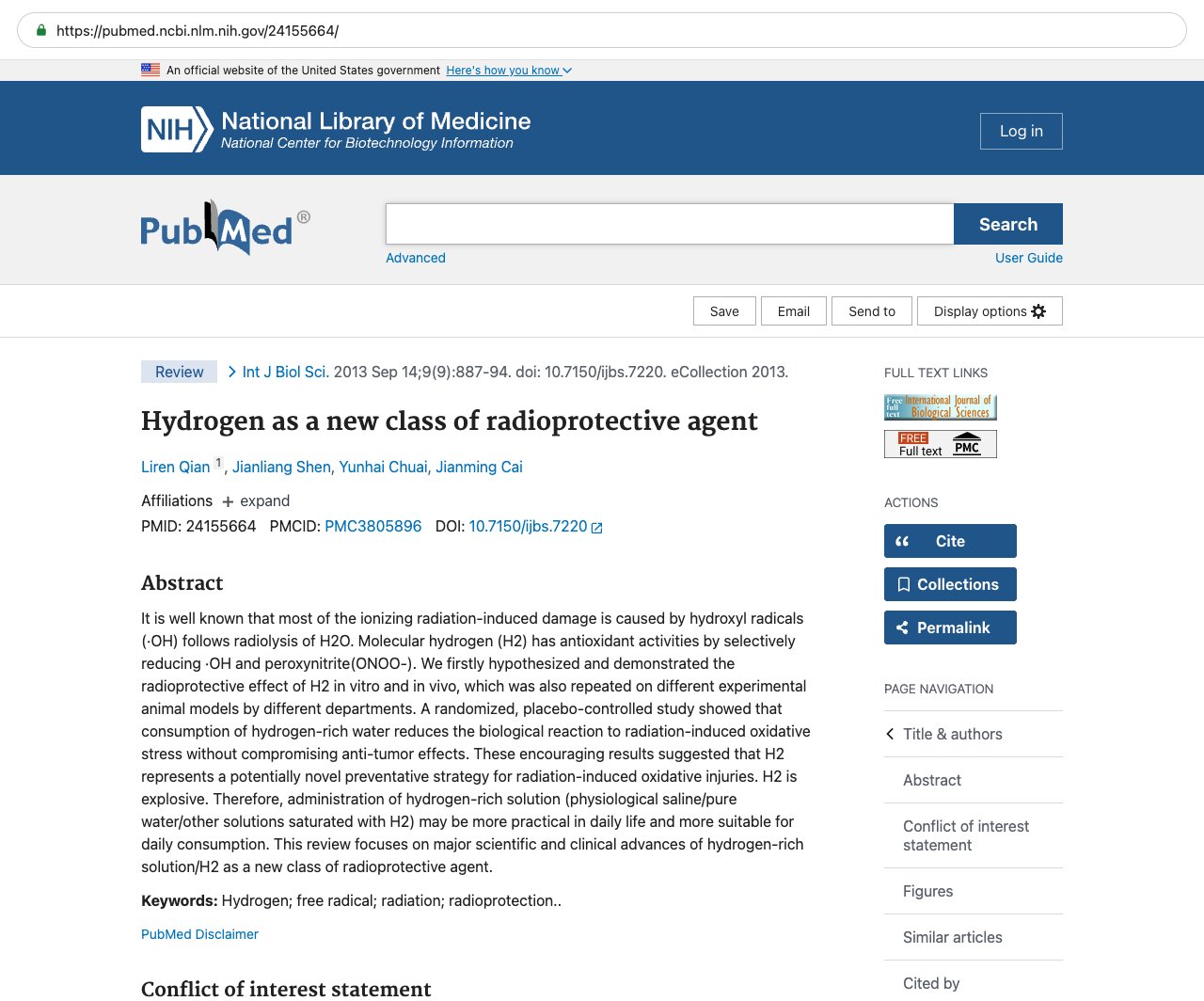
This page mirrors the published abstract (© the authors / publisher) for reference and citation. The canonical source is the PubMed record linked above. This is not medical advice.