2020 · Qian — Hydrogen in Patients With Corticosteroid-Refractory/Dependent Chronic Graft-Versus-Host-Disease: A Single-Arm, Multicenter, Open-Label, Phase 2 Trial
Super-Abstract
In chronic graft-versus-host disease that no longer responded to cortisone, 75 % of patients on hydrogen water achieved an objective improvement — without notable side effects. In the response group, 4-year survival was 86.6 %, in the non-response group 0 %. (Frontiers in Immunology, 2020, single-arm multicenter phase-2 trial, n = 24.)
Commentary
Chronic graft-versus-host disease is a serious complication after stem-cell transplantation and the main cause of late mortality not related to disease relapse. For patients in whom cortisone no longer works or who have become dependent on it, there is no standard therapy — a genuine therapeutic gap. In this open phase-2 study at several centers, 24 patients drank 4 ml/kg of hydrogen-rich water three times a day, and organ involvement was assessed every three months. The result is remarkable: 18 of the 24 patients — i.e. 75 % — showed an objective response, with no detectable toxicity even with long-term use. The most striking finding is the survival difference: in the response group, estimated 4-year survival was 86.6 %, in the non-response group 0 % (p = 0.000132). What it means: H₂ water could be a very low-risk approach for this group of patients with exhausted treatment options. But to be entirely honest and emphasize firmly: this is a <strong>single-arm study without a control group</strong> with only 24 patients. The dramatic survival difference simply separates responders from non-responders — it is not proof that H₂ causally prolongs survival, because patients who already have a better prognosis tend to respond more readily.
Key quotes
- „Of the 24 patients, 18 (75%; 95% CI, 55.1% to 88%) had an objective response.“ — three out of four patients improved objectively
- „No significant toxicity was observed.“ — good tolerability, also long term
- „The survival rate at 4 years in the response group is significantly higher than the nonresponse group (86.6% vs 0%; p= 0.000132).“ — the strong survival difference between responders and non-responders
Our assessment
One of the clinically most serious H₂ indications in this batch — a life-threatening disease with exhausted treatment options, in which H₂ water showed an objective response rate of 75 %. For us usable as a strong plausibility and educational argument for the immunomodulatory/antioxidant profile of H₂ — but never as a therapy promise, certainly not outside the specialized transplant-medicine context. Limitation, stated honestly: small sample (n = 24), single-arm, open design without a control group (no placebo, no blinding), and the spectacular survival difference 86.6 % vs. 0 % is a comparison of responders vs. non-responders — it does not prove a causal life extension by H₂. The good tolerability is the most robust finding.
Study design
- Type: single-arm, multicenter, open-label phase-2 trial (no placebo/control arm) · n: 24 (median age 27; corticosteroid-refractory/-dependent chronic GVHD) · Duration: assessment every 3 months, survival estimate over 4 years · H₂ delivery: hydrogen-rich water, 4 ml/kg orally, 3× daily
- Result metrics: objective response 18/24 = 75 % (95% CI 55.1–88 %); 4-year overall survival 74.7 % (95% CI 54.9–94.5 %); response vs. non-response group 86.6 % vs. 0 % (p = 0.000132); no significant toxicity
Abstract
Chronic graft-versus-host-disease (cGVHD) is the leading cause of late non-relapse mortality after allogeneic hematopoietic stem cell transplantation(HSCT). There is no standard therapy for patients refractory or dependent to corticosteroid treatment. We hypothesized that hydrogen may exert therapeutic effects on cGVHD patients with few side effects. A prospective open-label phase 2 study of hydrogen was conducted. Patients received hydrogen-rich water 4ml/kg orally three times a day. Responses were graded in the skin, mouth, Gastrointestinal(GI), liver, eyes, lungs and joints and fascia every 3 months. A total of 24 patients (median age 27) were enrolled. Of the 24 patients, 18 (75%; 95% CI, 55.1% to 88%) had an objective response. No significant toxicity was observed. The estimated 4-year overall survival rate was 74.7%(95% CI, 54.9%-94.5%). The survival time was significantly prolonged in the response group. The survival rate at 4 years in the response group is significantly higher than the nonresponse group (86.6% vs 0%; p= 0.000132). Hydrogen showed great efficacy on cGVHD patients and long-term administration of hydrogen was not associated with significant toxic effects. The trial was registered at www.ClinicalTrials.Gov, NCT02918188.
Source & links
Screenshot of the PubMed page
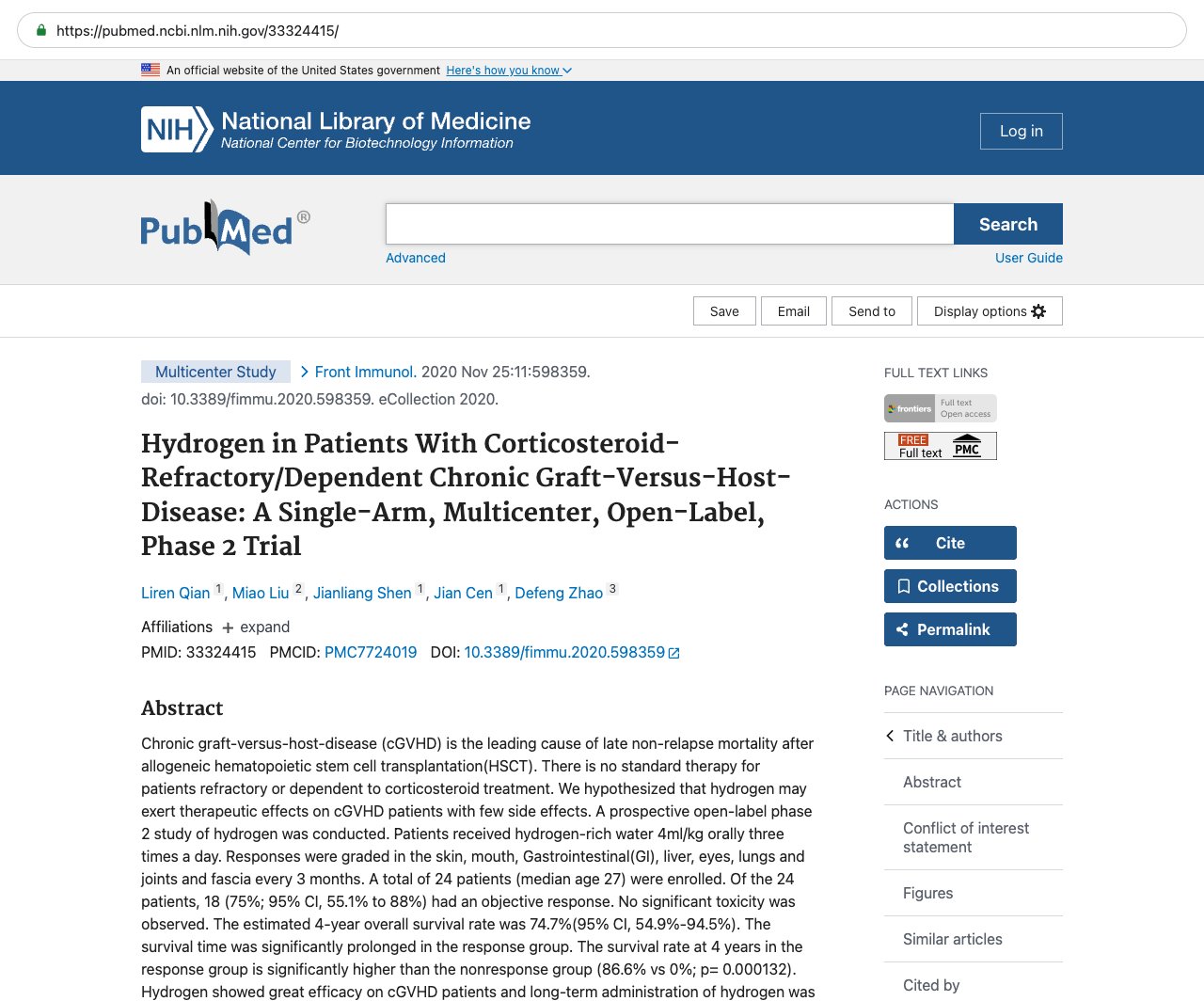
This page mirrors the published abstract (© the authors / publisher) for reference and citation. The canonical source is the PubMed record linked above. This is not medical advice.