2014 · Reis et al. — Clusianone, a naturally occurring nemorosone regioisomer, uncouples rat liver mitochondria and induces HepG2 cell death.
Super-Abstract
This in-vitro and animal study characterised clusianone — a natural plant compound — as a mitochondrial uncoupler and anticancer agent, where hydrogen appears only as a structural feature of the molecule (an intramolecular hydrogen bond), not as a therapeutic substance. The compound showed cytotoxic effects against liver cancer cells (HepG2) but weaker than its structural relative nemorosone.
Commentary
This paper is a natural product chemistry and pharmacology study investigating the mechanism of clusianone, a member of the polycyclic polyprenylated acylphloroglucinol family. The term ‚hydrogen' refers exclusively to an intramolecular hydrogen bond within the clusianone molecule at its C15 carbonyl group — a structural chemistry detail. This hydrogen bond reduces the compound's uncoupling and cytotoxic potency compared to nemorosone by stabilising the molecular conformation. There is no use of molecular hydrogen (H₂) as a gas, liquid, or supplement. This study is entirely outside the scope of H₂ medicine and is included in this database only because the compound name appears in hydrogen-related chemical searches.
Key quotes
- „The cytotoxic and uncoupling actions of clusianone were appreciably less than those of nemorosone, likely due to the presence of an intra-molecular hydrogen bond with the juxtaposed carbonyl group at the C15 position.“ — H₂ appears only as a molecular bond within the clusianone structure — not as a therapeutic gas
- „clusianone induced mitochondrial membrane potential dissipation, ATP depletion and phosphatidyl serine externalization; this later event is indicative of apoptosis induction.“ — mechanism of cancer cell death
- „clusianone is capable of pharmacologically increasing the leakage of protons from the mitochondria and with favorable cytotoxicity in relation to nemorosone.“ — mitochondrial uncoupling mechanism
Our assessment
This paper has no relevance to molecular hydrogen (H₂) medicine. The word ‚hydrogen' refers to a chemical bond within a plant-derived molecule, not to H₂ gas or hydrogen-rich water. It is an in-vitro/animal natural product pharmacology study. There are no H₂ therapeutic endpoints, no consumption of H₂, and no findings applicable to hydrogen medicine.
Study design
- Type: in-vitro + animal study (natural product pharmacology) · Model: HepG2 hepatocarcinoma cell line + isolated rat liver mitochondria · H₂ role: intramolecular hydrogen bond in clusianone molecule (structural chemistry, not therapy)
- Result: clusianone induces mitochondrial uncoupling and HepG2 apoptosis; weaker than nemorosone due to intramolecular H-bond; no molecular H₂ therapeutic endpoints
Abstract
Clusianone is a member of the polycyclic polyprenylated acylphloroglucinol family of natural products; its cytotoxic mechanism is unknown. Clusianone is a structural isomer of nemorosone, which is a mitochondrial uncoupler and a well-known cytotoxic anti-cancer agent; thus, we addressed clusianone action at the mitochondria and its potential cytotoxic effects on cancer cells. In the HepG2 hepatocarcinoma cell line, clusianone induced mitochondrial membrane potential dissipation, ATP depletion and phosphatidyl serine externalization; this later event is indicative of apoptosis induction. In isolated mitochondria from rat liver, clusianone promoted protonophoric mitochondrial uncoupling. This was evidenced by the dissipation of mitochondrial membrane potential, an increase in resting respiration, an inhibition of Ca(2+) influx, stimulation of Ca(2+) efflux in Ca(2+)-loaded mitochondria, a decrease in ATP and NAD(P)H levels, generation of ROS, and swelling of valinomycin-treated organelles in hyposmotic potassium acetate media. The cytotoxic and uncoupling actions of clusianone were appreciably less than those of nemorosone, likely due to the presence of an intra-molecular hydrogen bond with the juxtaposed carbonyl group at the C15 position. Therefore, clusianone is capable of pharmacologically increasing the leakage of protons from the mitochondria and with favorable cytotoxicity in relation to nemorosone.
Source & links
Screenshot of the PubMed page
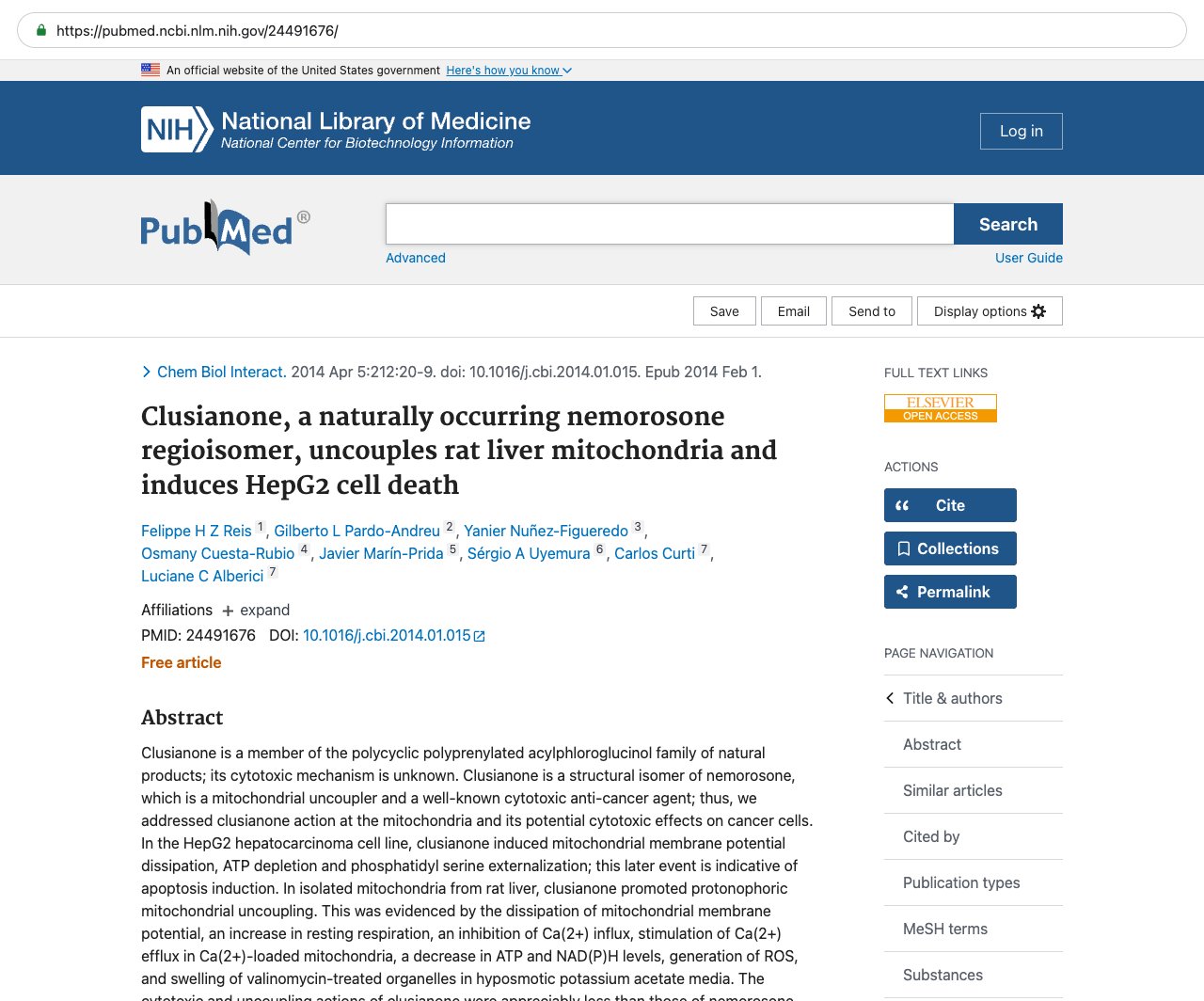
This page mirrors the published abstract (© the authors / publisher) for reference and citation. The canonical source is the PubMed record linked above. This is not medical advice.