2023 · Saif-Ur-Rahman et al. — Effect of Pharmacological Interventions for the Treatment of People with Post-COVID-19 Condition: A Rapid Review
Super-Abstract
This rapid review of drug treatments for post-COVID-19 condition reports better vital capacity, forced expiratory volume and 6-minute walk distance with inhaled hydrogen, but rates the evidence for every treatment it covers as low to very low certainty. The review identified 5 completed and 41 ongoing studies. Per full text, the hydrogen data come from a single randomised trial with 50 participants, which found no difference in breathlessness or resting oxygen saturation compared with ambient air. (Cochrane Evidence Synthesis and Methods, 2023.)
Commentary
Little is known about how to treat post-COVID-19 condition, and this rapid review examined drug treatments for it, per full text to inform a WHO guideline. The authors searched Medline, EMBASE, ClinicalTrials.gov and the International Clinical Trials Registry Platform, per full text for January 2020 to May 2022 and in English only. Two reviewers screened citations, extracted data and assessed quality. Because of heterogeneity, the data were synthesised narratively, and certainty was rated with GRADE. The completed studies tested corticosteroids for smell, ivabradine for sinus tachycardia and inhaled hydrogen for respiratory function. Per full text, the hydrogen trial randomised 50 people (26 hydrogen, 24 control) who had tested positive 21 to 35 days earlier. They inhaled hydrogen twice daily for 60 minutes at 300 mL/min for 14 days, while the control group inhaled ambient air. Outcomes included vital capacity, forced expiratory volume, 6-minute walk distance, oxygen saturation and breathlessness. The hydrogen concentration is not given.
Key quotes
- „Participants allocated to inhaled hydrogen therapy had an improved vital capacity (MD: 0.20, 95% CI: 0.07 to 0.33), forced expiratory volume (MD: 0.19, 95% CI: 0.04 to 0.34), 6-minute walk test (MD: 55.0, 95% CI: 36.04 to 73.96).“ — the review's result for inhaled hydrogen on lung function and walking distance
- „Due to heterogeneity in participants, interventions, and outcomes, we synthesized data narratively.“ — no pooled analysis, the studies were described one by one
- „The evidence is of low to very low certainty about the effect of all pharmacological interventions investigated for the treatment of people with PCC.“ — the authors' conclusion on certainty, which also covers the hydrogen result
Our assessment
This is a rapid review with shortened methods, and hydrogen is one of several treatments it covers. The hydrogen findings rest on one randomised trial with 50 participants and 14 days of follow-up (per full text). Vital capacity, forced expiratory volume and walking distance improved compared with ambient air. Per full text, breathlessness and resting oxygen saturation did not differ, and the review downgraded the evidence for risk of bias (inadequate allocation concealment, no blinding of outcome assessors), imprecision and indirectness. Limitations: lung function and walking distance are surrogate measures. Per full text, only two databases and two trial registries were searched, and none of the included studies used the WHO definition of post-COVID-19 condition. The control group inhaled ambient air. The abstract reports no hydrogen dose and no adverse events. As the authors state, the effect of inhaled hydrogen in post-COVID-19 condition remains uncertain.
Study design
- Type: Cochrane rapid review with narrative synthesis and GRADE rating · n: 5 completed and 41 ongoing studies; hydrogen: 1 randomised trial with 50 participants (per full text) · H₂ delivery: inhaled hydrogen twice daily for 60 minutes at 300 mL/min for 14 days (per full text)
- Included studies: 5 completed studies, per full text 4 randomised trials and 1 controlled before-after study. Per full text, one of them tested inhaled hydrogen against inhaled ambient air. Search per full text January 2020 to May 2022
- Result: inhaled hydrogen: vital capacity MD 0.20 (95% CI 0.07 to 0.33), forced expiratory volume MD 0.19 (95% CI 0.04 to 0.34), 6-minute walk test MD 55.0 (95% CI 36.04 to 73.96). Per full text no difference in breathlessness (MD 0.00) or resting oxygen saturation (MD 0.00). Certainty low to very low for all interventions
Abstract
OBJECTIVE: Little is known about the treatment of post-coronavirus disease 2019 (COVID-19) condition (PCC). This article examines the effectiveness of pharmacological interventions for treating people with PCC. METHODS: We searched Medline, EMBASE, ClinicalTrials. gov, and the International Clinical Trials Registry Platform. Two independent review authors screened citations, extracted data, and assessed the quality of the included studies. Due to heterogeneity in participants, interventions, and outcomes, we synthesized data narratively. We assessed the certainty of evidence using GRADE (Grading of Recommendations, Assessment, Development, and Evaluation). PARTICIPANTS: People with PCC. INTERVENTIONS: Pharmacological interventions include corticosteroids, ivabradine, and inhaled hydrogen. OUTCOME MEASURES: Olfactory function, sinus tachycardia, respiratory function. RESULTS: We identified 5 completed studies and 41 ongoing studies. Oral corticosteroids and olfactory training had higher olfactory scores after 10 weeks (MD: 5.60, 95% confidence interval [CI]: 1.41 to 9.79). Patients allocated oral corticosteroid, and nasal irrigation demonstrated improved recovery of olfactory function compared with the control group at 40 days (median 60, interquartile range [IQR]: 40 vs. median 30, IQR: 25, p = 0.024). Patients allocated to topical corticosteroid nasal spray and olfactory training had improved recovery of olfactory function after 2 weeks (median 7, IQR: 5-10 vs. median 5, IQR: 2-8, p = 0.08). Participants allocated to ivabradine had a greater mean reduction in heart rate compared with participants randomized to carvedilol (MD: -4.24, 95% CI: -10.09 to 1.61). Participants allocated to inhaled hydrogen therapy had an improved vital capacity (MD: 0.20, 95% CI: 0.07 to 0.33), forced expiratory volume (MD: 0.19, 95% CI: 0.04 to 0.34), 6-minute walk test (MD: 55.0, 95% CI: 36.04 to 73.96). CONCLUSIONS: The evidence is of low to very low certainty about the effect of all pharmacological interventions investigated for the treatment of people with PCC. There is currently a significant body of research underway that could expand the evidence to inform treatment decisions on pharmacological interventions for PCC.
Source & links
Screenshot of the PubMed page
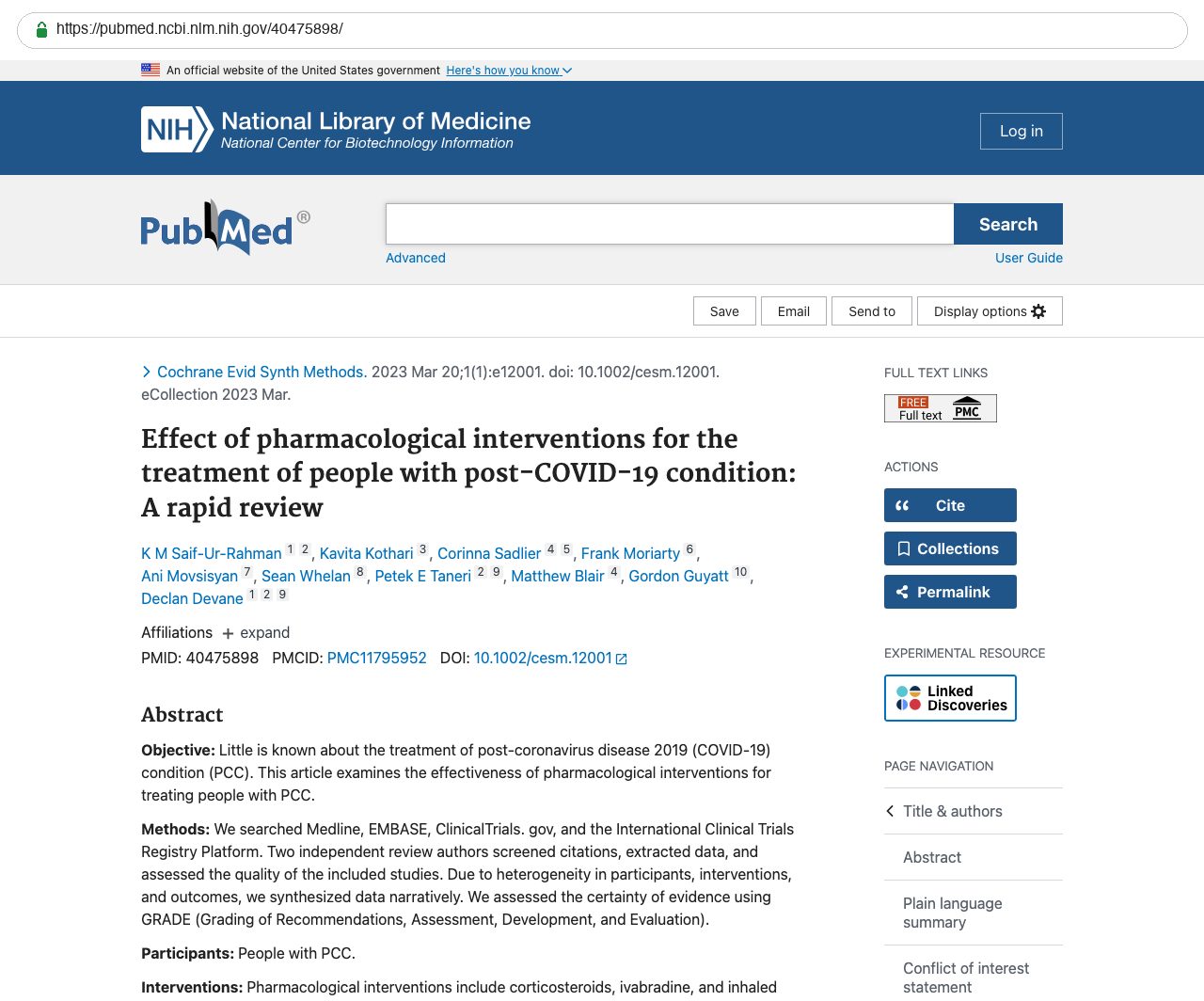
This page mirrors the published abstract (© the authors / publisher) for reference and citation. The canonical source is the PubMed record linked above. This is not medical advice.