2014 · Sakai et al. — Consumption of water containing over 3.5 mg of dissolved hydrogen could improve vascular endothelial function.
Super-Abstract
Drinking high-concentration hydrogen-rich water (7 ppm, 3.5 mg H₂ per 500 mL) significantly improved flow-mediated dilation (FMD) of the brachial artery compared to placebo. The randomized crossover study suggests H₂ may protect blood vessel walls from harmful reactive oxygen species — particularly the hydroxyl radical — by preserving nitric oxide signaling. (Vascular Health and Risk Management, 2014.)
Commentary
Endothelial function, measured via flow-mediated dilation (FMD), is considered one of the earliest and most sensitive markers of cardiovascular risk. The fact that a single high-dose H₂ drink produced a measurable FMD improvement within 30 minutes is mechanistically plausible: H₂ selectively scavenges the hydroxyl radical (•OH), which otherwise degrades nitric oxide (NO) before it can dilate vessels. The study is small (16 subjects in the H₂ group, 18 in placebo), but its design — randomized, placebo-controlled, with direct vascular measurement — gives the result real weight. The effect size (FMD +0.84 percentage points vs. −1.2 in placebo) is modest but statistically significant. The key threshold finding — that over 3.5 mg dissolved H₂ appears necessary — has practical relevance for product benchmarking.
Key quotes
- „FMD increased in the high-H2 group (eight males; eight females) from 6.80%±1.96% to 7.64%±1.68% and decreased from 8.07%±2.41% to 6.87%±2.94% in the placebo group.“ — the core FMD finding: H₂ improved, placebo worsened
- „The ratio to the baseline in the changes of FMD showed significant improvement (P<0.05) in the high-H2 group compared to the placebo group.“ — statistical significance confirmed
- „H2 may protect the vasculature from shear stress-derived detrimental ROS, such as the hydroxyl radical, by maintaining the nitric oxide-mediated vasomotor response.“ — proposed mechanism: H₂ preserves NO signaling
Our assessment
A small but methodologically solid pilot study with a meaningful objective endpoint (FMD ultrasound). The result is positive and statistically significant, but the sample size (n=16/18) limits generalisability. The acute single-drink design means long-term cardiovascular effects cannot be inferred. The required threshold of >3.5 mg H₂ per serving is an important practical note — many commercial products fall below this level. Limitations: small n, single acute dose, no follow-up, brachial FMD as a surrogate (not a clinical event endpoint).
Study design
- Type: randomized, placebo-controlled trial · n: 34 (16 H₂ group, 18 placebo) · H₂ delivery: 500 mL H₂-rich water at 7 ppm (~3.5 mg H₂), consumed acutely
- Outcome measure: flow-mediated dilation (FMD) of the brachial artery by ultrasound, measured at baseline and 30 min post-drink
- Result: FMD significantly improved in H₂ group (P<0.05); decreased in placebo group; proposed mechanism: hydroxyl radical scavenging → preserved NO bioavailability
Abstract
BACKGROUND: The redox imbalance between nitric oxide and superoxide generated in the endothelium is thought to play a pivotal role in the development of endothelial dysfunction. A third reactive oxygen species (ROS), H2O2, is known to have both beneficial and detrimental effects on the vasculature. Nonetheless, the influence of the hydroxyl radical, a byproduct of H2O2 decay, is unclear, and there is no direct evidence that the hydroxyl radical impairs endothelial function in conduit arteries. Molecular hydrogen (H2) neutralizes detrimental ROS, especially the hydroxyl radical. OBJECTIVES: To assess the influence of the hydroxyl radical on the endothelium and to confirm that a gaseous antioxidant, H2, can be a useful modulator of blood vessel function. METHODS: The efficacy of water containing a high concentration of H2 was tested by measuring flow-mediated dilation (FMD) of the brachial artery (BA). The subjects were randomly divided into two groups: the high-H2 group, who drank high-H2 water containing 7 ppm H2 (3.5 mg H2 in 500 mL water); and the placebo group. Endothelial function was evaluated by measuring the FMD of the BA. After measurement of diameter of the BA and FMD at baseline, volunteers drank the high-H2 water or placebo water immediately and with a 30-minute interval; FMD was compared to baseline. RESULTS: FMD increased in the high-H2 group (eight males; eight females) from 6.80%±1.96% to 7.64%±1.68% (mean ± standard deviation) and decreased from 8.07%±2.41% to 6.87%±2.94% in the placebo group (ten males; eight females). The ratio to the baseline in the changes of FMD showed significant improvement (P<0.05) in the high-H2 group compared to the placebo group. CONCLUSION: H2 may protect the vasculature from shear stress-derived detrimental ROS, such as the hydroxyl radical, by maintaining the nitric oxide-mediated vasomotor response.
Source & links
Screenshot of the PubMed page
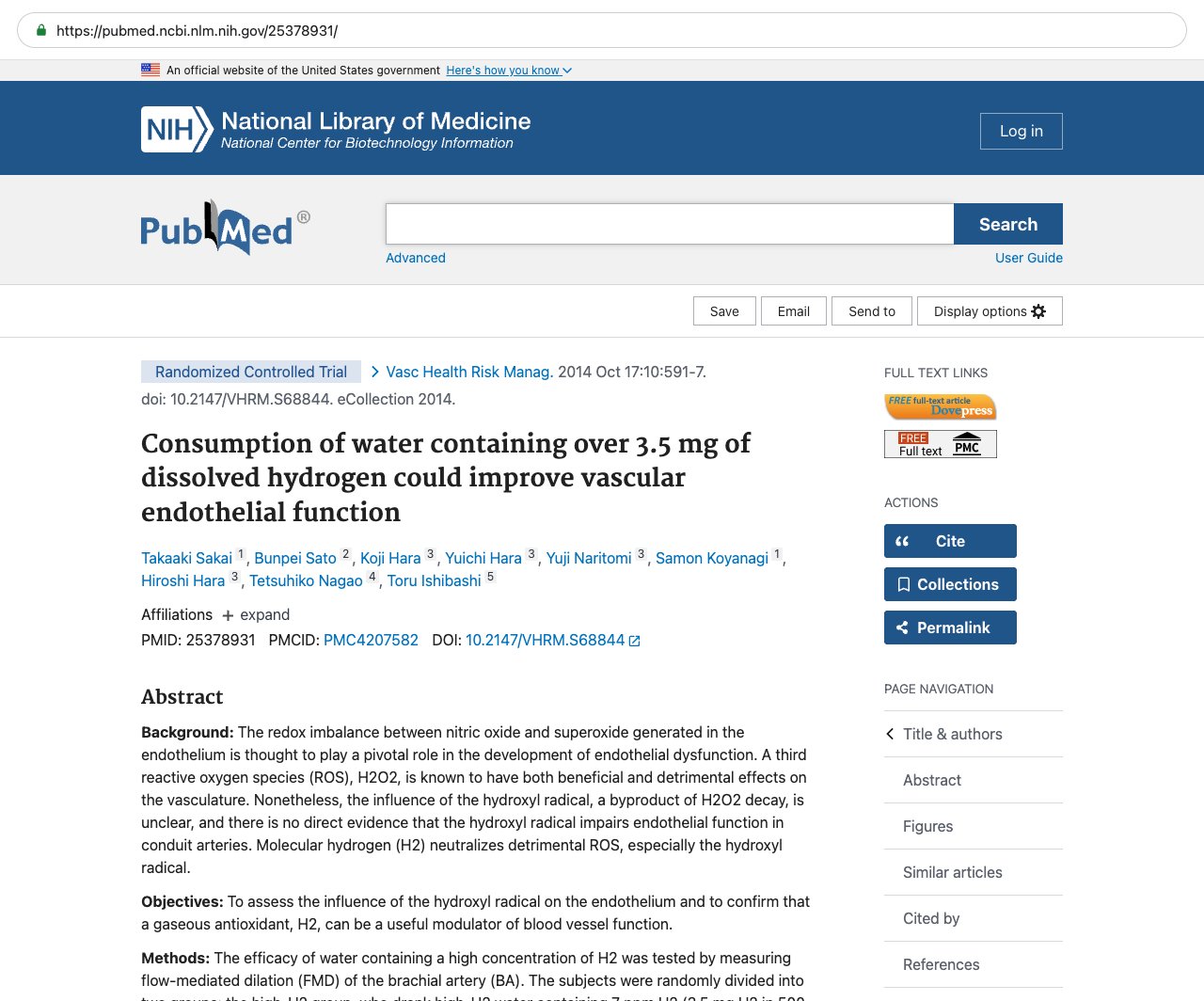
This page mirrors the published abstract (© the authors / publisher) for reference and citation. The canonical source is the PubMed record linked above. This is not medical advice.