1999 · Schneider — Anaerobic transformation of quercetin-3-glucoside by bacteria from the human intestinal tract.
Super-Abstract
This in-vitro study identifies two types of intestinal bacteria — Enterococcus casseliflavus and Eubacterium ramulus — capable of degrading the plant flavonoid quercetin-3-glucoside under anaerobic conditions. Molecular hydrogen is one of several minor fermentation byproducts detected. The study provides insight into how gut bacteria metabolise dietary polyphenols. (Archives of Microbiology, 1999.)
Commentary
This work by Schneider and colleagues investigates the anaerobic gut bacterial metabolism of quercetin-3-glucoside, a common dietary flavonoid. The finding that Eubacterium ramulus can fully degrade the aromatic ring system of quercetin — but only in the presence of glucose — is of interest for understanding polyphenol bioavailability. Molecular hydrogen was detected in small amounts as a byproduct of Eubacterium fermentation, alongside acetate and butyrate. The H₂ here is a minor metabolic byproduct of gut bacteria, not a therapeutic agent or subject of investigation. This study has no connection to H₂ medicine or H₂ supplementation.
Key quotes
- „Molecular hydrogen, 3,4-dihydroxybenzaldehyde, and ethanol were detected in small amounts.“ — H₂ appears only as a minor fermentation byproduct — not the focus of the study
- „Eubacterium ramulus did not grow on the aglycon quercetin or the ring-fission intermediate phloroglucinol, but cleaved the flavonoid ring system when glucose was present as a cosubstrate.“ — key finding: glucose-dependent ring degradation by Eubacterium ramulus
- „The most probable number of quercetin-3-glucoside-degrading bacteria determined in nine human fecal samples was 10(7)-10(9)/g dry mass.“ — ecological relevance: quercetin-degrading bacteria are abundant in human gut
Our assessment
This is a basic in-vitro gut microbiology study — it is not relevant to H₂ therapy. Molecular hydrogen appears only as a trace fermentation byproduct and is not the subject of investigation. The findings are relevant to polyphenol metabolism and gut microbiome research. No therapeutic H₂ conclusions can be drawn from this paper. The inclusion in an H₂ database is likely a keyword-based false positive.
Study design
- Type: in-vitro anaerobic microbiology · Model: human fecal isolates (Enterococcus casseliflavus, Eubacterium ramulus) grown on quercetin-3-glucoside · H₂ relevance: H₂ detected as minor fermentation byproduct only
- Result: Enterococcus casseliflavus ferments the sugar moiety only; Eubacterium ramulus fully degrades aromatic ring when glucose is present; H₂ detected in trace amounts alongside acetate, butyrate, DHPA; quercetin-degrading bacteria present at 10⁷–10⁹ CFU/g dry mass in 9 human fecal samples
Abstract
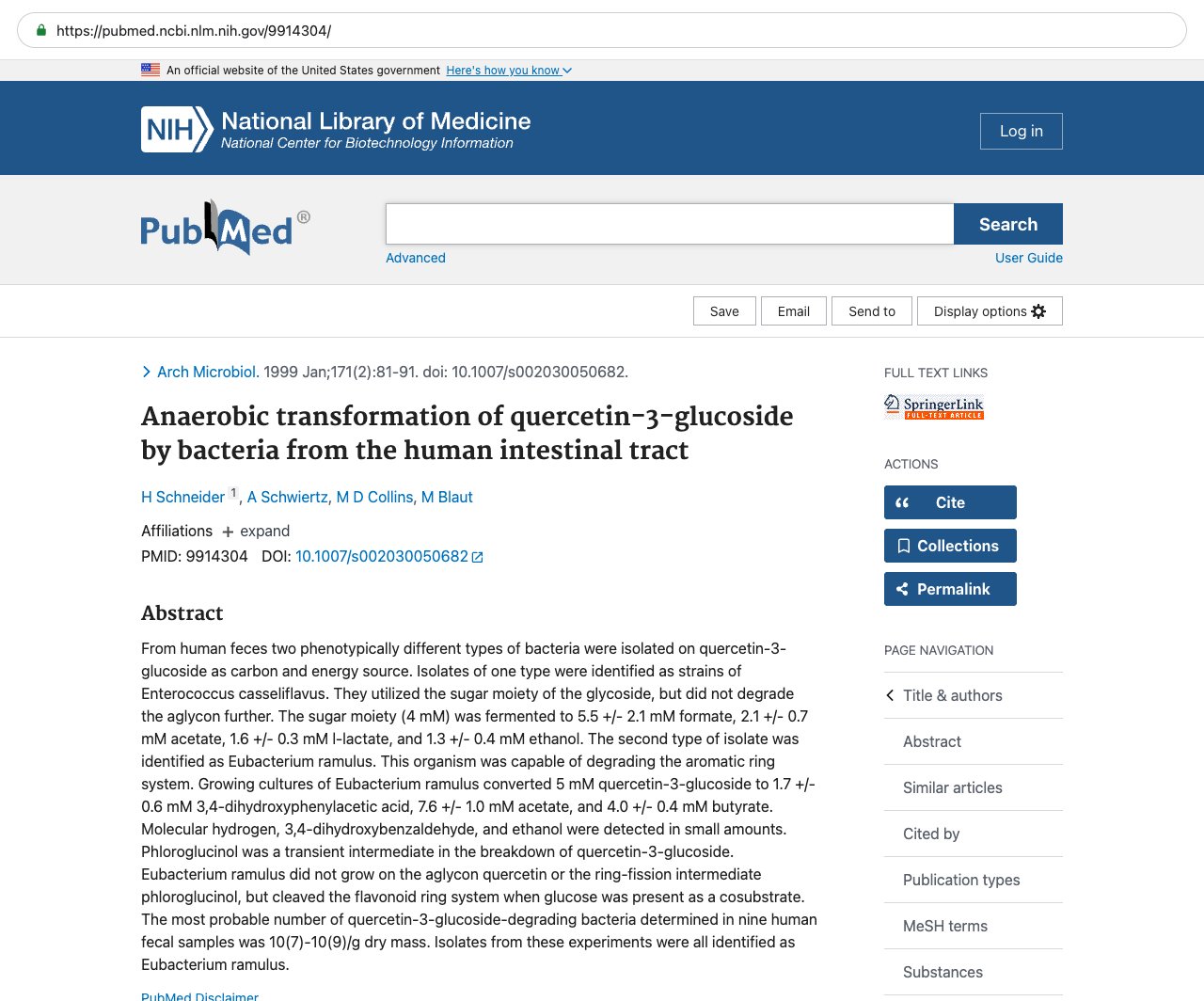
From human feces two phenotypically different types of bacteria were isolated on quercetin-3-glucoside as carbon and energy source. Isolates of one type were identified as strains of Enterococcus casseliflavus. They utilized the sugar moiety of the glycoside, but did not degrade the aglycon further. The sugar moiety (4 mM) was fermented to 5.5 +/- 2.1 mM formate, 2.1 +/- 0.7 mM acetate, 1.6 +/- 0.3 mM l-lactate, and 1.3 +/- 0.4 mM ethanol. The second type of isolate was identified as Eubacterium ramulus. This organism was capable of degrading the aromatic ring system. Growing cultures of Eubacterium ramulus converted 5 mM quercetin-3-glucoside to 1.7 +/- 0.6 mM 3,4-dihydroxyphenylacetic acid, 7.6 +/- 1.0 mM acetate, and 4.0 +/- 0.4 mM butyrate. Molecular hydrogen, 3,4-dihydroxybenzaldehyde, and ethanol were detected in small amounts. Phloroglucinol was a transient intermediate in the breakdown of quercetin-3-glucoside. Eubacterium ramulus did not grow on the aglycon quercetin or the ring-fission intermediate phloroglucinol, but cleaved the flavonoid ring system when glucose was present as a cosubstrate. The most probable number of quercetin-3-glucoside-degrading bacteria determined in nine human fecal samples was 10(7)-10(9)/g dry mass. Isolates from these experiments were all identified as Eubacterium ramulus.
Source & links
Screenshot of the PubMed page
This page mirrors the published abstract (© the authors / publisher) for reference and citation. The canonical source is the PubMed record linked above. This is not medical advice.