2013 Journal of cerebral blood flow and metabolism : official journal of the International Society of Cerebral Blood Flow and Metabolism Review / Meta-analysis Unspecified
2013 · Schönfeld — Why does brain metabolism not favor burning of fatty acids to provide energy? Reflections on disadvantages of the use of free fatty acids as fuel for brain
Super-Abstract
The brain almost exclusively uses glucose rather than fatty acids as fuel — this review explains why: fatty acid oxidation in neurons generates more oxidative stress, demands more oxygen, and produces ATP more slowly than glucose oxidation. The connection to hydrogen in this paper is the biochemical role of superoxide (a reactive oxygen species) generated during mitochondrial fatty acid beta-oxidation — not therapeutic molecular hydrogen (H₂). (Journal of Cerebral Blood Flow and Metabolism, 2013.)
Commentary
This is a neuroscience and mitochondrial biochemistry review paper, not a hydrogen medicine study. The hydrogen referenced here is in the context of „hydrogen-rich fatty acids“ — meaning the molecular structure of fatty acids (which contain many C–H bonds) — and „superoxide“ generated by beta-oxidation, a biochemical mechanism, not any therapeutic H₂ application. The authors construct a compelling evolutionary argument: the brain has downregulated fatty acid beta-oxidation enzymes to avoid the oxidative stress, oxygen demand, and slow ATP production that fat burning creates in neurons. This explains why ketogenic diets have neurological effects but also limits. This paper is indexed in the H₂ database likely due to keyword matching on „hydrogen“ in a biochemical context.
Key quotes
- „β-oxidation of fatty acids generates superoxide, which, taken together with the poor anti-oxidative defense in neurons, causes severe oxidative stress.“ — why fatty acid burning is harmful in brain neurons — the superoxide generation argument
- „ATP generation linked to β-oxidation of fatty acids demands more oxygen than glucose, thereby enhancing the risk for neurons to become hypoxic.“ — metabolic disadvantage 1: higher oxygen demand
- „the disadvantages connected with using fatty acids as fuel have created evolutionary pressure on lowering the expression of the β-oxidation enzyme equipment in brain mitochondria.“ — the evolutionary explanation for glucose preference in neurons
Our assessment
This is a neuroscience/biochemistry review with no relevance to therapeutic molecular hydrogen (H₂). The word „hydrogen“ appears only in its chemical context (fatty acid C–H bonds, superoxide chemistry). The paper provides no evidence — positive or negative — for H₂ as a health intervention. It is indexed in the H₂ database due to keyword overlap. The science is high quality and relevant to understanding brain metabolism and neurological disease, but has no application to H₂ medicine.
Study design
- Type: narrative mechanistic review · n: n/a (biochemical literature analysis) · H₂ relevance: none (hydrogen = chemical structural term for fatty acids; superoxide from beta-oxidation)
- Scope: neuronal energy metabolism, glucose vs. fatty acid oxidation, mitochondrial ROS generation, evolutionary pressure on beta-oxidation enzyme expression in brain
Abstract
It is puzzling that hydrogen-rich fatty acids are used only poorly as fuel in the brain. The long-standing belief that a slow passage of fatty acids across the blood-brain barrier might be the reason. However, this has been corrected by experimental results. Otherwise, accumulated nonesterified fatty acids or their activated derivatives could exert detrimental activities on mitochondria, which might trigger the mitochondrial route of apoptosis. Here, we draw attention to three particular problems: (1) ATP generation linked to β-oxidation of fatty acids demands more oxygen than glucose, thereby enhancing the risk for neurons to become hypoxic; (2) β-oxidation of fatty acids generates superoxide, which, taken together with the poor anti-oxidative defense in neurons, causes severe oxidative stress; (3) the rate of ATP generation based on adipose tissue-derived fatty acids is slower than that using blood glucose as fuel. Thus, in periods of extended continuous and rapid neuronal firing, fatty acid oxidation cannot guarantee rapid ATP generation in neurons. We conjecture that the disadvantages connected with using fatty acids as fuel have created evolutionary pressure on lowering the expression of the β-oxidation enzyme equipment in brain mitochondria to avoid extensive fatty acid oxidation and to favor glucose oxidation in brain.
Source & links
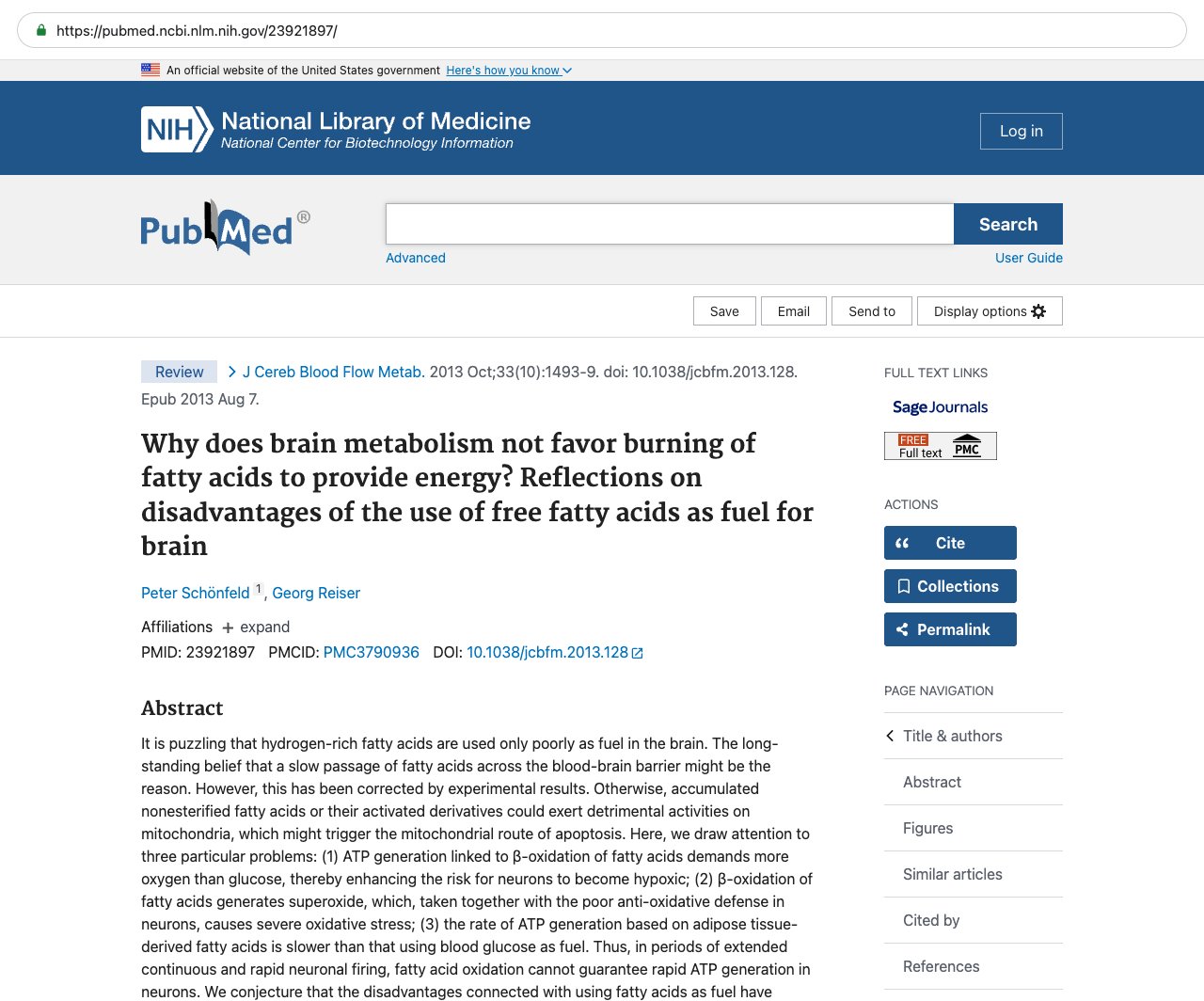
Screenshot of the PubMed page
This page mirrors the published abstract (© the authors / publisher) for reference and citation. The canonical source is the PubMed record linked above. This is not medical advice.