2021 · Schönfeld — How the brain fights fatty acids' toxicity.
Super-Abstract
This review explains why neurons, unlike most other cells, avoid using fatty acids as fuel — and describes the multiple biological strategies the brain has evolved to protect itself against lipotoxicity. Molecular hydrogen as a therapeutic is not the subject of this paper; hydrogen bonds appear only in their standard biochemical role within the discussed metabolic pathways. (Neurochemistry International, 2021.)
Commentary
Neurons are unusual among mammalian cells in their near-complete avoidance of fatty acid β-oxidation for energy. Schönfeld et al. review why this is the case — lower ATP yield per oxygen consumed, and severe ROS generation from β-oxidation — and then comprehensively cover the protective strategies neurons employ: partnering metabolically with astrocytes (which accept and detoxify fatty acids on neurons' behalf), autophagy of ROS-generating mitochondria, and hormonal neuroprotection via estrogens and neurosteroids via CREB pathway activation. The paper also connects this to conditions where fatty acid overload occurs in the brain: metabolic syndrome, traumatic brain injury, hypoxia, and inherited lipid disorders. The relevance to H₂ medicine is indirect at best: fatty acid β-oxidation generates hydrogen atoms (in the biochemical sense of proton + electron carriers like FADH₂), and hydrogen-rich fatty acids are mentioned in the abstract, but this refers to the hydrogen content of lipid molecules — not to molecular hydrogen (H₂) as a therapeutic gas. This review is neuroscience background on lipotoxicity and neuroprotective metabolism.
Key quotes
- „Neurons spurn hydrogen-rich fatty acids for energizing oxidative ATP synthesis, contrary to other cells.“ — key observation: neurons uniquely avoid fatty acid β-oxidation — „hydrogen-rich“ here refers to lipid chemistry, not H₂ gas
- „the use of fatty acids as hydrogen donor is accompanied by severe β-oxidation-associated ROS generation.“ — reason neurons avoid fatty acids: the oxidative cost is too high
- „neuronal autophagy of ROS-emitting mitochondria combined with the transfer of degradation-committed FFA for their disposal in astrocytes, is a potent protective strategy“ — key neuroprotective mechanism: metabolic cooperation between neurons and astrocytes
Our assessment
This is a narrative review of brain lipid metabolism and neuronal lipotoxicity protection. It does not study molecular hydrogen (H₂) as a therapeutic agent. References to „hydrogen“ in this paper are biochemical (fatty acid hydrogen atoms, FADH₂, etc.) — not to H₂ gas therapy. This paper provides important background on neuronal metabolism and ROS biology, but is only tangentially relevant to H₂-medicine. Readers should not interpret this as evidence for or against H₂ supplementation in neurological conditions.
Study design
- Type: narrative review · Scope: neuronal fatty acid avoidance, lipotoxicity mechanisms, astrocyte-neuron metabolic cooperation, neuroprotective strategies · H₂ relevance: none (lipid hydrogen chemistry only, no H₂ therapy)
- Conclusion: neurons are protected from lipotoxicity via β-oxidation avoidance, astrocyte cooperation, autophagy, and neurosteroid signaling — not by molecular hydrogen supplementation
Abstract
Neurons spurn hydrogen-rich fatty acids for energizing oxidative ATP synthesis, contrary to other cells. This feature has been mainly attributed to a lower yield of ATP per reduced oxygen, as compared to glucose. Moreover, the use of fatty acids as hydrogen donor is accompanied by severe β-oxidation-associated ROS generation. Neurons are especially susceptible to detrimental activities of ROS due to their poor antioxidative equipment. It is also important to note that free fatty acids (FFA) initiate multiple harmful activities inside the cells, particularly on phosphorylating mitochondria. Several processes enhance FFA-linked lipotoxicity in the cerebral tissue. Thus, an uptake of FFA from the circulation into the brain tissue takes place during an imbalance between energy intake and energy expenditure in the body, a situation similar to that during metabolic syndrome and fat-rich diet. Traumatic or hypoxic brain injuries increase hydrolytic degradation of membrane phospholipids and, thereby elevate the level of FFA in neural cells. Accumulation of FFA in brain tissue is markedly associated with some inherited neurological disorders, such as Refsum disease or X-linked adrenoleukodystrophy (X-ALD). What are strategies protecting neurons against FFA-linked lipotoxicity? Firstly, spurning the β-oxidation pathway in mitochondria of neurons. Secondly, based on a tight metabolic communication between neurons and astrocytes, astrocytes donate metabolites to neurons for synthesis of antioxidants. Further, neuronal autophagy of ROS-emitting mitochondria combined with the transfer of degradation-committed FFA for their disposal in astrocytes, is a potent protective strategy against ROS and harmful activities of FFA. Finally, estrogens and neurosteroids are protective as triggers of ERK and PKB signaling pathways, consequently initiating the expression of various neuronal survival genes via the formation of cAMP response element-binding protein (CREB).
Source & links
Screenshot of the PubMed page
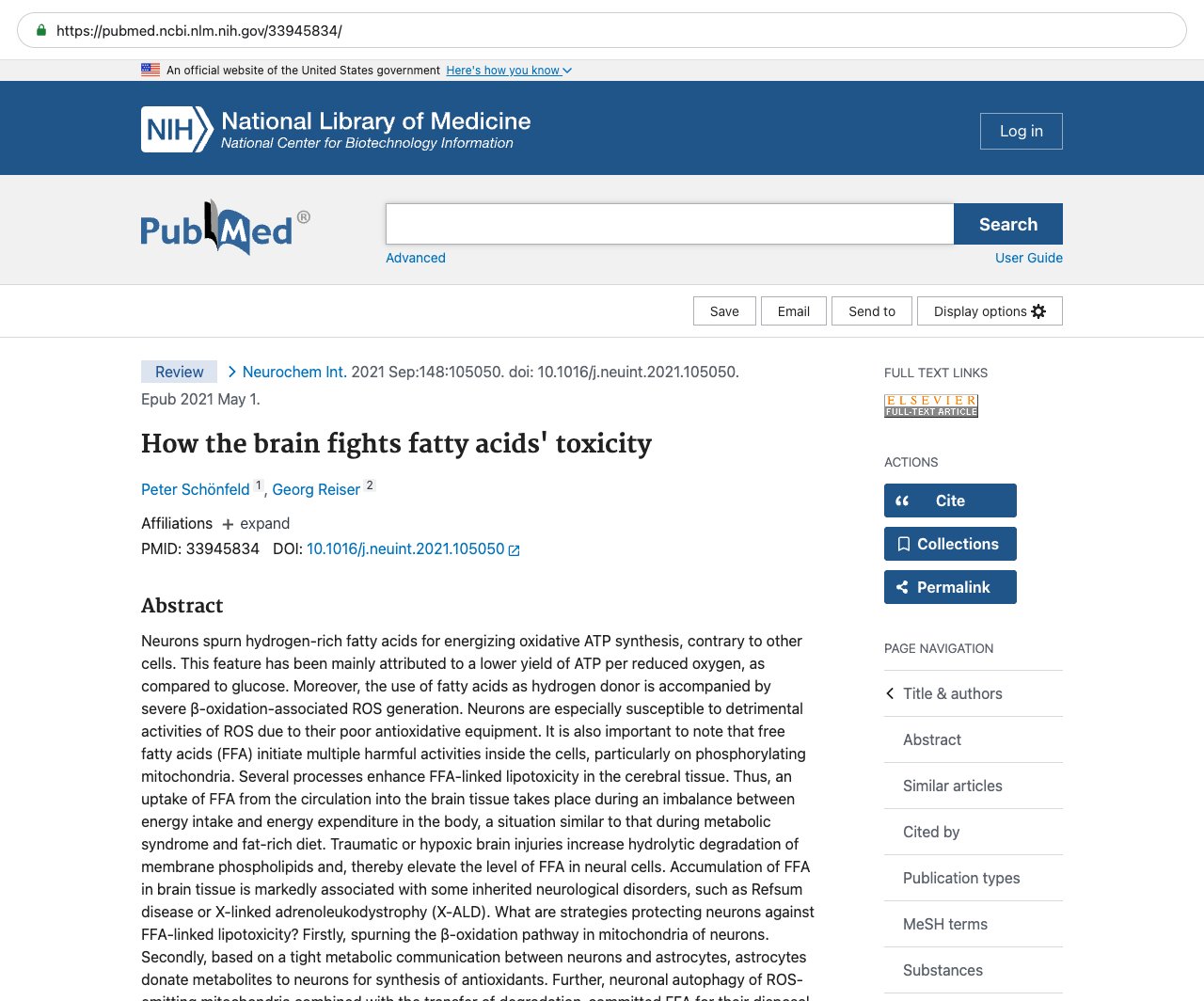
This page mirrors the published abstract (© the authors / publisher) for reference and citation. The canonical source is the PubMed record linked above. This is not medical advice.