1993 · Scrimgeour — A Simplified Method for Deuterium/Hydrogen Isotope Ratio Measurements on Water Samples of Biological Origin
Super-Abstract
This methodological study describes an improved technique for measuring the deuterium-to-hydrogen (D/H or ²H/¹H) isotope ratio in biological water samples using platinum catalyst–driven equilibration in Vacutainers — enabling non-invasive assessment of total body water and water turnover in human studies. The method is especially suited for repeated studies without washout waiting periods. (Biological Mass Spectrometry, 1993.)
Commentary
This is an analytical methods paper in stable isotope mass spectrometry — not a hydrogen therapy study. The ²H/¹H isotope ratio is used in nutrition and physiology research to measure total body water, water turnover, and energy expenditure (doubly-labeled water method). The link to „hydrogen” lies in the isotopic labeling: deuterium (²H) is a stable, non-radioactive isotope of hydrogen used as a metabolic tracer. Molecular H₂ therapy is entirely unrelated to this work. The new method offers practical advantages (cheap, disposable materials; delayed equilibration suitable for complex biological matrices) over zinc reduction methods.
Key quotes
- „The method has particular application in studies of human total body water where repeated studies can be carried out over a short time period without the need to wait for the previous dose to wash out.“ — the key practical advantage of the new equilibration method
- „Water turnover rates from total diurnal energy expenditure studies measured by this method were not significantly different from those obtained by the zinc reduction method.“ — validation against the established zinc reduction reference method
- „Equilibration of hydrogen gas with the water in a variety of biological sample materials was carried out in Vacutainers using platinum-on-alumina catalyst physically isolated from the liquid water.“ — the technical approach: catalyst-isolated gas-phase equilibration
Our assessment
This is a methodological / analytical chemistry paper about stable isotope measurement — not a hydrogen therapy study. Deuterium (²H) is a stable hydrogen isotope used as a metabolic tracer; this paper has no relevance to therapeutic molecular H₂ administration. Its contribution lies in enabling more convenient total body water and energy expenditure measurements in nutritional research. Researchers seeking evidence on H₂ therapy will find nothing applicable here.
Study design
- Type: methodological study (analytical chemistry / stable isotope mass spectrometry) · n: not specified for validation cohort · H₂ delivery: not applicable — hydrogen appears as deuterium (²H) tracer in metabolic water studies, not as therapeutic H₂
- Result: platinum-on-alumina catalyst in Vacutainers achieves full equilibration in 3 days at room temperature; method valid for plant stems, soil, and biological fluids; water turnover rates not significantly different from zinc reduction reference
Abstract
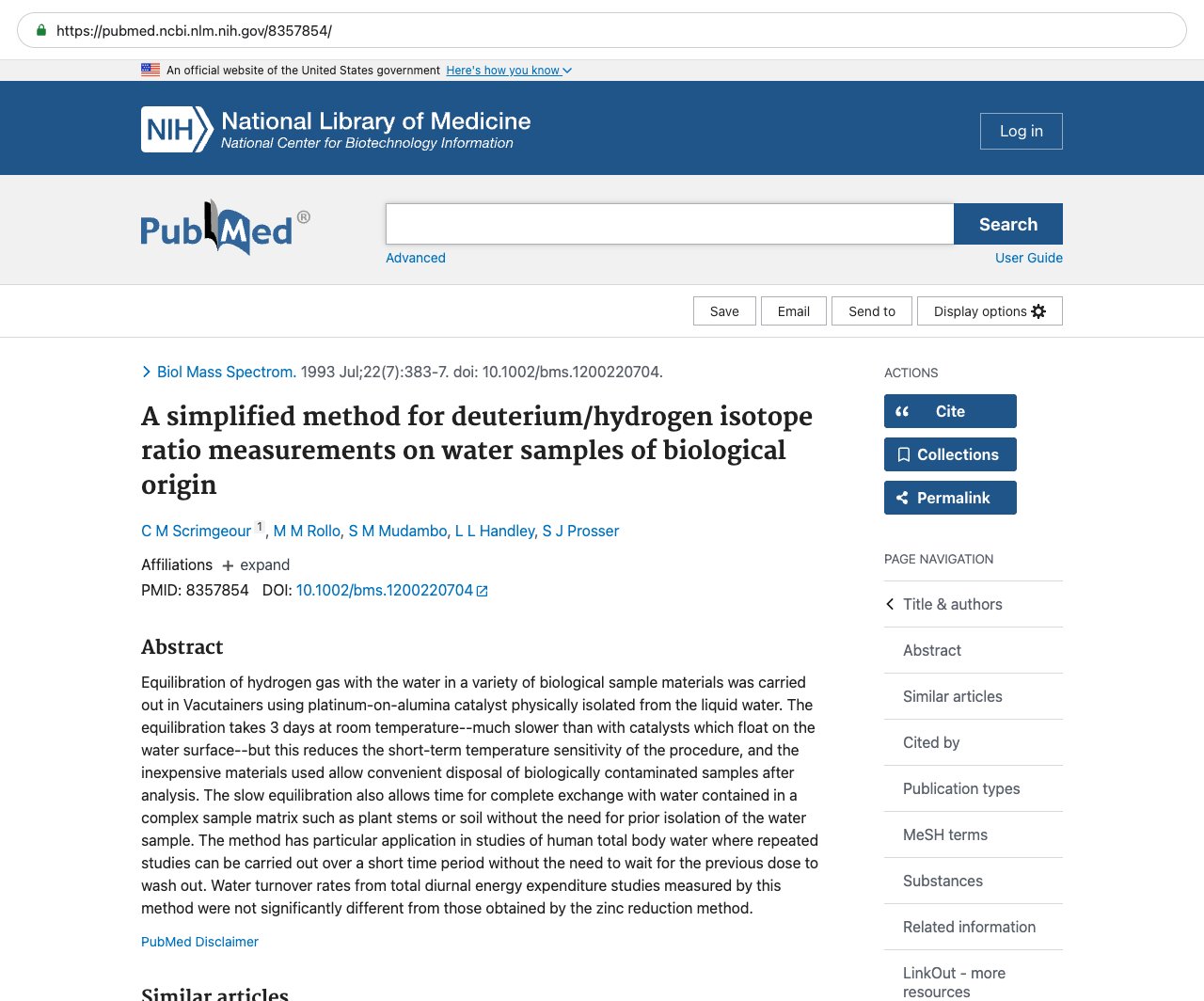
Equilibration of hydrogen gas with the water in a variety of biological sample materials was carried out in Vacutainers using platinum-on-alumina catalyst physically isolated from the liquid water. The equilibration takes 3 days at room temperature--much slower than with catalysts which float on the water surface--but this reduces the short-term temperature sensitivity of the procedure, and the inexpensive materials used allow convenient disposal of biologically contaminated samples after analysis. The slow equilibration also allows time for complete exchange with water contained in a complex sample matrix such as plant stems or soil without the need for prior isolation of the water sample. The method has particular application in studies of human total body water where repeated studies can be carried out over a short time period without the need to wait for the previous dose to wash out. Water turnover rates from total diurnal energy expenditure studies measured by this method were not significantly different from those obtained by the zinc reduction method.
Source & links
Screenshot of the PubMed page
This page mirrors the published abstract (© the authors / publisher) for reference and citation. The canonical source is the PubMed record linked above. This is not medical advice.