2013 Advances in experimental medicine and biology Pilot / Observational Human H₂ therapy InhalationDrinking (HRW)
2013 · Shimouchi et al. — Molecular hydrogen consumption in the human body during the inhalation of hydrogen gas.
Super-Abstract
Using a gas chromatography method, this study measured the rate at which the human body consumes inhaled H₂ gas and confirmed a consumption rate of approximately 0.7 µmol/min/m² body surface area — closely matching prior data from H₂-rich water ingestion. The method is proposed as a noninvasive tool for monitoring hydroxyl radical production in the body. (Advances in Experimental Medicine and Biology, 2013.)
Commentary
Understanding how much H₂ the human body actually consumes — and at what rate — is fundamental for dosing and delivery method comparisons. This paper extends the team's prior H₂-rich water work to inhaled H₂ gas. The confirmed body consumption rate (~0.7 µmol/min/m² BSA during inhalation, ~1.0 µmol/min/m² BSA from prior drinking data) is remarkably consistent across two delivery routes, which is strong evidence that the measurement reflects true metabolic consumption, not route artifact. A key practical insight: individual consumption rate varied widely when baseline breath H₂ was >10 ppm (indicating active colonic fermentation), requiring pretreatment fasting to get reliable measurements. The study was conducted in a small number of subjects — the exact n is not stated in the abstract — and is mechanistic/physiological rather than a clinical efficacy trial.
Key quotes
- „H2 consumption rate was found to be approximately 0.7 μmol/min/m²BSA, which was compatible with the findings we obtained using H2-rich water.“ — consistent consumption rate across inhalation and drinking routes
- „H2 consumption rate varied markedly when pretreatment fasting to reduce colonic fermentation was not employed, i.e., when the subject's baseline breath hydrogen level was 10 ppm or greater.“ — important methodological finding: gut fermentation confounds H₂ measurements without fasting
- „Our H2 inhalation method might be useful for the noninvasive monitoring of hydroxyl radical production in the human body.“ — proposed clinical application: using exhaled H₂ as an oxidative stress biomarker
Our assessment
A physiological/mechanistic study rather than a clinical efficacy trial. Its contribution is methodological: establishing consistent H₂ consumption kinetics across delivery routes and identifying colonic fermentation as a key confound in breath H₂ measurements. The proposed use of exhaled H₂ as a noninvasive oxidative stress monitor is an intriguing concept but remains to be validated clinically. Limitations: sample size not reported in abstract (very small implied), no clinical endpoints, physiological measurements only. Evidence level is low by design — the study answers a mechanistic question, not a therapeutic one.
Study design
- Type: physiological measurement study (mechanistic) · n: not specified in abstract (small) · H₂ delivery: inhalation of 160 ppm H₂ gas mixed with purified artificial air
- Method: gas chromatography with semiconductor sensor measuring inspired/expired H₂, O₂, CO₂; ventilation equation for consumption rate
- Result: H₂ consumption ≈ 0.7 µmol/min/m² BSA during inhalation; consistent with prior drinking data (~1.0); gut fermentation confounds measurements when baseline breath H₂ ≥10 ppm
Abstract
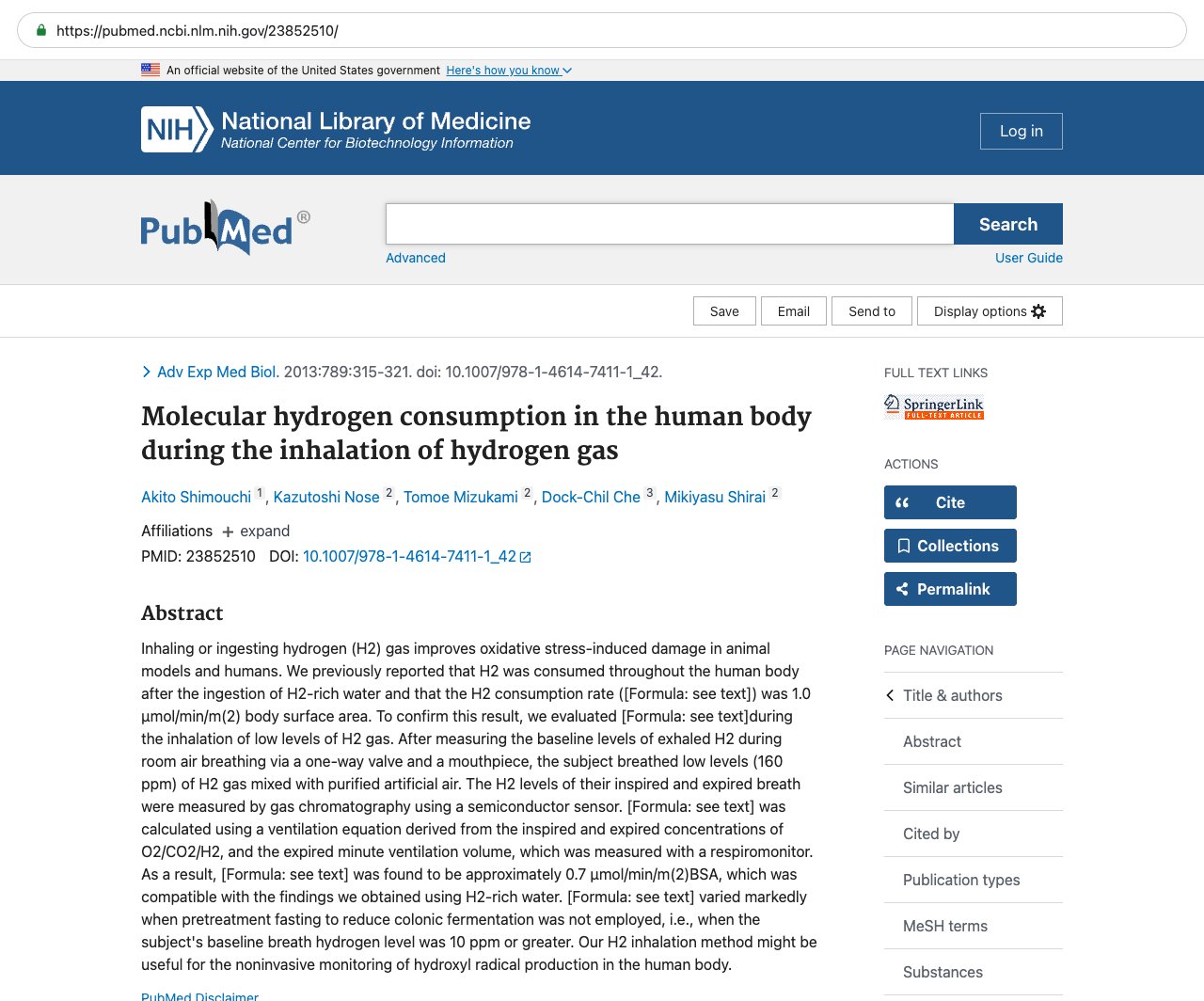
Inhaling or ingesting hydrogen (H2) gas improves oxidative stress-induced damage in animal models and humans. We previously reported that H2 was consumed throughout the human body after the ingestion of H2-rich water and that the H2 consumption rate ([Formula: see text]) was 1.0 μmol/min/m(2) body surface area. To confirm this result, we evaluated [Formula: see text]during the inhalation of low levels of H2 gas. After measuring the baseline levels of exhaled H2 during room air breathing via a one-way valve and a mouthpiece, the subject breathed low levels (160 ppm) of H2 gas mixed with purified artificial air. The H2 levels of their inspired and expired breath were measured by gas chromatography using a semiconductor sensor. [Formula: see text] was calculated using a ventilation equation derived from the inspired and expired concentrations of O2/CO2/H2, and the expired minute ventilation volume, which was measured with a respiromonitor. As a result, [Formula: see text] was found to be approximately 0.7 μmol/min/m(2)BSA, which was compatible with the findings we obtained using H2-rich water. [Formula: see text] varied markedly when pretreatment fasting to reduce colonic fermentation was not employed, i.e., when the subject's baseline breath hydrogen level was 10 ppm or greater. Our H2 inhalation method might be useful for the noninvasive monitoring of hydroxyl radical production in the human body.
Source & links
Screenshot of the PubMed page
This page mirrors the published abstract (© the authors / publisher) for reference and citation. The canonical source is the PubMed record linked above. This is not medical advice.