2015 · Shimura et al. — Radiation occupational health interventions offered to radiation workers in response to the complex catastrophic disaster at the Fukushima Daiichi Nuclear Power Plant.
Super-Abstract
Following the 2011 Fukushima nuclear disaster, a comprehensive set of occupational health measures protected emergency workers from radiation overexposure — fewer than 1% received doses above 100 mSv, and no deaths from radiation were reported. This review documents the interventions used, including dosimetry improvements, iodine administration, and health tracking systems. (Journal of Radiation Research, 2015.)
Commentary
This paper by Shimura and colleagues reviews the occupational health response to the Fukushima Daiichi disaster — a topic where molecular hydrogen appears only as a contextual background detail (the hydrogen explosions that damaged the plant). The paper itself is not a hydrogen medicine study; it describes public health and occupational medicine interventions. The H₂ connection in the source data likely refers to this contextual mention, not to therapeutic hydrogen. The review is relevant to radiation protection research but has little direct bearing on molecular hydrogen as a medical agent.
Key quotes
- „Less than 1% of all emergency workers were exposed to external radiation of >100 mSv, and to date no deaths or health adversities from radiation have been reported for those workers.“ — the key outcome: the occupational health system largely succeeded in protecting workers
- „Those interventions were not only vital for preventing unnecessary radiation, but also for managing other general health issues such as mental health, heat illness and infectious diseases.“ — the interventions addressed a broader spectrum of health risks beyond radiation
- „Long-term administration of the aforementioned occupational health interventions is essential to ensure the ongoing support and care for these workers.“ — the need for sustained follow-up — Fukushima workers represent an ongoing cohort
Our assessment
This is a review of occupational health and radiation protection interventions following the Fukushima disaster. It is not a study on molecular hydrogen as a therapeutic or medical agent. Hydrogen appears in this paper only as the explosive gas that caused structural damage at the plant. The paper provides no evidence for or against hydrogen medicine. It is included here for completeness of the source dataset; its relevance to H₂ health science is indirect at best.
Study design
- Type: narrative review of occupational health interventions · n: n/a (review of intervention programs) · H₂ relevance: hydrogen mentioned only as explosive gas in the disaster — not as a therapeutic agent
- Result: multi-pronged occupational health interventions (dosimetry, iodine tablets, exposure limits, health tracking) successfully limited severe radiation exposure in Fukushima workers; long-term follow-up identified as ongoing necessity
Abstract
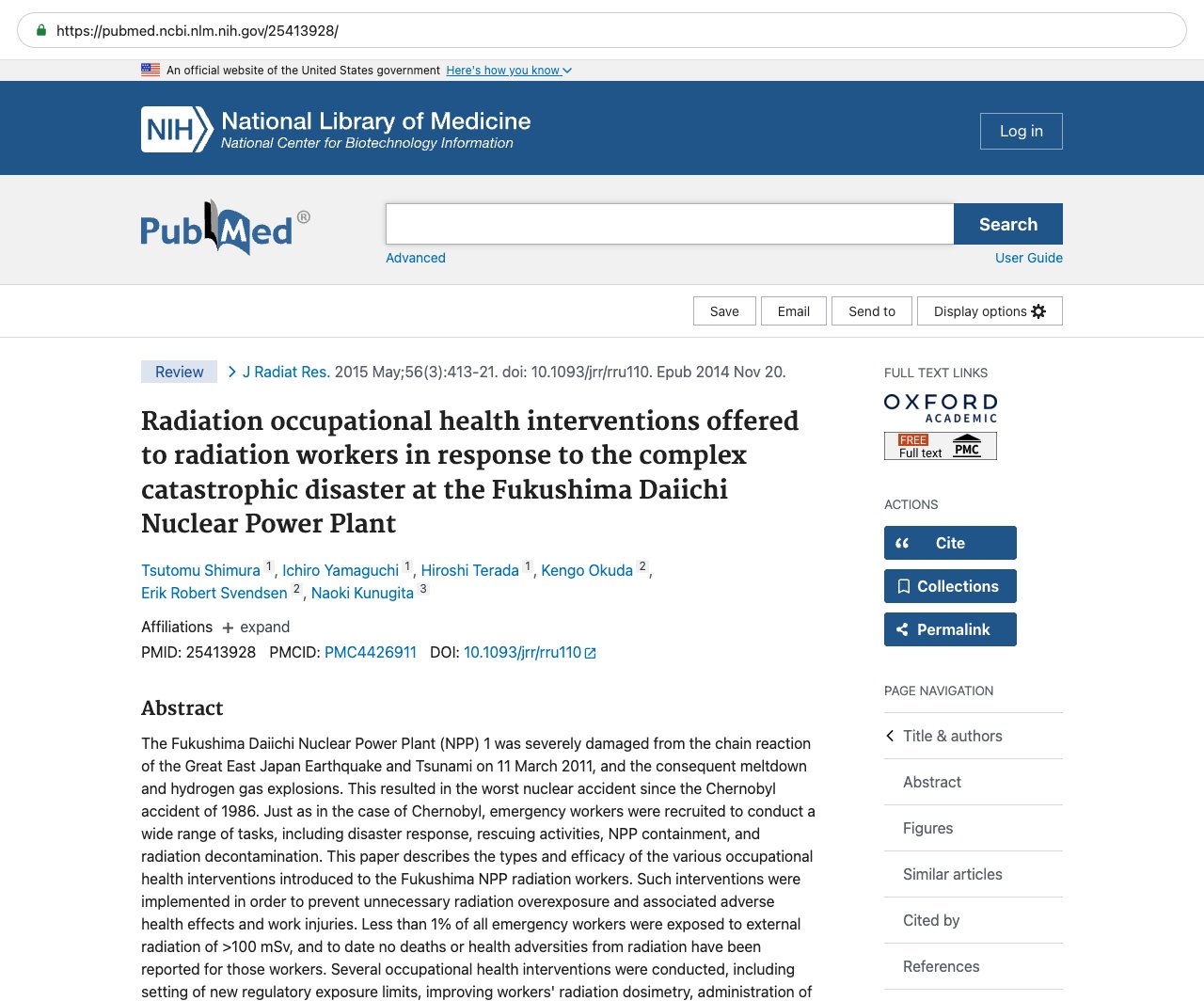
The Fukushima Daiichi Nuclear Power Plant (NPP) 1 was severely damaged from the chain reaction of the Great East Japan Earthquake and Tsunami on 11 March 2011, and the consequent meltdown and hydrogen gas explosions. This resulted in the worst nuclear accident since the Chernobyl accident of 1986. Just as in the case of Chernobyl, emergency workers were recruited to conduct a wide range of tasks, including disaster response, rescuing activities, NPP containment, and radiation decontamination. This paper describes the types and efficacy of the various occupational health interventions introduced to the Fukushima NPP radiation workers. Such interventions were implemented in order to prevent unnecessary radiation overexposure and associated adverse health effects and work injuries. Less than 1% of all emergency workers were exposed to external radiation of >100 mSv, and to date no deaths or health adversities from radiation have been reported for those workers. Several occupational health interventions were conducted, including setting of new regulatory exposure limits, improving workers' radiation dosimetry, administration of stable iodine, running an occupational health tracking system, and improving occupational medicine and preventative care. Those interventions were not only vital for preventing unnecessary radiation, but also for managing other general health issues such as mental health, heat illness and infectious diseases. Long-term administration of the aforementioned occupational health interventions is essential to ensure the ongoing support and care for these workers, who were put under one of the most severe occupational health risk conditions ever encountered.
Source & links
Screenshot of the PubMed page
This page mirrors the published abstract (© the authors / publisher) for reference and citation. The canonical source is the PubMed record linked above. This is not medical advice.