2021 · Yuan et al. — In Situ Hydrogen Nanogenerator for Bimodal Imaging Guided Synergistic Photothermal/Hydrogen Therapies
Super-Abstract
This nanotechnology study developed a nanoparticle system that generates hydrogen gas locally within tumors, combining hydrogen therapy with photothermal therapy (heat-based cancer treatment) to kill cancer cells. Tests were conducted in cell cultures and in mice — this is a preclinical study with no human data. The approach is innovative at the research level but remains far from clinical application.
Commentary
The field of nano-oncology seeks to deliver therapeutic agents precisely to tumors while minimizing systemic side effects. This study engineered mesoporous polydopamine nanoparticles (MPDA NPs) loaded with aminoborane (AB) — a compound that releases H₂ in the mildly acidic microenvironment characteristic of tumors. The same MPDA material also acts as a photothermal agent with high light-to-heat conversion efficiency under near-infrared (NIR) light, enabling selective heating of tumor tissue. The H₂ released in the tumor microenvironment exerts anti-cancer effects, while the nanoparticles also function as contrast agents for ultrasound (US) and CT imaging — allowing real-time guidance of treatment. In-vitro and in-vivo (mouse xenograft) results showed effective tumor suppression and good biocompatibility. This is sophisticated materials science applied to oncology; the H₂ here is delivered by a nanoparticle carrier system, not via drinking water or inhalation. Clinical translation faces substantial regulatory and safety hurdles for any injectable nanoparticle system.
Key quotes
- „H2 gas generated by AB in the weak acid conditions of the tumor microenvironment not only was used to treat tumors via a combination of hydrogen and photothermal therapies but also serves as a US and CT contrast agent.“ — dual role of H₂: therapy and imaging guidance simultaneously
- „The designed multifunctional nanosystem not only showed excellent properties such as high hydrogen-loading capacity, long-lasting sustained hydrogen release ability and excellent biocompatibility.“ — key performance characteristics demonstrated in cell and mouse models
- „The proposed hydrogen gas-based strategy for combination therapies and bimodal imaging integration holds promise as an efficient and safe tumor treatment for future clinical translation.“ — the authors' framing: a research-stage strategy with clinical translation as a future goal
Our assessment
This is an inventive preclinical nanotechnology study demonstrating proof-of-concept for tumor-targeted H₂ delivery combined with photothermal therapy in cell culture and mouse models. The mechanistic integration of H₂ therapy, photothermal ablation, and imaging guidance is scientifically innovative. Critical limitations: all efficacy data is from cell lines and mouse tumor xenografts; clinical translation of injectable nanoparticle systems is notoriously complex and lengthy. This study has no relevance to hydrogen water or inhaled H₂; it represents a completely different delivery paradigm. The results cannot be extrapolated to any currently available consumer H₂ product.
Study design
- Type: preclinical in-vitro and in-vivo (mouse xenograft) nanoparticle study · n: cell assays + mouse tumor models · H₂ delivery: in-situ generation via aminoborane-loaded nanoparticles in tumor microenvironment
- Photothermal agent: mesoporous polydopamine NPs (808/980/1064 nm NIR, η=38–69%) · Endpoints: tumor suppression, H₂ release kinetics, US/CT imaging, biocompatibility · Result: effective tumor suppression in vitro and in vivo; no human data
Abstract
Multifunctional nanoagents integrating multiple therapeutic and imaging functions hold promise in the field of non-invasive and precise tumor therapies. However, the complex preparation process and uncertain drug metabolism of nanoagents loaded with various therapeutic agents or imaging agents greatly hinder its clinical applications. Developing simple and effective nanoagents that integrate multiple therapeutic and imaging functions remain a huge challenge. Therefore, a novel strategy based on in situ hydrogen release is proposed in this work: aminoborane (AB) was loaded onto mesoporous polydopamine nanoparticles (MPDA NPs) as a prodrug for hydrogen production, and then, PEG was modified on the surface of nanoparticles (represented as AB@MPDA-PEG). MPDA NPs not only act as photothermal agents (PTA) with high photothermal conversion efficiency (808 nm, η = 38.72%) but also as the carriers of AB accumulated in the tumor through enhanced permeability and retention (EPR) effect. H2 gas generated by AB in the weak acid conditions of the tumor microenvironment (TME) not only was used to treat tumors via a combination of hydrogen and photothermal therapies but also serves as a US and CT contrast agent, providing accurate guidance for tumor treatment. Finally, in vivo and in vitro investigation suggest that the designed multifunctional nanosystem not only showed excellent properties such as high hydrogen-loading capacity, long-lasting sustained hydrogen release ability and excellent biocompatibility but also achieve selective PTT/hydrogen therapies and US/CT bimodal imaging functions, which can effectively guide antitumor therapies. The proposed hydrogen gas-based strategy for combination therapies and bimodal imaging integration holds promise as an efficient and safe tumor treatment for future clinical translation.
Source & links
Screenshot of the PubMed page
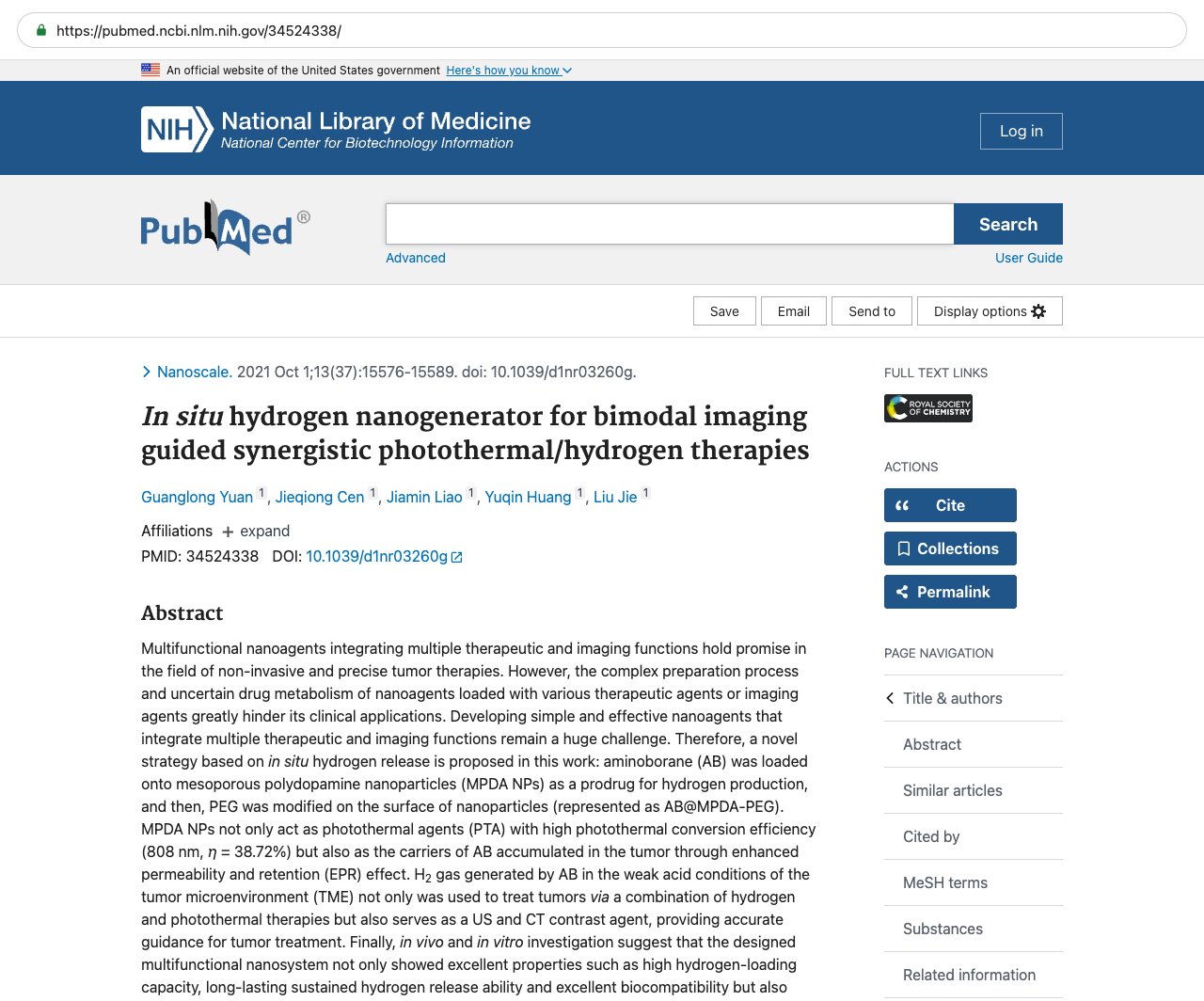
This page mirrors the published abstract (© the authors / publisher) for reference and citation. The canonical source is the PubMed record linked above. This is not medical advice.