2020 · Sim — Hydrogen-rich water reduces inflammatory responses and prevents apoptosis of peripheral blood cells in healthy adults: a randomized, double-blind, controlled trial
Super-Abstract
Hydrogen-rich water dampens inflammatory responses and protects blood cells from cell death — in healthy adults. In a randomized double-blind design (38 participants, 1.5 L/day, 4 weeks), inflammatory and NF-κB signaling pathways were significantly down-regulated and apoptosis of immune cells markedly lower. (Scientific Reports, 2020 — with RNA sequencing as molecular evidence.)
Commentary
This study is unusually deep methodologically: it combines a randomized, double-blind, placebo-controlled design with biochemical, cellular and molecular analysis — including RNA sequencing of the immune cells. 38 healthy adults (20–59 years) drank either 1.5 liters of hydrogen-rich water or plain water per day for four weeks. For the classic blood antioxidant markers there was no difference in the overall cohort — but in those over 30, antioxidant capacity (BAP) rose more strongly in the H₂ group. The actual finding lies deeper: apoptosis of the mononuclear blood cells was significantly lower, the frequency of CD14+ cells dropped, and RNA sequencing showed a clearly distinguishable transcriptome — with significantly down-regulated inflammatory and NF-κB signaling networks. That is a molecular mechanism, not a mere surrogate. Honestly though: these were healthy adults, the sample is small (n = 38), the duration short (4 weeks), and the classic oxidation markers remained unchanged in the overall cohort.
Key quotes
- „Apoptosis of peripheral blood mononuclear cells (PBMCs) was significantly less in the HW group.“ — less cell death of immune cells under H₂ water
- „transcriptional networks of inflammatory responses and NF-κB signaling were significantly down-regulated in the HW group.“ — molecular evidence of inflammation suppression
- „These finding suggest HW increases antioxidant capacity thereby reducing inflammatory responses in healthy adults.“ — the conclusion of the authors
Our assessment
Notable for the question of inflammation and immune function because here not only an effect is measured but a molecular mechanism (NF-κB down-regulation, less apoptosis) is shown in healthy people — and that in a double-blind, controlled design in an established journal (Scientific Reports). This fits the mechanistic picture of „prevention and wellbeing“, not just „disease treatment“. Limitation, stated honestly: small sample (n = 38), healthy subjects (no disease endpoint), only 4 weeks, and the classic oxidation markers (BAP, dROM, 8-OHdG) did not differ in the overall cohort — the benefit only appeared in subgroups (≥ 30 years) and at the molecular level.
Study design
- Type: RCT, randomized/double-blind/placebo-controlled · n: 38 (HW = 20, water = 18; healthy adults 20–59 yrs) · Duration: 4 weeks · H₂ delivery: 1.5 L/day hydrogen-rich water
- Result: PBMC apoptosis significantly lower (HW group); CD14+ cell frequency ↓; NF-κB/inflammation transcriptomes significantly down-regulated; BAP significantly ↑ only in subgroup ≥ 30 yrs; classic oxidation markers (BAP, dROM, 8-OHdG) with no group difference in the overall cohort
Abstract
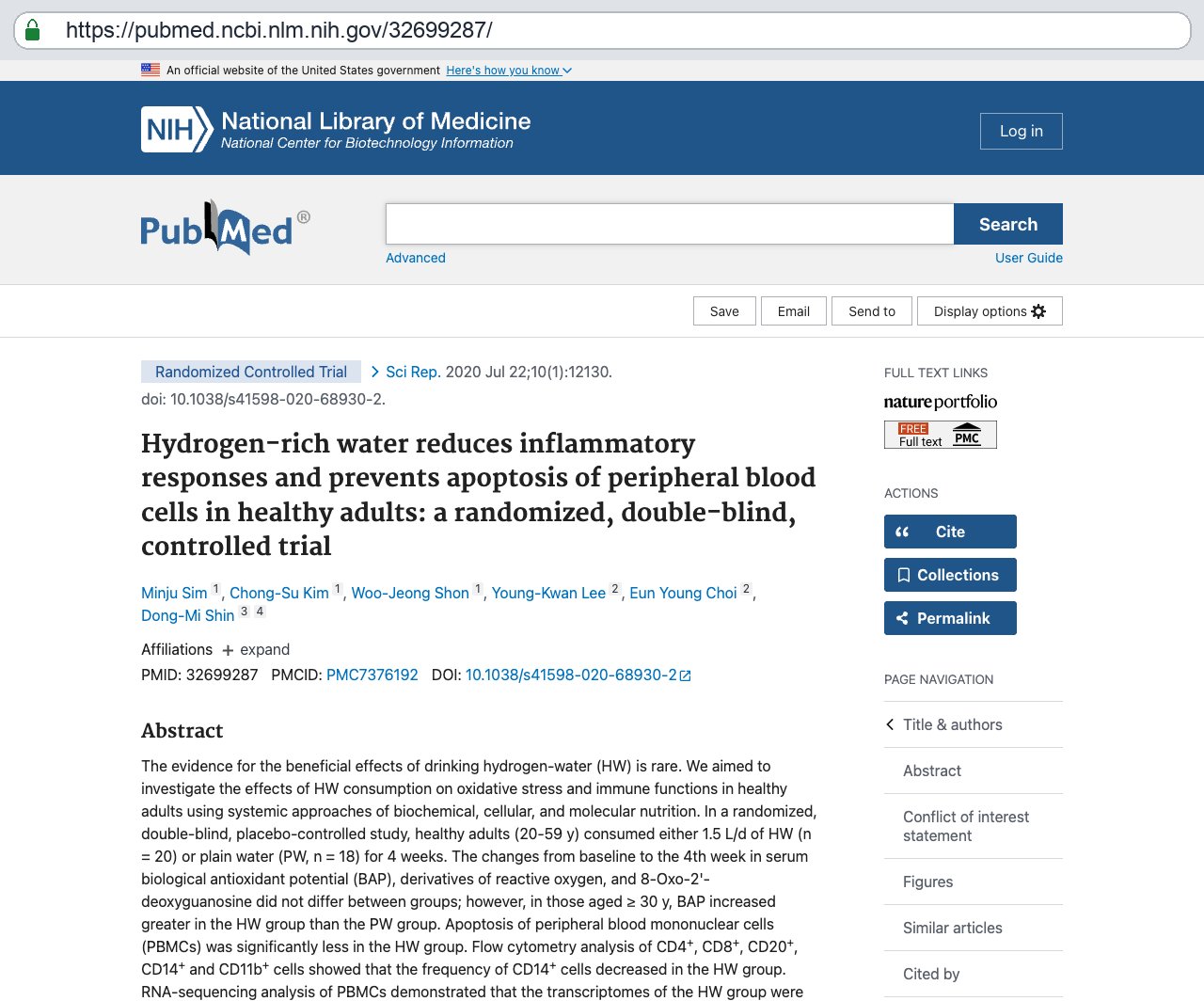
The evidence for the beneficial effects of drinking hydrogen-water (HW) is rare. We aimed to investigate the effects of HW consumption on oxidative stress and immune functions in healthy adults using systemic approaches of biochemical, cellular, and molecular nutrition. In a randomized, double-blind, placebo-controlled study, healthy adults (20-59 y) consumed either 1.5 L/d of HW (n = 20) or plain water (PW, n = 18) for 4 weeks. The changes from baseline to the 4th week in serum biological antioxidant potential (BAP), derivatives of reactive oxygen, and 8-Oxo-2'-deoxyguanosine did not differ between groups; however, in those aged ≥ 30 y, BAP increased greater in the HW group than the PW group. Apoptosis of peripheral blood mononuclear cells (PBMCs) was significantly less in the HW group. Flow cytometry analysis of CD4+, CD8+, CD20+, CD14+ and CD11b+ cells showed that the frequency of CD14+ cells decreased in the HW group. RNA-sequencing analysis of PBMCs demonstrated that the transcriptomes of the HW group were clearly distinguished from those of the PW group. Most notably, transcriptional networks of inflammatory responses and NF-κB signaling were significantly down-regulated in the HW group. These finding suggest HW increases antioxidant capacity thereby reducing inflammatory responses in healthy adults.
Source & links
Screenshot of the PubMed page
This page mirrors the published abstract (© the authors / publisher) for reference and citation. The canonical source is the PubMed record linked above. This is not medical advice.